




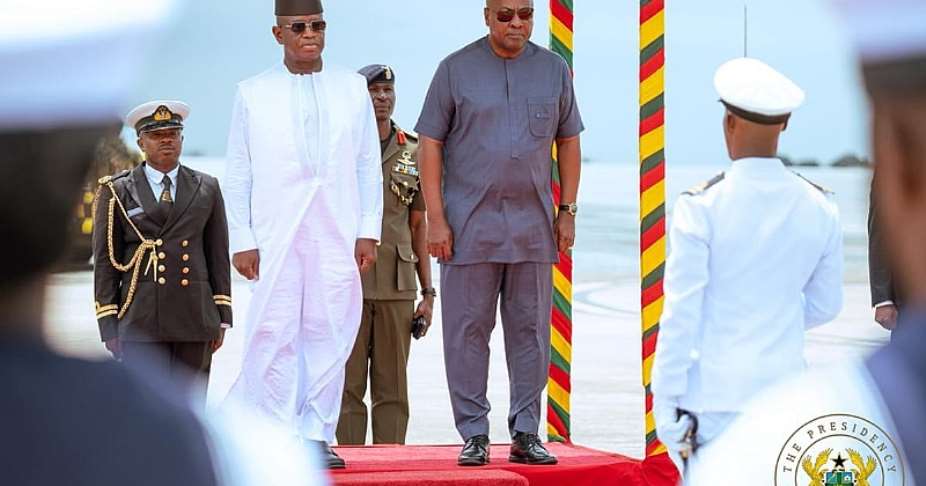
President John Dramani Mahama has called on ECOWAS member states that have satisfied the requirements for adopting a single currency to proceed with its introduction rather than delay the process until all 15 countries are ready.
He made the proposal on Tuesday at the West African Integration and Investment Summit (WAIIS) in Sierra Leone, where he advocated a phased approach to launching the ECO, allowing other countries to join when they meet the required convergence criteria.
The proposal, jointly advanced by President Mahama and his Sierra Leonean counterpart, President Julius Maada Bio, was presented at the last ECOWAS summit.
“If two countries are ready,” he said, “let them start,” explaining that the ECO could initially operate alongside national currencies and enable traders within the region to conduct transactions without relying on the US dollar.
President Mahama questioned the repeated changes in the number of countries meeting the convergence requirements, noting that the figure had fluctuated between two, five, three and seven at different stages.
He warned that insisting on all 15 member states meeting the criteria before introducing the currency could indefinitely delay the project.
Waiting for every country to qualify, he said, was like “waiting for Jesus Christ to come back”.
He further lamented the low level of trade among West African countries, which he estimated at between 12% and 15%, despite ECOWAS setting 2027 as its target for launching the single currency.
On Monday, President Mahama received the new ECOWAS Commission President, General Birame Diop (Rtd.), for discussions that included plans for the common currency.
During the engagement, he announced Ghana's readiness to host the proposed West African Central Bank and the West African Monetary Institute.
Mahama pushes regional energy cooperation
The President also called for greater investment in cross-border electricity infrastructure, noting that only about 7% of electricity generated in West Africa was currently traded across national borders through the West African Power Pool.
He said improved transmission links could increase the proportion to nearly 30% within five years.
According to him, Ghana has the capacity to supply more affordable gas-fired electricity to the regional power pool, with approximately 2,000 megawatts of spare generation capacity available if adequate transmission infrastructure is developed.
Energy Minister John Jinapor has similarly advocated the use of Ghana's excess generation capacity to strengthen energy security across the region during engagements with ECOWAS energy ministers.
President Mahama also highlighted the need for West African countries to strengthen domestic food production and reduce dependence on imports.
He disclosed that Ghana alone spends approximately US$3 billion annually importing food products, including rice and poultry.
“Every time we eat that foreign rice or we eat the foreign chicken, we are exporting value and importing poverty,” he said, attributing the expression to African industrialist Aliko Dangote.
He argued that greater investment in local production and processing would help retain economic value within the region and create employment opportunities.
Mahama laments slow pace of regional integration
President Mahama cited the proposed Lagos-Abidjan highway as an example of the slow implementation of major regional integration projects.
He recalled that the project was first discussed in 1998 and 1999, when he served as a minister, but remained largely on the drawing board decades later.
He criticised the pace of ECOWAS integration, arguing that the regional bloc had for too long focused on engagements among heads of state rather than delivering tangible benefits to ordinary citizens.
He described the West African Integration and Investment Summit, an initiative of President Bio, as an important platform for accelerating regional cooperation and moving the integration agenda forward.
According to him, the summit offered an opportunity to shift discussions from political commitments to practical measures that could deepen economic cooperation and improve the lives of people across West Africa.

 "NPP must remain in opposition to continue offering criticisms they are very goo...
 Why BoG reduced monetary policy rate from 14% to 11% – Governor explains
 'You will be sorely missed' – Opare Addo pays tribute to late Greater Accra Depu...
 Ghana’s export earnings hit US$30.42bn in 10 months in 2026, gold contributes US...
 ECO would run alongside national currencies; If two ECOWAS countries are ready, ...
 I pledge to you that as long as I am President we will maintain the fiscal disci...
 NPA partners KNUST to assess impact of electric vehicles on petroleum revenue
 Apologise to Ghanaians or go for confession for buying two jets in one year — Ni...
 I solely have the power to enstool and destool Chiefs because the land belongs t...
 Ghana to experience sunny weather with isolated thunderstorms in coastal and mid...


