




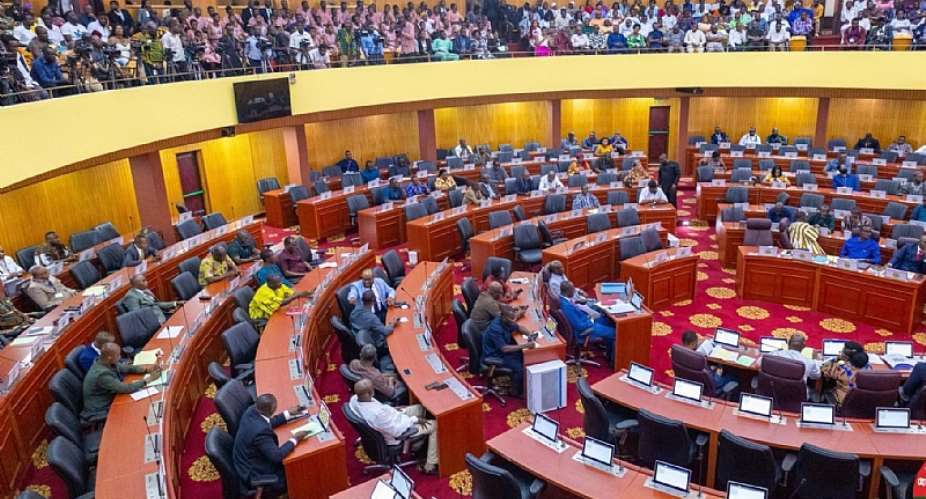
Members of Parliament have begun debating the 2027 Budget Statement and Economic Policy, with lawmakers from the Majority and Minority Caucuses taking opposing positions on the government's proposed New Economy agenda.
Defending the budget on Wednesday, Cape Coast South MP Kweku George Ricketts-Hagan said the Mahama administration was pursuing fiscal discipline by ensuring that government spending remained aligned with revenue while directing investment towards productive sectors.
He argued that the government's economic policies had helped improve macroeconomic stability, strengthen fiscal consolidation and support the appreciation of the cedi against major international currencies.
According to him, the economy was positioned for stronger growth in 2027, driven by value addition and the domestic processing of raw materials to generate employment.
Explaining the relationship between the government's flagship programmes, Mr Ricketts-Hagan said the 24-Hour Economy was designed to be largely driven by the private sector, while the New Economy programme would receive funding support from the government.
He described the 24-Hour Economy as a foundation for economic transformation, with the New Economy initiative intended to increase productivity and promote value addition.
The NDC legislator also criticised the previous New Patriotic Party (NPP) administration over what he described as excessive borrowing, arguing that its Eurobond issuances had substantially increased Ghana's public debt and compounded fiscal challenges.
However, Karaga MP and Ranking Member of Parliament's Finance Committee, Dr Mohammed Amin Adam, rejected the government's proposed New Economy agenda, describing it as a repackaged version of the 24-Hour Economy programme.
He questioned the initiative's capacity to address Ghana's immediate economic challenges, arguing that six of its eight pillars had already been incorporated into the earlier 24-Hour Economy framework.
Dr Amin Adam also raised concerns about the government's ability to secure the estimated US$10 billion required to implement the programme, insisting that it had yet to present a convincing financing plan.
He argued that the administration had struggled to mobilise the projected US$4 billion required for the 24-Hour Economy initiative and questioned how it could raise the larger amount needed for the New Economy programme.
The Minority legislator further challenged the government's assurance that the initiative would not depend on borrowing, citing the projected GH¢85 billion in domestic borrowing for 2027 as evidence of continued reliance on debt.
He maintained that although the budget highlighted improvements in several macroeconomic indicators, those gains had not translated into better living conditions for ordinary Ghanaians, describing the situation as a “paper economy”.
Atewa East MP Abena Osei Asare also supported concerns raised by the Minority Caucus, criticising the proposed New Economy policy.
On the other side, Sagnarigu MP Atta Issah strongly defended the government's flagship initiatives and its broader economic management strategy.
The debate has exposed sharp political divisions over the government's economic priorities, with discussions expected to continue until November 24.
Leaders of the Majority and Minority Caucuses are scheduled to present their concluding submissions on November 25, after which Parliament is expected to vote on the policy proposals outlined in the budget.

 Dr. Bomfeh opposes calls to restore Acheampong’s military rank posthumously
 Mahama pledges to translate Africa’s migration commitments into practical action
 Majority, Minority clash over Mahama’s New Economy agenda during 2027 Budget deb...
 V/R: Rare dolphin washes ashore at Kedzikope after decades
 Dutch court approves extradition of Asante Akim North MP to US over fraud allega...
 Mahama says new DNA laboratory will help resolve paternity, inheritance disputes
 Two remanded over murder of woman in attempt to GH¢19,000 owed her at Dormabin
 Hegseth makes surprise trip to Venezuela, renews military cooperation
 Anthropic prices blockbuster IPO, defying broader AI stock slump
 Xi, Trump and Putin prepare for historic summit, but will it reset the world ord...


