




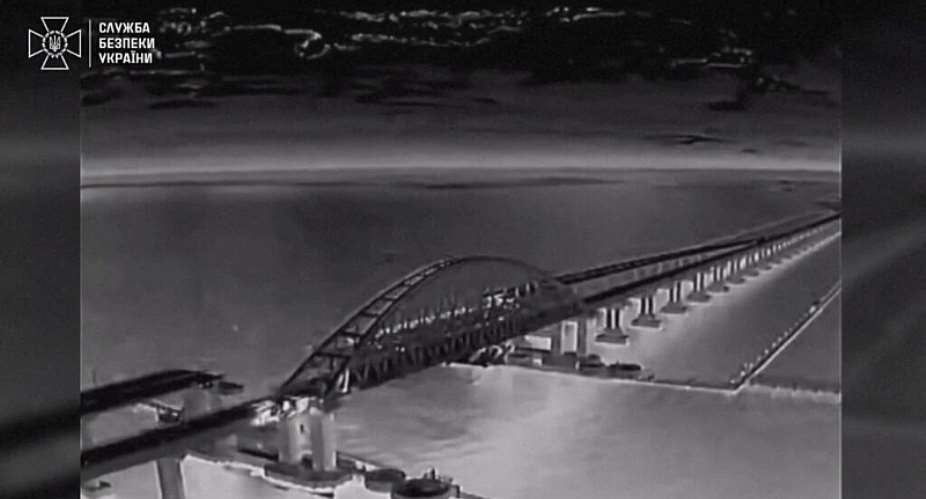
On Sunday and Monday night, Ukraine's military launched back-to-back drone and cruise missile strikes on the Kerch Strait Bridge linking the annexed Crimean Peninsula to the Russian mainland. The first wave of strikes left one of the bridge's twin arches slouching to the side. The second brought the arch – and the stretch of highway below it – crashing down into the sea.
While the rail section of the bridge that runs parallel to the highway is back up and running, smartphone footage shot by passengers in passing trains show a gaping void where the bridge's road section once stood. Ukrainian surveillance drones filming the attack showed a tangle of concrete and reinforced steel choking the waters below – a vital shipping route between the Russian-held Sea of Azov and the Black Sea.
The strikes mark the fourth attack on the bridge since Russia launched its full-scale invasion of Ukraine in 2022, and one that was weeks in the making.
Ukrainian President Volodymyr Zelensky said Tuesday that the strikes were the final step in a seven-stage military operation that had gradually worn down Russian radar, air defence systems and electronic jamming equipment, leaving the bridge exposed to a final barrage of drones and cruise missiles launched from southern Ukraine.
Sending a message
The timing of the bombardment also seems to have been planned precisely. Built over two years in 2016 following Russia's largely bloodless annexation of the Crimean Peninsula in 2014, the bridge carries heavy symbolic weight for both Kyiv and Moscow.
For Kyiv, the bridge stands as a concrete sign of Russian President Vladimir Putin's military expansion into Ukrainian territory.
And for Moscow, the project marks the definitive reintegration of Crimea into Russia more than half a century after Soviet leader Nikita Khrushchev transferred the peninsula from the Russian to the Ukrainian Soviet republic. Russian President Vladimir Putin speaks with workers as he inspects the road section of the road-rail bridge linking Crimea to mainland Russia near Kerch, Crimea, Wednesday, March 14, 2018.
So perhaps it's no surprise that Ukraine's cruise missiles cut down the soaring steel arch on the eve of the three-way meeting between Putin, US President Donald Trump and his Chinese counterpart Xi Jinping in Shenzhen Wednesday.
In a social media post announcing the strikes, Zelensky said the attack was meant as a message that Moscow could not be allowed to forget.
“War will always return to where it began,” he said.
A link in the chain
Natia Seskuria, the head of the Russia, Eurasia and Black Sea Security Programme at the UK-based Royal United Services Institute defence think-tank, said that Moscow had long used the bridge to move men and materiel to Ukraine's southern front.
“The Kerch Bridge has been an important logistics link for Russia, particularly in the early stages of the full-scale invasion,” she said. “It gave Moscow a direct road and rail connection to occupied Crimea, allowing it to move personnel, fuel, equipment and ammunition into southern Ukraine.”
But Crimea is no longer the only route leading to the front. In the first months of the 2022 onslaught, Russian troops surging up from the peninsula seized Ukrainian lands bordering the Sea of Azov, carving out a land corridor linking Crimea to Russia's Rostov region at the mouth of the Don River.
“The land corridor through occupied Ukrainian territory has since reduced Russia's dependence on the bridge, but it has not made it redundant,” Seskuria said.
Taking a toll
While Moscow has spent billions of dollars building road and rail infrastructure throughout occupied Ukraine, those same supply lines have grown increasingly perilous.
Over the past year, Ukraine has stepped up a campaign of “mid-range” drone strikes on Russian supply routes behind the front line – including those reaching through the land corridor in Ukraine's occupied south. Rail, port and energy infrastructure, as well as bridges and fixed crossings, have all been targeted by Kyiv.
Read more Russia's new low-cost munitions pose a fresh threat to Ukraine
Seskuria said that the strike on the Kerch Strait Bridge would likely cut into Russia's options when it came to supplying its front lines.
“The damage complicates Russian logistics, but it does not cut off Crimea or sever supply lines to the southern front,” she said. “The main effect is a loss of flexibility. Having more than one route allows Russia to redistribute traffic when there are delays or disruptions. With one major road link out of use, there is less room for manoeuvring.”
But while the bridge's role in supplying the Russian troops fighting in southern Ukraine has shrunk, it remains a significant lifeline for the Russian troops stationed in Crimea – and the peninsula's civilian population.
Those same people have borne much of the brunt of Ukraine's months-long mid-range strike campaign. Over the summer, Crimea's authorities were forced to impose sweeping fuel restrictions as the Ukrainian bombing campaign on oil depots, fuel tankers and transport facilities took its toll.
“The Kerch Bridge is an important everyday transport link for civilians – it connects residents of occupied Crimea with Russia,” Seskuria said. “For residents, the immediate effect is likely transport disruptions and slower deliveries of goods and potentially higher transport costs – the scale of the impact will depend on how quickly normal traffic can resume.”
Kremlin spokesperson Dmitry Peskov was quick to downplay the significance of the attacks on the bridge.
“There is no doubt that the bridge will be restored – and will be even better than it was before,” he said.


 Court of Appeal indefinitely adjourns Hanan Abdul-Wahab’s appeal over NAFCO char...
 “Even though macro indicators are well, see my pocket; there's no money” – Steph...
 33 manufacturing firms, 12 oil marketers join Ghana’s 24-hour Economy programme ...
 ACP Odonkor cautions police against hiding behind containers to intercept motorb...
 University of Ghana Enterprises cites GH¢70million debt as reason GH¢8,000 Legon...
 Parliament committee demands independent probe into deadly Manso Keniago clash
 Why Ukraine keeps trying to bring down Russia's bridge to Crimea
 Bank of Ghana cuts policy rate to 11% as economic conditions improve
 $60m presidential jet could save Ghana up to $2m annually in charter costs – Nkr...
 August 6 helicopter crash should end politicisation of presidential jet purchase...


