




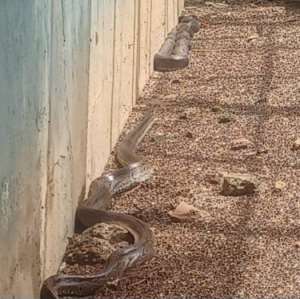
Two African Rock Pythons and their clutch of eggs, which were rescued recently from electricity transformer substation at Ahodwo-Daban in Kumasi, are thriving in their new environment at the Kumasi Zoological Gardens.
The hatchlings from the active eggs have been released into the wild at various locations to support the ecosystem balance.
The reptiles were rescued from a transformer in April 2026, when Electricity Company of Ghana (ECG) technicians from the Ahinsan district were at the site to repair a fault.
A distress call was made to the Kumasi Zoological Gardens and in a spate of about three hours, the two large matured African Rock pythons were safely captured together with their 42 viable eggs, which had been nestled in the transformer, and sent to the gardens.
The ECG officials, the reptile infestation had been the cause of the major power outage, prompting the rescue and their subsequent transfer to the Kumasi Zoological Gardens.
Dr Meyer Ziekah Yiryele, the Resident Veterinary Doctor at the Zoo, after the rescue operations at that time, informed the Ghana News Agency that, the reptiles had been admitted at the facility.
He explained that the swift intervention was crucial because of the potential danger the situation posed to both the animals and the ECG personnel.
He said upon their arrival at the Zoo, the reptiles underwent a thorough medical examination, which confirmed that one was male and the other female, indicating they were in their breeding phase.
The period coincided with the natural breeding season for the species, which likely prompted their movement in search of a conducive environment.
The eggs retrieved during the operation were placed in an incubator under controlled conditions for close monitoring.
Dr Ziekah at that time, assured the public that once the eggs were hatched, the young pythons would be released back into the wild to play their part in maintaining ecological balance.
Two weeks after the initial rescue operation was completed, the GNA conducted a follow-up visit to the Zoological Gardens to carefully monitor the health, rehabilitation, and developmental progress of both the rescued reptiles and their delicate eggs.
Dr Yiryele informed GNA that, out of the 42 eggs rescued from the Ahodwo ECG substation, six baby pythons had successfully hatched in a makeshift incubator at the Zoo in May 2026, while ten eggs spoiled and the remaining ones continued to be monitored.
He said the young pythons are being raised for eventual release back into the wild, where reintroducing them would support natural pest control and help sustain ecological balance.
When the GNA again visited the Zoological gardens in late October 2026, Dr Yiryele confirmed that the adult reptiles had adapted well to their new environment and responding positively to their current abode.
Dr Yiryele said the hatchlings had since been released into the ecosystem across various locations.
He said it was essential for Ghanaians to deeply embrace the vital importance of wildlife conservation, to actively support the natural control of agricultural pests, which would in turn help to maintain a balanced, resilient, and healthy ecosystem for future generations.
The pythons were hatched from eggs recovered from the Ahodwo ECG substation in May 2026
GNA

 El Niño: Ghana Health Service urges early preparedness against meningitis, heat-...
 24-Hour Economy is a subset of the New Economy – Ricketts-Hagan
 Some people contest elections to strengthen political bargaining power, not to w...
 Polls help presidential aspirants assess chances and avoid wasting money – Mussa...
 $60m presidential jet could save Ghana up to $2m annually in charter costs – Nkr...
 August 6 helicopter crash should end politicisation of presidential jet purchase...
 Three leaders, three agendas: Who wants what from Xi-Trump-Putin summit?
 Policewoman allegedly insults Don Little, says 'My clitoris is longer than you'
 GRA identifies 19 out of 22 non-compliant shops at West Hills Mall


