




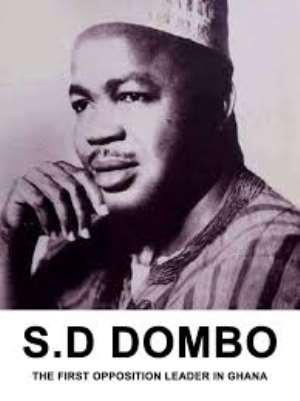
Introduction: A national history that must be told completely
Who was Simon Diedong Dombo? What did he contribute to the political development of Ghana? Why should his name be remembered beyond the political tradition with which he is historically associated? These questions are important because Ghana's political history is sometimes narrated in a manner that gives prominence to a handful of political personalities while overlooking others whose contributions were equally consequential.
The story of Ghana's independence, constitutional development, parliamentary democracy and nation-building cannot be told adequately without recognizing the contribution of Northern Ghana. Indeed, Northern Ghana produced political organizers, parliamentarians, ministers, educationists, traditional rulers and women whose participation helped shape the direction of the country before and after independence. Among these personalities were Simon Diedong Dombo, Adam Amandi, Jato Kaleo, Clement Kubindiwor Tedam, J. A. Braimah, Yakubu Tali, Mumuni Bawumia, Joseph Henry Allassani and Susanna Al-Hassan. There were also women such as Lydia Akanbodiipo and Catherine Tedam whose contributions to parliamentary politics deserve wider national recognition.
Our purpose is not to elevate one region above another, nor to suggest that Ghana's independence was achieved by Northerners alone. Rather, it is to correct an imbalance in our historical narrative. Northern Ghana was not a passive participant in the making of Ghana. Its people actively participated in the political negotiations, struggles, disagreements and decisions that produced the independent nation we know today. And Simon Diedong Dombo provides an appropriate starting point for examining this history.
The Colonial Background: A North that Demanded Development and Political Representation
To understand Dombo, we must first understand the circumstances in which Northern Ghana entered the political life of the Gold Coast. Under British colonial administration, the Northern Territories experienced a different pattern of governance and development from the southern parts of the country. Western education was limited, economic opportunities were fewer, infrastructure was inadequate, and the colonial administration maintained a system that left the North considerably behind the South in several areas of development. The North was largely administered through traditional authorities and indirect rule. Its integration into the emerging constitutional structures of the Gold Coast was gradual.
A Northern Territories Council was established in 1946. By 1951, Northerners had entered the Legislative Assembly, providing them with a platform to articulate their concerns about education, economic development, infrastructure and political representation. Their concern was understandable. They feared that political independence, if achieved without adequate safeguards for Northern development, could leave the North permanently disadvantaged within a new national political arrangement. This concern was not necessarily opposition to independence. It was a demand that independence should mean something for all the territories that would constitute the new country.
Paul Ladouceur's “Chiefs and Politicians: The Politics of Regionalism in Northern Ghana” provides an important examination of the relationship between traditional authority, emerging political leadership and regional interests. Similarly, N.J.K. Brinkum's 1998 study, “Underdevelopment and the Dilemma of Independence: Northern Ghana in Nationalist Politics, 1946–1956”, examines the political concerns that shaped Northern participation in the independence struggle. These works help explain why Northern political leaders considered economic development and constitutional arrangements inseparable from the question of independence.
Simon Diedong Dombo and the Northern People's Party (NPP)
Simon Diedong Dombo was born in 1925 and became a teacher, traditional leader and politician. He belonged to a generation of educated Northerners who recognized that the political future of their region could not be left entirely to political organizations dominated by southern interests. The Northern People's Party (NPP) emerged from discussions among members of the Northern Territories Council and Northern representatives in the Legislative Assembly. The organization was formally launched in April 1954.
Dombo, together with J. A. Braimah, Yakubu Tali and Mumuni Bawumia, was among the leading figures involved in its formation. At its inaugural conference, Dombo became chairman, with Mumuni Bawumia as vice-chairman. Other personalities associated with its formation and organization included Adam Amandi, Jato Kaleo, Abeifaa Karbo, Imoru Salifu, B. K. Adama and Clement Kubindiwor Tedam.
The party's objectives were centered on the accelerated development of Northern Ghana, particularly in education, healthcare, agriculture and infrastructure. Its slogan, "Always Together", reflected an effort to mobilize different Northern communities around common political and developmental interests. This was significant. The North was not a politically uniform territory. It contained different ethnic communities, traditional institutions, languages and political interests. The emergence of the NPP demonstrated that political cooperation across these differences was possible. Dombo's leadership therefore represented something larger than the fortunes of an individual political party. It represented an attempt to give Northern Ghana a collective political voice.
The 1956 Election: Dombo's Political Significance
The 1956 general election was a defining moment in the political history of the Gold Coast. The British government called the election against the background of the constitutional impasse between the Convention People's Party (CPP) and its opponents. The election was intended to establish which political grouping commanded sufficient parliamentary support for the country's constitutional future. The CPP won 71 of the 104 seats. The Northern People's Party won 15 seats in the North, where 26 constituencies were contested. The CPP secured the remaining 11 Northern seats. This was a significant political achievement. The NPP had demonstrated that it could mobilize support across the Northern Territories and emerge as a major political force. The results also revealed that Northern Ghana was not politically monolithic. Eleven Northern constituencies supported the CPP, while fifteen supported the NPP. It is important to appreciate the political significance of this division.
Dombo was not merely an opposition politician from a remote part of the country. He was a leader whose party had secured a substantial parliamentary mandate and whose support base could not be ignored in national constitutional negotiations. The NPP was allied with the National Liberation Movement and other opposition groups in the 1956 election. Under the alliance arrangement, Kofi Busia led the coalition, with Dombo as his deputy. The coalition advocated a federal constitutional arrangement, partly reflecting concerns about the protection of regional interests and the distribution of political power. The NPP leadership had also come to accept that independence was imminent. The election therefore involved more than a contest between Nkrumah and his opponents. It involved competing ideas about the structure of the emerging Ghanaian state.
The Question of Northern Ghana and Upper Volta
One aspect of this history that deserves further examination is the constitutional future of the Northern Territories. The North had a different colonial history and developmental experience from the southern Gold Coast. There were concerns about its economic preparedness for independence and the possibility of its interests being subordinated in a unitary state. There were also historical, cultural and geographical connections across the northern frontier with territories that became part of Upper Volta, now Burkina Faso. However, it would be misleading to suggest that the NPP simply wanted Northern Ghana to become part of Upper Volta.
The historical debate was more complicated. Opposition leaders explored constitutional alternatives, including separate political arrangements and greater regional autonomy. Indeed, the NPP and NLM sought discussions in London about the possibility of separate independence for the Northern Territories and Ashanti, alongside questions about the division of national assets and liabilities. The British government rejected partition, arguing that it was not in the interests of the country as a whole. Dombo's political journey must be understood against this background of competing constitutional visions. His subsequent participation in the national political process is part of the story of how the North became integrated into independent Ghana.
The United Party and the Avoidance of Discrimination Act
After independence on 6 March 1957, Ghana entered a new political phase. The government passed the Avoidance of Discrimination Act, 1957 (C.A. 38), which was assented to on 30 December 1957 and commenced on 31 December. The legislation prohibited organizations engaging in ethnic, regional, racial or religious propaganda to the detriment of other communities and imposed restrictions on organizations substantially confined to particular communities or religious faiths. The political consequences were considerable.
The existing opposition parties faced the prospect of losing their separate organizational identities. Consequently, several opposition organizations came together under the United Party (UP). These included the Northern People's Party, National Liberation Movement, Muslim Association Party, Togoland Congress, Anlo Youth Organisation and Ga Shifimo Kpee. The United Party brought together political organizations with different regional and communal origins under a common national political platform.
There are differing dates in historical accounts of its inauguration, with 13 October and 3 November 1957 both appearing in accounts. The larger historical question, however, remains important. Was the legislation simply intended to promote national unity, or did it also restrict the ability of opposition organizations to organize and compete politically? A balanced examination must acknowledge both the government's stated objective of national integration and the consequences of restricting political organization.
Dombo, Busia and the Opposition Struggle
Dombo's contribution did not end with the disappearance of the Northern People's Party. He became deputy leader of the United Party under Busia. In 1959, Busia, who was on a lecture tour in Europe, was disqualified from Parliament under the National Assembly Disqualification Act after being absent for twenty consecutive sittings without the required permission. Busia decided to remain abroad, and Dombo assumed the leadership of the parliamentary opposition. This was an important moment in Dombo's political career. He had moved from leading a regional political organization to occupying a significant position in the national parliamentary opposition. The political environment was increasingly difficult for opposition leaders.
The Preventive Detention Act of 1958 provided for detention without trial, and opposition figures were among those affected by the increasingly restrictive political climate. The United Party experienced arrests, defections, exile and a decline in its parliamentary strength.
Dombo's subsequent return to national government under Busia's Progress Party administration in 1969, when he served as Minister of Health and later Minister of the Interior, further demonstrated his continuing importance in Ghanaian politics. He died in 1998.
Other Northern Political Pioneers who Helped Shape Ghana
Dombo was not alone. A number of Northern personalities made substantial contributions to the political development of Ghana.
- Adam Amandi was among the founding members of the Northern People's Party. He belonged to the generation of Northern political organizers who believed that the region needed an effective parliamentary voice to advance its developmental interests. He subsequently served in the Progress Party government under Busia between 1969 and 1972. His contribution deserves recognition as part of the history of the political organization of Northern Ghana.
- Jato Kaleo was another important figure in the formation of the Northern People's Party. He came from the north-western part of the country and participated in the political mobilization that helped establish the party. His career also connected traditional leadership with national politics. He later served in Parliament and held ministerial office under the Busia administration. His political journey illustrates how Northern leaders moved between traditional institutions, political organizations and national government.
- Clement Kubindiwor Tedam, popularly known as C. K. Tedam, was another founding figure of the Northern People's Party. He entered the Legislative Assembly in 1954 and remained involved in national politics through subsequent political transitions. His contribution was not confined to party politics. He served on the Northern Territories Board of Education and participated in efforts to expand educational opportunities for Northern children. A special scholarship scheme for the acceleration of education in the Northern Territories was among the initiatives associated with this period. Tedam later became an important figure in the “Danquah-Busia-Dombo” political tradition. He was also a member of the Council of State during the Kufuor administration. His life illustrates the connection between education, political organization and national development.
- J. H. Allassani: A Northern politician on the CPP side --- A complete account of Northern political history must also recognize personalities who belonged to political traditions different from Dombo's. Joseph Henry Allassani, was a teacher, parliamentarian and prominent CPP politician. He entered the Legislative Assembly in 1951 and subsequently served as Minister of Education and Minister of Health under Nkrumah. He also played a role in the constitutional discussions concerning the integration of Northern Togoland with the Gold Coast. His career is particularly important because it demonstrates that Northern political participation was never the exclusive preserve of the Northern People's Party or the Busia-Dombo tradition. Northerners participated in the CPP, the NPP, the UP and other political formations. They disagreed, competed and sometimes supported opposing constitutional visions. That is precisely what makes their contribution to Ghana's political development so significant.
- J. A. Braimah, Yakubu Tali and Mumuni Bawumia --- These three personalities also deserve substantial recognition. J. A. Braimah was among those who helped initiate the idea of a Northern political organization. Together with Dombo, Yakubu Tali and Mumuni Bawumia, he participated in the discussions that led to the establishment of the Northern People's Party. Yakubu Tali, the Tolon Na, was an influential traditional ruler and political personality whose participation helped connect traditional authority with emerging democratic institutions. Mumuni Bawumia became the NPP's first vice-chairman and was part of the leadership that sought to build a political organization capable of representing Northern interests. These were not isolated individuals. They were part of a generation of Northern leaders who understood that political organization was necessary for effective participation in national affairs.
Northern Women in Ghana's Political History
If the contributions of Northern men have received insufficient attention, those of Northern women have been even more neglected. This is an omission that must be corrected.
- Susanna Al-Hassan, born in Tamale in 1927, occupies a special place in Ghana's political history --- a national pioneer. She attended Achimota School and subsequently became an educationist. Between 1955 and 1960, she served as headmistress of Bolgatanga Girls' Middle School. In 1960, she entered Parliament representing the Northern Region under the Representation of the People (Women Members) legislation. In 1961, she became Ghana's first female minister. She subsequently served as Minister of Social Affairs and held other ministerial responsibilities. Her significance went beyond being a female political pioneer. She was also an author whose children's books included “Asana and the Magic Calabash”. She demonstrated that Northern women could participate in national governance, education and intellectual life. Her achievement should be celebrated in every account of Ghanaian women's political history.
- Lydia Akanbodiipo was another Northern woman who entered Parliament during the Second Republic. She was among the women whose political achievements have not received the national attention they deserve. Her parliamentary career is particularly significant when considered alongside the experiences of women in a period when political representation was heavily dominated by men.
- Caatherine Tedam also deserves recognition. She entered Parliament during the Second Republic and participated in national politics from a different political position from Lydia Akanbodiipo. Interestingly, the two women sat on opposing sides of Parliament. Their experiences demonstrate that Northern women were not merely supporters or campaigners for male political leaders. They were political actors in their own right. A 2007 scholarly bibliographical essay, “Northern Ghana Women in National Politics: Biographies of Lydia Akanbodiipo and Catherine Tedam”, provides an important starting point for documenting their lives.
The stories of these women should not be confined to occasional commemorative speeches. They deserve a permanent place in Ghana's political history.
Northern Ghana and the Evolution of Multiparty Democracy
The contribution of Northern Ghana did not end with independence. Northern politicians continued to participate in the Second Republic, subsequent military and constitutional transitions, and the Fourth Republic. Their experiences reflect the changing nature of Ghanaian politics. Some supported Nkrumah and the CPP. Others belonged to the UP and later the Progress Party. Still others participated in different political movements. The important point is that Northern Ghana contributed to the development of both government and opposition. The region supplied ministers, parliamentarians, traditional leaders, party organizers and public servants. Its political history cannot therefore be reduced to the history of one party. Indeed, the evolution of the “Danquah-Busia-Dombo” political tradition into what is today the New Patriotic Party is only one part of the larger story.
The historical Northern People's Party and the modern New Patriotic Party should not be treated as identical organizations. The latter draws on the political tradition associated with Dombo, Busia and Danquah, but Dombo's historical contribution belongs to the wider Ghanaian national experience. He was a Ghanaian political pioneer before he became an important figure in a political tradition that continues to exist today.
Why Must We Honour Simon Diedong Dombo and His Contemporaries?
There are several reasons why Ghana should give greater recognition to Dombo and the other Northern pioneers.
- They helped bring Northern Ghana into the national political conversation at a time when the region was struggling with educational, economic and infrastructural disadvantages.
- They participated in the constitutional debates that shaped the structure of independent Ghana.
- They contributed to the development of parliamentary opposition and multiparty politics.
- They helped establish political organizations that mobilized people across traditional, ethnic and regional boundaries.
- Their contribution was not limited to men. Northern women such as Susanna Al-Hassan, Lydia Akanbodiipo and Catherine Tedam also helped expand the boundaries of women's participation in national politics.
These contributions should be recognized without partisan ownership. Dombo does not belong exclusively to the NPP. Allassani does not belong exclusively to the CPP. Susanna Al-Hassan's achievement does not belong to one political administration. They belong to Ghana.
What Should Ghana Do?
It is time for Ghana to move beyond occasional tributes and make a deliberate effort to preserve the contributions of its political pioneers.
I propose the following:
- National recognition: The Government of Ghana should consider appropriate national honours for Simon Diedong Dombo and other outstanding Northern political pioneers whose contributions have not received adequate recognition.
- Historical documentation: The Ministry of Education, the National Council for Curriculum and Assessment, universities and research institutions should ensure that the political history of Northern Ghana is properly incorporated into the teaching of Ghanaian history.
- Memorial institutions: Consideration should be given to establishing a Simon Diedong Dombo Centre for Political History and Democratic Studies in the Upper West Region. Such an institution could document the lives and contributions of Northern political pioneers.
- Recognition of women: Susanna Al-Hassan, Lydia Akanbodiipo and Catherine Tedam should receive appropriate national recognition. Their contributions should be preserved in educational materials and public historical records.
- Archival preservation: Families of these pioneers, traditional authorities, political parties and public institutions should collaborate to preserve photographs, speeches, correspondence, parliamentary records and personal documents.
- National commemorations: Ghana should consider an annual national lecture or symposium on the contribution of Northern Ghana to the political development of the country.
These proposals are not about creating regional competition. They are about ensuring that Ghana remembers its history comprehensively.
My Final Thoughts
Dombo was a Ghanaian statesman, not merely a Northern politician. There is a tendency in our political discourse to remember historical personalities according to the political parties with which they were associated. That approach is too narrow.
Simon Diedong Dombo was a teacher, traditional leader, political organizer, parliamentarian and minister. He participated in the struggle over the constitutional future of the Gold Coast and helped establish a political organization that gave Northern Ghana a stronger voice. His contemporaries, including Adam Amandi, Jato Kaleo, C. K. Tedam, J. A. Braimah, Yakubu Tali and Mumuni Bawumia, also helped shape the political development of the country. J. H. Allassani demonstrated that Northern participation extended across political traditions. Susanna Al-Hassan, Lydia Akanbodiipo and Catherine Tedam demonstrated that Northern women were also part of the evolution of Ghanaian parliamentary and national leadership.
We must therefore resist the temptation to write Ghana's political history as though it were the exclusive achievement of a few personalities or regions. The independence of Ghana was a national achievement. The construction of its democratic institutions was a national undertaking. The sacrifices, disagreements, negotiations and political struggles that shaped the country involved people from all parts of the Gold Coast. Northern Ghana was part of that story.
Simon Diedong Dombo deserves to be remembered, not because he belonged to a particular political tradition, but because of his contribution to the making of Ghana. He was not simply an NPP or UP politician. He was part of the generation that helped shape the political destiny of this country. Ghana must remember him. And in remembering him, we must remember the many Northern men and women who helped make modern Ghana possible.
References
Brinkum, N. J. K. (1998). Underdevelopment and the dilemma of independence: Northern Ghana in nationalist politics, 1946–1956. Research Review, Institute of African (https://pdfproc.lib.msu.edu/?file=%2FDMC%2FAfrican+Journals%2Fpdfs%2FInstitue+of+African+Studies+Research+Review%2F1998v14n1%2Fasrv014001003.pdf&utm_source=chatgpt.com).
Ghana News Agency. (2006). Adam Amandi Laid To Rest. [ModernGhana archive] (https://www.modernghana.com/news/95626/adam-amandi-laid-to-rest.amp?utm_source=chatgpt.com).
Graphic Online. (2019). C. K. Tedam Laid To Rest. [Obituary and political biography] (https://www.graphic.com.gh/news/politics/ghana-news-c-k-tedam-laid-to-rest.html?utm_source=chatgpt.com).
Ibrahim, I. B. (2014). The life and times of a patriot: A biography of Chief Simon Diedong Dombo. University of Ghana. [University of Ghana Repository] (https://ugspace.ug.edu.gh/items/1b9fc318-00c1-42a6-8dc8-b3575758ffbe?utm_source=chatgpt.com).
Ladouceur, P. (1979). Chiefs and politicians: The politics of regionalism in Northern Ghana. (https://www.academia.edu/9881961/Chiefs_and_Politicians_The_Politics_of_Regionalism_in_Northern_Ghana_London_Longmans_1979_?utm_source=chatgpt.com).
Lentz, C. (2006). Ethnicity and the making of history in Northern Ghana. Edinburgh University Press.
Northern Ghana women in national politics: Biographies of Lydia Akanbodiipo and Catherine Tedam. (2007). [African Journals Online library record] (https://awdflibrary.org/index.php?id=581&p=show_detail&utm_source=chatgpt.com).
Republic of Ghana. (1957). Avoidance of Discrimination Act, 1957 (C.A. 38). (https://www.judy.legal/legislation/akn/gh/act/1957/38?utm_source=chatgpt.com).
Ulzen, T. (2018). The Northern People's Party is Launched, 11 April 1954. Edward A. Ulzen Memorial Foundation. [Historical account] (https://www.eaumf.org/ejm-blog/2018/4/10/april-11-1954-the-northern-peoples-party-is-launched?utm_source=chatgpt.com).
Ulzen, T. (2018). January 17, 1997: Ghana's First Woman Minister, Mrs Susanna Al-Hassan Passes Away. Edward A. Ulzen Memorial Foundation. [Historical biography] (https://www.eaumf.org/ejm-blog/2018/1/17/january-17-1997-ghanas-first-woman-minister-mrs-susanna-al-hassan-passes-away?utm_source=chatgpt.com).
FUSEINI ABDULAI BRAIMAH
+233208282575 / +233550558008
[email protected]


 Musah Superior Dismisses Government’s $10bn Economic Plan as Unrealistic
 Zaato Accuses Ablakwa, NDC of Politicising Akufo-Addo’s Chartered Flights
 Akufo-Addo Never Sought Approval for New Presidential Jet, Says Dr Zaato
 Beyuo Defends Acquisition of New Presidential Jet
 Auditors Should Help Shape GIFMIS Relaunch, Says Seth Terkper
 Rent Commissioner Seeks Police Protection After UG Hostel Confrontation
 Zenith University College law students gain practical knowledge in copyright, mu...
 NAP Graduates to Receive Start-Up Kits, Tools, and Monthly Stipends
 'Unacceptable': EU chief condemns alleged Russian plot to kill US-Ukrainian citi...
 Nkrumah used secret walking stick signals to direct cameraman Chris Hesse – Docu...


