




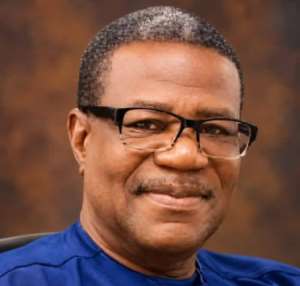
Richard Afutu Kotei, son of Ghana’s Coat of Arms designer, Nii Amon Kotei, has criticised the cultural and historical representations on the newly introduced Ghana cedi notes, expressing concern that his father’s contribution to the country’s national identity has not received adequate recognition.
In a strongly worded article, Mr Kotei questioned the choice of imagery on the redesigned banknotes, arguing that the selection appeared to overlook important aspects of Ghana’s cultural heritage and historical contributions.
He also raised concerns about the composition of the panel responsible for reviewing and approving the designs, questioning whether its members fully understood the historical significance of the Coat of Arms and the legacy of its creator.
“My first question is: Who were the members of the panel responsible for reviewing and approving this decision? Were they sufficiently informed about the historical significance of Ghana’s Coat of Arms?” he asked.
Mr Kotei maintained that the Coat of Arms, together with the National Flag and National Anthem, forms a fundamental part of Ghana’s identity and deserves appropriate recognition in national representations.
He further challenged what he described as the heavy reliance on Adinkra symbols in portraying Ghanaian culture, insisting that the country's diverse ethnic groups have other important symbols, artistic traditions and historical contributions that should also be celebrated.
“Have we become so limited and small-minded in our understanding of Ghanaian cultural heritage that we cannot look beyond Adinkra symbols when representing our national identity?” he queried.
He said his concerns were not limited to the artistic decisions behind the new currency but reflected a wider debate about cultural representation, inclusion and the recognition of the contributions of Ghana’s various ethnic communities.
Mr Kotei said the matter was particularly troubling to the Ga-Dangme community, arguing that its historical and cultural contributions had not received the recognition they deserved.
“To the Ga-Dangme people like myself, this is particularly painful. The disregard for our historical and cultural contributions is difficult to ignore,” he stated.
He described the situation as part of a broader pattern in which the contributions of some communities to Ghana’s development and national identity were, in his view, not adequately acknowledged.
To reinforce his position, Mr Kotei cited a Ga proverb which he said highlighted the importance of speaking out when decisions concerning collective interests and heritage are being made.
“Kɛ owieee loo he lɛ, obaa kpe wu,” he quoted, explaining that it means. "If you fail to speak up when the meat is being shared, you will eventually be left chewing the bones and scraps.”
He said the proverb served as a reminder that individuals and communities must demand fair recognition rather than remain silent when decisions affecting their identity and heritage are taken.
Mr Kotei insisted that Ghana’s national identity should reflect the country's cultural diversity and should not be reduced to the celebration of selected traditions, symbols or historical figures.
“Ghana belongs to all of us, and its history deserves to be told with fairness, balance, dignity and equal recognition,” he emphasised.
He called on Ghanaians, particularly members of the Ga-Dangme community, to speak out against what they consider the marginalisation of their cultural heritage and historical contributions.

 Govt launches probe into viral video of Ghanaian woman allegedly assaulted by bo...
 Coat of Arms designer’s son questions omission of father’s legacy from new cedi ...
 NAIMOS arrests 30 persons, intercepted 35 tipper trucks over suspected illegal s...
 Mahama visits Akufo-Addo at Nima residence for talks on national, international ...
 NDC clears 98 aspirants for december 19 national executive elections
 Mahama to commission DNA testing and vaccine development laboratories at Noguchi...
 Canadian police arrest 12, including eight Nigerians, over $4.5m stolen vehicle ...
 Current economic conditions do not make presidential jets purchase a misplaced p...
 Ghana is my second home, one-quarter of my family was born here – Dangote reveal...
 “She kissed me first” – Labone SHS French teacher tells court in indecent assaul...


