




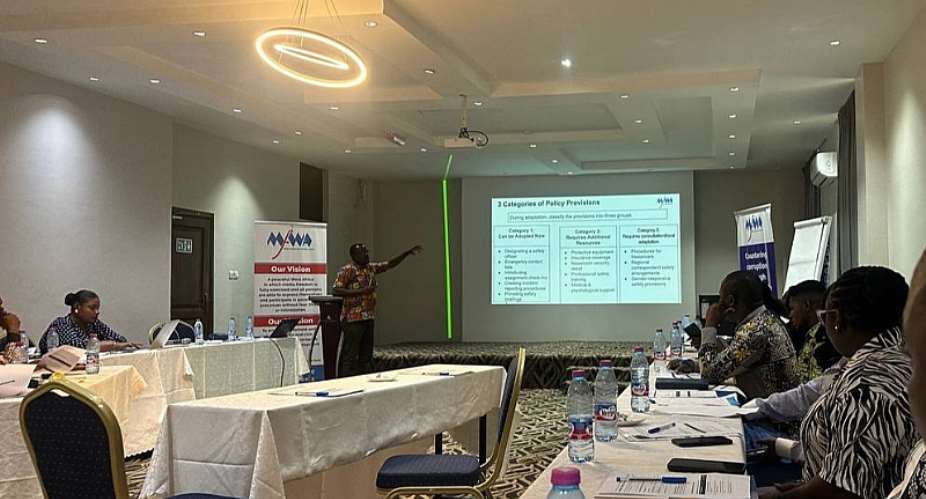
The Media Foundation for West Africa (MFWA) has urged media owners, editors, and newsroom managers across Ghana to take institutional responsibility for the safety and welfare of journalists by adopting its newly developed Model Safety of Journalists Policy.
The call was made during a one-day training workshop held at the Airport View Hotel in Accra on Thursday, November 12, 2026. The engagement brought together editors, managers, and senior journalists from selected media houses to build consensus on translating safety principles into everyday newsroom practice.
Developed by the MFWA, the Model Safety of Journalists Policy offers a practical framework that media organisations can adapt to protect staff before, during, and after field assignments. It outlines clear institutional procedures for risk assessment, newsroom and physical security, digital safety, legal support, emergency response, incident reporting, and psychosocial wellbeing.
Delivering the welcome address, the Programs Director for the MFWA, Dr. Kojo Impraim, expressed concern that the burden of managing occupational risks is too often left to individual reporters. He stressed that while reporters must take personal precautions, media houses and industry regulators bear an institutional duty to safeguard staff.
"For the media owners, managers, and editors who are in this room, adopting this policy should not be seen as an additional administrative responsibility. Rather, it is an intentional investment in the people who make journalism possible," Dr. Impraim stated.
He noted that unchecked attacks against media practitioners create a climate of fear and self-censorship, which ultimately weakens the ability of the press to serve the public interest and strengthen Ghana's democracy.
"We cannot encourage journalists to consistently hold power to account if their own safety and wellbeing are not adequately protected," Dr. Impraim added. "This policy must help us to turn protection from principle into everyday practice."
Acknowledging that media houses vary in size, resources, and operational structures, Dr. Impraim explained that the document was intentionally designed as a flexible guide. He advised media managers that they do not need to roll out the entire policy at once, urging them instead to implement sections that suit their immediate capacities while working toward full adoption. He also revealed that the MFWA will conduct a follow up assessment in the coming months to track how newsrooms are integrating the framework.
During the technical sessions, a consultant and lecturer at the University of Media, Arts and Communication Institute of Journalism (UniMAC IJ), Dr. Martin Thompson Ntem, guided participants through the core provisions of the document. His sessions focused on identifying existing safety gaps, understanding field risks, and drafting practical adoption plans tailored to individual newsrooms.
The workshop forms part of the project titled "Countering Corruption through Accountability Journalism and Improved Freedom of Expression Environment in Ghana." The initiative seeks to promote accountable governance and improve press freedom across the country.
It is being implemented under the Participation, Accountability, Integrity for a Resilient Democracy (PAIReD) Programme, which is commissioned by the German Federal Ministry for Economic Cooperation and Development (BMZ), co-financed by the European Union (EU) and the Swiss State Secretariat for Economic Affairs (SECO), and implemented by GIZ in cooperation with the Ministry of Finance.

 How eight 'A's WASSCE graduate from Wesley Girls killed by speeding motorcycle w...
 GTEC freezes new PhD admissions nationwide pending audit of doctoral programmes
 NATO faces sovereignty dilemma as militaries rely on private tech, AI
 Afenyo-Markin demands answers over poor water quality in Central Region
 Mahama says Mayweather’s Ghana visit will boost tourism, boxing
 Police to develop human rights manual to strengthen professionalism and public t...
 How Korle Bu surgeons fixed back man's penis cut off whiles attempting to sit on...
 German President to visit Ghana for talks on trade and skills development
 Madina Court remands man over alleged GH¢18,500 theft from girlfriend
 Akufo-Addo left Mahama govt GH¢680bn debt bill for 2027-2030 — Isaac Adongo


