




1. Introduction: The Making of a National Historical Identity
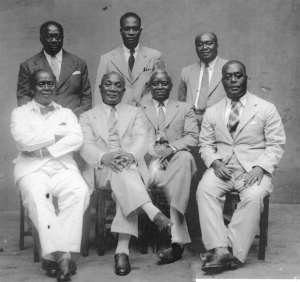
The designation “Big Six” occupies an important place in Ghana’s political history. It is commonly used to identify six prominent members of the United Gold Coast Convention (UGCC) who were arrested and detained by the colonial administration following the disturbances of February and March 1948. Their names have since become closely associated with the nationalist movement and Ghana’s eventual attainment of independence.
Yet the historical importance of the designation extends beyond the identities of the six individuals. It raises questions about the circumstances in which they were brought together, the political interpretation placed upon their activities, and the manner in which colonial action contributed to their emergence as a collective symbol of nationalist resistance.
The central concern of this analysis is not to diminish the contributions of the six personalities. Their place in Ghana’s political history is established. Rather, it is to examine how six individuals, whose political backgrounds, temperaments and subsequent objectives were not identical, came to be remembered under one collective designation.
It is equally important to distinguish the six from the wider nationalist movement. The struggle against colonial rule was not the exclusive undertaking of six political leaders. It involved ex-servicemen, traders, traditional authorities, workers, organised groups, educated Africans and ordinary citizens whose grievances and aspirations contributed to the political atmosphere of the period.
The events of 28 February 1948 provide a useful starting point for this examination. They also invite a question that deserves particular attention: where were J. B. Danquah and Kwame Nkrumah when the ex-servicemen’s march at Christiansborg Crossroads ended in bloodshed?
The historical record indicates that both men were at Saltpond, approximately sixty miles from Accra. This detail matters because it helps distinguish physical presence at the incident from subsequent political association, colonial suspicion and the responsibility later attributed to the UGCC leadership.
The argument advanced here is that the “Big Six” designation acquired its enduring significance through the intersection of colonial repression, political circumstances and nationalist memory. The six became a recognisable symbol, but the history they came to represent was considerably wider than their number.
2. The Background to 28 February 1948: A Colony Under Pressure
The Gold Coast in the years immediately following the Second World War was experiencing considerable political and economic pressure. The war had raised expectations among Africans who had served the British Empire, contributed to its military effort and returned home anticipating fair treatment, employment opportunities and recognition for their service.
Many ex-servicemen found that the conditions awaiting them did not correspond with the expectations created during their service. Questions of employment, pensions, gratuities and the general treatment of former soldiers became sources of dissatisfaction.
The wider population was also experiencing economic difficulties. The cost of living, trading inequalities, limited African participation in important sectors of the economy and the uneven distribution of opportunities had created an atmosphere of frustration.
The commercial boycott associated with Nii Kwabena Bonne II reflected some of these grievances. It was directed against perceived exploitation and unfair trading practices, particularly those associated with foreign commercial interests. The boycott became part of a broader expression of dissatisfaction with the economic arrangements of colonial society.
Politically, the formation of the United Gold Coast Convention in 1947 had given organised expression to demands for constitutional change and greater African participation in government. The UGCC brought together prominent personalities who believed that the Gold Coast should move towards self-government.
Kwame Nkrumah, who had returned from abroad to serve as the Convention’s General Secretary, brought organisational energy and a more radical political outlook to the movement. J. B. Danquah and other established nationalists represented different political experiences and approaches to the question of constitutional advancement.
The colony was therefore not facing a single isolated grievance. It was experiencing the convergence of economic discontent, political dissatisfaction, demands for recognition and growing expectations of self-government.
The events of February 1948 must be understood against this wider background. To interpret them solely as the action of a few political personalities would be to overlook the many social and economic pressures already present in the colony.
3. The Christiansborg Crossroads Incident: What Happened on 28 February?
On 28 February 1948, a group of ex-servicemen assembled in Accra and proceeded towards Christiansborg Castle, then the seat of colonial government. Their purpose was to present a petition to the Governor concerning their grievances and the treatment they had received after returning from military service.
The procession was intended to bring their concerns directly to the colonial authorities. It was not simply a political demonstration organised by the UGCC. The ex-servicemen had their own grievances, their own immediate objectives and their own reasons for seeking an audience with the Governor.
As the march approached the Christiansborg area, the situation deteriorated. The police intervened, and shots were fired at the demonstrators. Three ex-servicemen were killed:
- Sergeant Cornelius Francis Adjetey;
- Corporal Patrick Attipoe; and
- Private Odartey Lamptey.
Their deaths became a defining moment in the history of the Gold Coast. The shooting transformed a demonstration over the treatment of former soldiers into a much wider public crisis.
Disturbances and looting followed in Accra and other parts of the colony. The colonial administration responded with emergency measures, arrests and an investigation into the causes of the unrest.
It is necessary, however, to distinguish the original march from the disturbances that followed. The ex-servicemen’s petition, the shooting at the crossroads and the subsequent unrest were connected events, but they were not identical in character or necessarily directed by the same individuals.
The deaths of the three servicemen remain central to the historical account. Their sacrifice should not become a mere introduction to the political story of the six leaders. They were participants in their own right, representing the grievances of a body of men who believed that their service to the country and the Empire deserved recognition.
The incident also raises questions about police preparedness, the handling of public demonstrations and the responsibilities of colonial authority in a tense political environment.
4. An Important Historical Detail: Where Were Danquah and Nkrumah?
One detail deserves particular emphasis in any balanced account of the events of 28 February 1948: J. B. Danquah and Kwame Nkrumah were not in Accra when the ex-servicemen’s demonstration took place.
The historical accounts place both men at Saltpond, approximately sixty miles from Accra. Nkrumah was there with other UGCC leaders, engaged in political activity. The news of the disturbances reached him while he was away from the capital.
This point is important because it establishes a distinction between being physically present at an incident and being politically associated with the events that follow it.
Neither Danquah nor Nkrumah should be represented as having personally taken part in the march at Christiansborg Crossroads on the basis of the evidence that places them at Saltpond. Nor should their absence be ignored when examining the colonial administration’s subsequent decision to arrest them.
However, historical fairness also requires restraint in the opposite direction. Their absence from Accra at the time of the shooting does not, by itself, settle every question concerning their subsequent political activities, statements, organisational responsibilities or responses to the disturbances.
The proper distinction is therefore between:
- Physical presence at the Christiansborg Crossroads incident;
- Direct participation in the ex-servicemen’s demonstration;
- Political association with the wider nationalist movement;
- Subsequent responses to the disturbances; and
- Allegations of responsibility made by the colonial administration.
These are separate historical questions and should not be treated as interchangeable.
The fact that the two prominent leaders were at Saltpond is especially significant when considering how colonial suspicion developed. The disturbances occurred within an already tense political environment, and the administration was inclined to interpret the unrest through the political activities of the UGCC.
The proximity of political events and the presence of a growing nationalist organisation may have encouraged colonial officials to associate the Convention’s leadership with the unrest. But political suspicion, however strongly held, is not the same as demonstrated responsibility for a particular incident.
A historical account must therefore preserve the distinction between what happened, who was present, what was alleged and what can be established.
5. The Colonial Response: From Political Suspicion to Arrest
The disturbances of February and March 1948 presented the colonial administration with a serious challenge. The government faced widespread public anger, demands for explanations and questions about its handling of the ex-servicemen’s demonstration.
The administration also had to confront the broader political implications of the unrest. The UGCC had become an important voice in the demand for constitutional change, and its leaders were increasingly visible in public affairs.
In this atmosphere, colonial officials came to regard the Convention’s leadership with suspicion. The political activities of the UGCC were interpreted as part of the explanation for the disturbances, and the authorities moved against prominent members of the organisation.
Six leaders were arrested and detained:
- Kwame Nkrumah;
- Dr J. B. Danquah;
- Emmanuel Obetsebi-Lamptey;
- Edward Akufo-Addo;
- William Ofori-Atta; and
- Ebenezer Ako-Adjei.
The Governor signed the removal order on 12 March 1948, and the six were taken into detention in the Northern Territories.
Their arrest brought together six men who had different backgrounds and political experiences. They were connected through their involvement in the UGCC, but they were not necessarily identical in their understanding of political strategy or the future direction of the nationalist struggle.
The colonial action gave their association a new public significance. They were no longer seen only as individual members of a political organisation. Their detention created an identifiable group whose collective treatment could be interpreted as an example of colonial repression.
This is an important part of the story behind the “Big Six” designation.
It would nevertheless be premature to conclude that the colonial administration formally invented the expression. The safer historical position is that the arrests and collective detention helped establish the six as a recognisable group in public memory. The precise origin and earliest use of the popular designation require documentary verification.
What can be examined with greater confidence is the political consequence of the arrests. The administration’s decision to detain the six gave their names a common historical setting and helped transform them into a collective symbol.
6. The Emergence of the “Big Six”: From Detained Leaders to National Symbols
The emergence of the “Big Six” as a national designation illustrates how political circumstances can shape historical memory.
Before their arrest, the six were individuals with distinct political identities and responsibilities within the UGCC. Their association arose from their participation in the same nationalist organisation, not from an identical political philosophy or a permanent agreement on the future direction of the country.
Their collective detention changed the public meaning of that association.
The colonial administration had treated them as a group requiring removal from the political environment in which the disturbances had occurred. Their arrest, however, also gave the nationalist movement a set of recognisable personalities around whom public attention could gather.
In this sense, repression had an unintended consequence. An action intended to contain political opposition helped create a collective image that could be remembered and invoked in the wider struggle for self-government.
The six became symbols not simply because they were prominent politicians, but because their detention connected them to a significant episode in the history of colonial resistance.
It is worth recognising that national symbols often acquire meanings that extend beyond the original circumstances of their creation. The “Big Six” came to represent opposition to colonial rule, political courage and the movement towards independence.
Yet symbolism should not be confused with a complete account of historical events.
The six were not the only people who suffered under colonial rule. They were not the only people who demanded change, and they were not the only people whose actions contributed to the growth of nationalist consciousness.
Their designation is historically useful, but it cannot be allowed to become a substitute for the wider history of the period.
7. The Watson Commission: An Inquiry into More Than Six Personalities
Following the disturbances, the colonial government established the Commission of Enquiry into the disturbances in the Gold Coast, commonly known as the Watson Commission.
Its task extended beyond examining the conduct of individual political leaders. The Commission was required to investigate the disturbances and their underlying causes and to make recommendations on matters arising from its enquiry.
The Commission’s report and the evidence submitted to it provide an important documentary record of the period. They address the grievances of ex-servicemen, African participation in government, trading discrimination, industrial development, education, housing and other conditions affecting life in the colony.
The importance of this material lies partly in the range of voices it preserves. The enquiry received evidence from individuals and organisations representing different sections of Gold Coast society.
The testimony therefore provides an opportunity to examine the disturbances beyond the immediate political controversy surrounding the UGCC leadership.
Jennifer Hart’s 2024 study of the Watson Commission archive draws attention to the value of these records. She describes the collection as an unusually broad body of testimony from people across the social, economic and political spectrum of the colonial Gold Coast.
This wider documentary record is important because it demonstrates that the grievances of the period cannot be reduced to the activities of a small number of political leaders.
The ex-servicemen had their own claims. Traders and consumers had their own complaints. Workers, students, youth organisations and other groups had concerns about the unequal distribution of opportunity and protection under colonial rule.
The Watson Commission must therefore be read as more than an investigation into the political fortunes of the six detained leaders. It was an enquiry into a colony experiencing accumulated dissatisfaction.
At the same time, the Commission was a colonial investigation, conducted within the institutional and political framework of British rule. Its findings should be examined critically, with attention to the evidence presented, the assumptions made and the circumstances in which the enquiry operated.
The report remains indispensable, but no single official document should be treated as the final word on every aspect of a complex historical event.
8. The Aftermath: Political Differences Within the Nationalist Leadership
The subsequent history of the UGCC demonstrates why the “Big Six” should not be understood as a permanently unified political organisation.
The six were brought together in public memory by their arrest and detention. That common experience did not remove their differences in political outlook, strategy or ambition.
The most consequential division emerged between Kwame Nkrumah and the established leadership of the UGCC. Differences over political organisation, the pace of constitutional change and the methods required to achieve self-government contributed to a separation that reshaped the nationalist movement.
In 1949, Nkrumah broke away from the UGCC and established the Convention People’s Party (CPP). The new party adopted a more direct and mass-oriented approach to the struggle for self-government.
The emergence of the CPP marked a significant change in Gold Coast politics. It demonstrated that the nationalist movement was not a single, unchanging body. It contained different tendencies and competing ideas about leadership, political mobilisation and the route to independence.
The later political history of the country also revealed that the six did not share one permanent political destination. Their paths and positions differed, and the political divisions that followed became part of the history of the independence struggle.
This does not invalidate their collective historical significance. Rather, it helps explain the limits of the designation.
The “Big Six” is a useful description of a particular historical association. It should not be mistaken for evidence that the six remained united in political purpose throughout the subsequent struggle.
Historical memory often prefers simple groupings. Political history, however, is rarely so simple.
9. Historical Memory: The Six and the Wider Nationalist Movement
The prominence of the “Big Six” in Ghana’s national history raises a broader question: how should a country remember the people and events that contributed to its independence?
The six leaders deserve recognition for their place in the nationalist movement and for the political significance of their detention in 1948. Their names have become part of the national story.
But the struggle for independence was wider than the six.
It involved ex-servicemen who had served in the war and returned with expectations of fair treatment. It involved traders who challenged economic arrangements they considered unjust. It involved traditional authorities, workers, students, youth organisations and ordinary citizens whose experiences of colonial rule shaped their demands for change.
The three ex-servicemen killed at Christiansborg Crossroads should remain central to the memory of 28 February. Their names should not be overshadowed by the later political prominence of those who were arrested.
Likewise, the people who participated in the boycott, expressed grievances through public meetings and memoranda, or contributed to the political climate of the period deserve a place in the wider historical account.
A national narrative becomes incomplete when it gives all the attention to recognised political personalities while leaving the experiences of ordinary people at the margins.
This is not an argument against the “Big Six” designation. It is an argument for placing it within its proper historical setting.
The six became a powerful symbol of nationalist resistance. They did not constitute the entire nationalist movement, nor can their collective identity explain every cause and consequence of the disturbances.
A more complete understanding of Ghana’s journey to independence requires recognition of both the prominent political leaders and the wider population whose grievances, sacrifices and participation helped create the conditions for change.
10. The Broader Historical Paradox: When Repression Creates Recognition
There is a historical paradox at the centre of the “Big Six” story.
The colonial administration sought to respond to a period of unrest by arresting prominent nationalist leaders and removing them from the immediate political environment. Yet the collective detention of these men helped give them a lasting public identity.
The six were brought together by an act of colonial authority. Their subsequent place in national memory was shaped, in part, by the political meaning attached to that act.
This is an example of how repression can produce consequences different from those intended by the authority exercising it.
An administration may seek to contain opposition, but the treatment of political opponents can instead strengthen public identification with them. An attempt to isolate leaders may give them a common identity that outlasts the circumstances of their detention.
The “Big Six” designation illustrates this possibility.
However, the historical paradox should not be overstated. The nationalist movement did not begin with the arrest of the six, and the movement did not depend entirely on their detention for its existence. Political organisation, economic grievances and public demands for change had developed before February 1948.
The arrests became a significant episode in an already developing struggle. They contributed to the construction of a national symbol, but they did not create the entire movement.
The distinction matters. It allows us to recognise the influence of colonial repression without reducing the history of nationalism to a single administrative decision.
It also reminds us that national memory is formed through the interaction of events, personalities, institutions and later interpretations.
The history of the “Big Six” is therefore not only a story of six men. It is also a story about how political authority, public reaction and historical remembrance can combine to give an event a meaning that extends far beyond its immediate circumstances.
Conclusion: Beyond the Familiar Six Names
The designation “Big Six” remains an important feature of Ghana’s political and historical vocabulary. It identifies six prominent UGCC leaders whose arrest and detention following the 1948 disturbances gave them a shared place in the national memory.
Their historical importance should be acknowledged. But the circumstances surrounding their collective identification deserve careful examination
The events of 28 February 1948 began with the march of ex-servicemen seeking redress for their grievances. The shooting at Christiansborg Crossroads resulted in the deaths of Sergeant Cornelius Francis Adjetey, Corporal Patrick Attipoe and Private Odartey Lamptey. The disturbances that followed exposed deeper economic, social and political tensions within the colony.
The fact that J. B. Danquah and Kwame Nkrumah were at Saltpond, approximately sixty miles from Accra, when the incident occurred is an important historical detail. It requires us to distinguish physical presence from political association and colonial allegation from established responsibility.
The subsequent arrest of six UGCC leaders brought them together under circumstances that helped shape their collective identity. Their detention became part of the political history of colonial repression and contributed to the lasting significance of the “Big Six” designation.
Yet the six were not the whole movement. The struggle for independence drew strength from a much wider range of people and experiences. The ex-servicemen, traders, workers, traditional authorities, students and ordinary citizens who challenged the conditions of colonial rule must remain within the historical picture.
The purpose of revisiting the designation is therefore not to displace established national figures, but to deepen the understanding of how their place in history was formed.
A nation’s history is best served when its symbols are examined with respect, its records are read critically and its less celebrated contributors are not forgotten.
The Big Six became a symbol of Ghana’s nationalist struggle, but the struggle itself was larger than the six men. Understanding that distinction is essential to understanding Ghana’s journey to independence.
SOURCES AND HISTORICAL REFERENCES
The following sources provide a documentary and scholarly foundation for the principal historical issues discussed in this analysis.
- Great Britain, Colonial Office. Report of the Commission of Enquiry into the Disturbances in the Gold Coast, 1948. Colonial No. 231. London: His Majesty’s Stationery Office, 1948.
This is the primary official report of the Watson Commission. It examines the disturbances and the wider social, political and economic conditions in the Gold Coast. A digitised copy is held by the University of Ghana repository.
- Great Britain, Colonial Office. Statement by His Majesty’s Government on the Report of the Commission of Enquiry into Disturbances in the Gold Coast, 1948. London: His Majesty’s Stationery Office, 1948.
This government statement provides evidence of the colonial administration’s response to the Commission’s report and its recommendations.
- Hart, Jennifer. “One British Archive: Archives of Dissent: Complicating Anti-colonial Histories through the Watson Commission (Gold Coast/Ghana).” Journal of British Studies 63, no. 3 (July 2024): 517–520.
DOI: 10.1017/jbr.2024.60.
This study examines the Watson Commission archive and highlights the breadth of testimony submitted by people from different social, economic and political backgrounds. - Austin, Dennis. “The Working Committee of the United Gold Coast Convention.” The Journal of African History 2, no. 2 (1961): 273–297.
DOI: 10.1017/S0021853700002474.
This article draws on the UGCC Working Committee minute book and provides valuable insight into the organisation, internal developments and political divisions of the Convention. - Nkrumah, Kwame. Ghana: The Autobiography of Kwame Nkrumah. Edinburgh: Thomas Nelson, 1957.
Nkrumah’s account is an important primary personal source for his political experiences and the development of the nationalist movement. Like other personal accounts, it should be read alongside documentary and independent historical evidence.
- “The ‘Cat’s Paw of Dictatorship’: State Security and Self-Rule in the Gold Coast, 1948 to 1957.” eScholarship, University of California.
This academic study discusses colonial security policy, the 1948 disturbances, Nkrumah’s presence at Saltpond and the subsequent detention of the six UGCC leaders. The complete bibliographic details of the study should be confirmed from its repository record before formal publication.
HISTORICAL POINTS REQUIRING PARTICULAR CARE
For the sake of accuracy, the following distinctions should guide the reading of this essay:
- Saltpond: The presence of Danquah and Nkrumah at Saltpond on 28 February 1948 is significant when assessing claims about their direct participation in the Christiansborg Crossroads incident. It does not, by itself, resolve every question about their subsequent political involvement.
- The ex-servicemen’s march: The petitioning march, the police shooting and the disturbances that followed should be treated as connected but distinguishable events.
- Colonial allegations: Allegations made by colonial officials should not automatically be presented as proven responsibility.
- The Watson Commission: Its report is an essential primary source, but its findings should be read alongside the evidence submitted to it and later scholarship.
- The designation “Big Six”: The collective historical identity of the six is clear. However, the precise origin and earliest documented use of the expression should not be attributed conclusively to the colonial administration without further documentary evidence.
- The wider nationalist movement: The six were prominent participants, but the struggle for independence involved a much wider population and a range of political, social and economic interests.
FINAL EDITORIAL ASSESSMENT
This essay is strongest when it treats the “Big Six” designation not merely as a familiar historical label, but as a subject worthy of examination. Its contribution lies in asking how six individual political personalities came to occupy a collective place in Ghana’s national memory.
Three central arguments give the work its identity.
First, the question of historical responsibility. The Saltpond detail introduces an important distinction between physical presence at the incident and subsequent political association. It encourages a more disciplined reading of the events and discourages the careless repetition of allegations as established facts.
Second, the unintended consequences of colonial repression. The detention of the six helped give them a collective identity that outlived the immediate circumstances of their arrest. The essay examines how an attempt to contain political opposition could contribute to the making of a lasting nationalist symbol.
Third, the distinction between national symbolism and historical reality. The six deserve their place in Ghana’s history, but the nationalist struggle was broader than their individual contributions. The essay restores attention to the ex-servicemen, traders, workers, traditional authorities and ordinary citizens whose grievances formed part of the historical setting.
The principal editorial caution concerns the origin of the expression “Big Six.” The essay appropriately treats the collective designation as a product of the historical circumstances surrounding the arrests, while avoiding an unsupported claim that the colonial administration formally coined the expression. Further archival work would be needed to establish its earliest documented use.
The account of Danquah and Nkrumah at Saltpond should remain prominent. It is an important corrective to any suggestion that they were physically present at the crossroads when the ex-servicemen were shot. At the same time, the essay correctly avoids treating their absence as a complete answer to every question about the political events that followed.
Overall recommendation: The work is suitable as a standalone historical commentary by Nana Akwah. Its value lies in its willingness to revisit an established national designation through careful questions, documentary awareness and a broader understanding of historical participation.
Its final proposition is both clear and defensible:
The Big Six became a symbol of Ghana’s nationalist struggle, but the struggle itself was larger than the six men. Understanding that distinction is essential to understanding Ghana’s journey to independence.


 INTERPOL orders deletion of Ken Ofori-Atta’s records from its databases
 Akufo-Addo’s presidential jet critics were driven by hatred, crude — Kennedy Ose...
 Govt launches probe into viral video of Ghanaian woman allegedly assaulted by bo...
 Coat of Arms designer’s son questions omission of father’s legacy from new cedi ...
 Mahama visits Akufo-Addo at Nima residence for talks on national, international ...
 NDC clears 98 aspirants for december 19 national executive elections
 Mahama to commission DNA testing and vaccine development laboratories at Noguchi...
 Canadian police arrest 12, including eight Nigerians, over $4.5m stolen vehicle ...
 Current economic conditions do not make presidential jets purchase a misplaced p...
 Ghana is my second home, one-quarter of my family was born here – Dangote reveal...


