




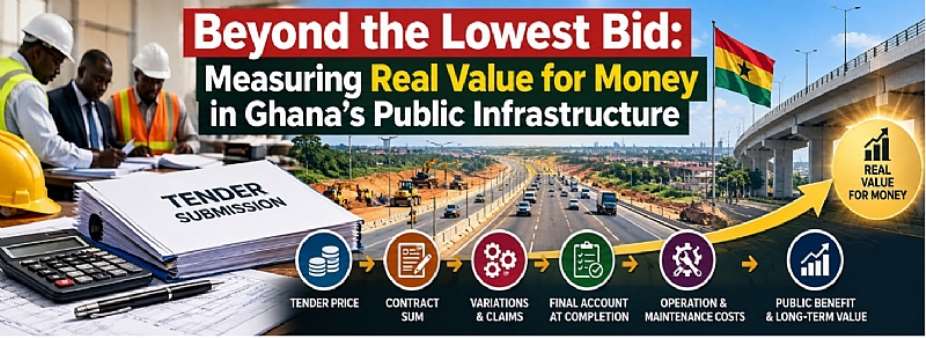
Ghana’s procurement law rightly favours the lowest responsive evaluated tender. But the tender figure is only the opening line of a longer story. A quantity surveyor explains how public value should be measured, and what Ghana’s audit record shows about the gap between what the state pays and what it gets.
The number everyone remembers
Ask most Ghanaians what a road, a school block or a market complex “cost”, and they will quote one figure: the contract sum announced at the sod-cutting. It is used as shorthand for whether government spent wisely.
On its own, it is a poor measure of value.
This is not a criticism of competitive tendering, which remains one of Ghana’s most effective safeguards for open and honest public procurement. A tender price tells us what a contractor was willing to accept, at the time of bidding, to deliver a defined scope of work. It does not tell us whether that scope was properly defined, whether the work can be delivered at that price without shortcuts or later claims, what the finished asset will cost to run and maintain, or whether it will still be serving the public a decade from now.
The question is timely. The Value for Money Office Act, signed into law in May 2026, will subject contracts above a set threshold to scrutiny before they proceed. That is a welcome safeguard against inflated prices. But value for money is not settled at award; much of it is won or lost afterwards. So, is the cheapest tender always the best value for the public over the life of an asset? The honest answer is that it depends, and the only responsible way to answer it, project by project, is with evidence.
“Value for money is not settled at award; much of it is won or lost afterwards.”
What the procurement rule actually requires
Ghana’s Public Procurement Act, 2003 (Act 663), as amended by the Public Procurement (Amendment) Act, 2016 (Act 914), does not require a procuring entity to award a contract to whoever writes the smallest figure on the tender form. Section 59 directs award to the Lowest Responsive Evaluated Tenderer, an idea sometimes expressed as the Most Economically Advantageous Tender. A tender must first meet responsiveness and qualification requirements before its price counts in the final ranking, and the evaluated price may reflect adjustments disclosed in advance, not just the raw bid.
Much public frustration with “the lowest bidder” is really frustration with what happens after award. What no evaluation can fully screen out on award day is a contractor’s true delivery capacity, the completeness of the design that was priced, or the maintenance burden the winning design will impose. Those risks sit in implementation, which is where value for money is ultimately won or lost.
Follow the cost beyond the award
Follow one figure through a project’s life: tender price, contract sum, variations and claims, final account at completion, then operating, maintenance and renewal costs, and finally the public benefit the asset delivers. At each stage, the original figure can move. Sometimes there is good reason, such as an unforeseen ground condition; sometimes the scope was never properly defined; and sometimes payment and contract administration broke down.
This is the terrain quantity surveying exists to manage. Cost planning starts long before a tender is advertised, with a Bill of Quantities (BoQ) that should reflect a complete, buildable design. When bids arrive, the quantity surveyor looks beyond the bottom line, checking that rates are consistent, reflect current market prices, and that nothing critical has been priced at zero or omitted to make the total look attractive. During construction, the quantity surveyor values work done, prices variations and, at completion, reconciles the final account against the original contract sum.
At each step, the gap between “cheap to award” and “expensive to own” is either caught early or missed until an audit finds it years later. That is also why an unusually low bid deserves a second look. That means genuine scrutiny of whether the price is credible for the defined scope, not automatic rejection.
Cost, quality and time are also linked. An unrealistically compressed programme tends to produce delay claims, quality shortcuts or both. A price with little provision for testing and supervision may look attractive at tender and prove expensive once defects surface. The answer is not always to pay more. The objective is neither the cheapest nor the most expensive solution, but the contractually and technically appropriate one that delivers the required outcome at a defensible whole-life cost.
Roads illustrate the point, because pavement failure follows well-understood patterns. A pavement built to specification, with a properly compacted sub-base and adequate drainage, deteriorates gradually over its design life. Timely routine and periodic maintenance can extend that life for a fraction of the cost of reconstruction. A pavement built below what its traffic requires tends to fail early. The state then pays for reconstruction years early, on top of the original cost. This is a general engineering illustration, not a claim about any particular Ghanaian road.
What Ghana’s audit record shows
Ghana’s own audit evidence shows this is not hypothetical. The Auditor-General’s report on the public accounts of public boards, corporations and other statutory institutions for 2024 recorded contract irregularities of GH¢871.8 million. The largest share arose from unpaid interim payment certificates, which had accumulated GH¢615.9 million in outstanding interest liabilities. That interest added nothing to any asset; it was the cost of weak payment discipline after contracts had been signed. A project can be competitively tendered and still cost the state far more than its contract sum. The reason is not that the price was wrong, but that what came after the price was poorly managed.
“A project can be competitively tendered and still cost the state far more than its contract sum.”
A second report points the same way. The Auditor-General’s performance audit of capital projects funded through the District Development Facility (DDF) in 30 Metropolitan, Municipal and District Assemblies (MMDAs) was published in 2020. It found that government invested GH¢848.7 million in small-scale infrastructure through MMDAs between 2008 and 2018. Education facilities accounted for 40 per cent of projects, sanitation 15 per cent, and health 12 per cent. Ninety per cent of the DDF projects audited were completed on schedule. That was markedly better than projects funded through the District Assemblies Common Fund (DACF) and the GETFund. The Auditor-General attributed the difference largely to regular, timely payment of contractors.
The report also recommended that the Ministry of Local Government and Rural Development verify the rate and quality of works before payment; that Assemblies finish ongoing projects before starting new ones and budget for maintaining completed facilities; and that unapproved variations should not be paid for.
The finding is specific. It shows that the funding and payment mechanism behind a contract, and not just its award price, measurably affected whether projects were finished on time. It does not show that DDF projects were better value overall: the audit compared completion timeliness, not whole-life cost or quality.
Compliance is not the same as value
None of this argues for abandoning competitive tendering or the Lowest Responsive Evaluated Tenderer rule. That discipline, which prevents arbitrary awards, is worth protecting. A procuring entity may not lawfully reject the lowest responsive evaluated tender because an engineer or quantity surveyor privately prefers a higher bidder. Evaluation criteria must be set in advance, applied consistently, and never adjusted after tenders are opened.
What compliance does not do, and was never designed to do, is guarantee what happens after the contract is signed. That is the work of contract administration, supervision, payment discipline and asset management. Treating lawful process as proof of value for money is a persistent error, and it cuts both ways: it is as wrong to assume the lowest bidder must have cut corners as it is to assume competitive tendering alone guarantees a good outcome.
A practical value-for-money test
Value for money in public infrastructure is best judged across seven dimensions, which I describe as the QS Value-for-Money Framework:
- Price: Is the tender price commercially credible when checked against the estimate and market data?
- Scope: Does it correspond to a sufficiently defined design and BoQ? Poorly defined scope is where most later cost growth begins.
- Quality: Will the solution meet the specification and performance requirements it is priced against?
- Time: Can the project realistically be delivered within the programme, given the resources committed?
- Risk: What could materially change the final cost or outcome, and has that risk been identified and priced rather than ignored?
- Whole-life cost: What will the asset cost to operate, maintain and renew, not just to build?
- Outcome: Does the completed infrastructure deliver the public benefit it was commissioned for?
For any single procurement decision, these can be compressed into a quick 4C Test. Credibility: is the price, and the estimate behind it, credible for the scope? Compliance: does the process follow the legal framework? Cost: what is the expected whole-life cost, not just the contract sum? Consequence: what happens if quality, time, or performance assumptions prove wrong? An entity that can answer all four honestly is in a defensible position, whatever the tender price.
“The tender price is the opening line, not the conclusion.”
Certain warning signs should prompt closer review. These include a price well below a credible independent estimate without explanation; buried assumptions or exclusions that affect comparability; incomplete design information at tender; heavy reliance on variations after award; weak evidence of delivery capacity; and a low initial price paired with foreseeably high running costs. Each is a reason to look closer, not proof of wrongdoing.
What institutions should do:
To close the gap between acquisition price and lasting value, institutions should prioritise five things.
- Get the design and estimate right before tendering. Complete designs, professionally prepared estimates, current market-rate databases, and risk-based cost planning, rather than arbitrary contingencies, allow like-for-like comparison of bids.
- Evaluate transparently. Define criteria in advance, apply them consistently without post-tender adjustment, and build evaluation capacity within procuring entities.
- Manage the contract, not just the award. Approve variations before work proceeds, pay certified work on time, and track actual cost against the estimate and contract sum through to the final account.
- Think in whole-life terms. Use whole-life costing wherever the law permits, and monitor performance after completion, not only at handover.
- Join up the data. The Ghana Electronic Procurement System (GHANEPS) was introduced to bring greater transparency to tendering. The next step is to link procurement records with cost databases, digital BoQs and contract-performance and asset-management systems, so new tenders can be checked against how similar contracts performed. A digital system cannot make institutions act on what it records, but it removes a recurring excuse in audit findings: that nobody could establish what happened between award and final account.
Underpinning all five are stronger professional capacity across MMDAs and central agencies, and a culture that treats Auditor-General findings as inputs for improvement rather than criticism to be managed defensively. Completed projects should be reviewed against their original assumptions, and the lessons applied to the next.
What did the spending actually produce?
The lowest tender price will continue to matter in Ghanaian public procurement, and it should. Competitive, transparent evaluation remains one of the strongest defences against arbitrary spending. But price at award was never meant to be the whole story. Ghana’s own audit record shows what happens when it is treated as if it were, from unpaid certificates accruing interest to the payment discipline behind the DDF’s completion rates.
The real question is not simply what government paid to acquire an asset, but what public value that expenditure produced, and whether the evidence can show it. Quantity surveying exists, in large part, to answer that question honestly, bringing scope, quantities, rates, risk, variations, payment and lifecycle costs into one defensible picture of cost and value.
Between us, our careers run from district works departments, a regional contracts office and the procurement directorate of the Ministry of Roads and Highways to private-sector cost management and project administration. That experience teaches you to distrust any account of a project that stops at the award letter. The tender price is the opening line, not the conclusion. Whether it proved to be good value is a question only the finished asset, years into its working life, can answer, and only if someone keeps watching after the ribbon is cut.
ABOUT THE AUTHOR
Surv. Dr. Emmanuel Norgah Bukari is Chief Quantity Surveyor in the Procurement Directorate at Ghana's Ministry of Roads and Highways, and a Lecturer in Procurement and Supply Chain Management at KAAF University-Ghana. He specialises in and writes on public procurement governance, value for money in infrastructure, and construction contract administration in Ghana.
Surv. S. A. Razak Batong is a Quantity Surveyor and Director of Homeland Resources Ltd., Accra. He specialises in construction cost management, quantity surveying, and project administration, with professional interests in contract management, cost control, and value for money.
The views expressed are the authors’ own.

 21-year-old Ghanaian man stabbed to death in north London
 Another phone snatcher jailed 11 years in Ashaiman, marking second conviction in...
 Defeated NDC Central Regional Chairman blames former secretary, threatens legal ...
 Haruna Iddrisu urges AG, CID for prosecution of culpable persons in Obuasi SHTS ...
 24-hour economy is private sector-led, New Economy is US$10 billion government-l...
 Nana Kwasi breaks down in tears after reclaiming NDC Ashanti Regional chairmansh...
 Benjamin Danso unseats Ashie-Moore as NDC Greater Accra Regional Chairman
 Ghana to ratify three key AU financial institutions by 2027
 Catholic Bishops want full implementation of Kalba-Gbinyiri conflict report
 For Christ’s sake ‘cocaine economy’ label could damage Ghana’s reputation, put G...


