




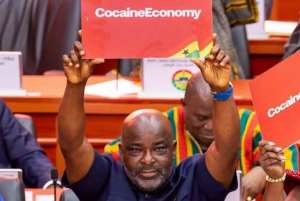
Security analyst Emmanuel Kutin has urged the Minority in Parliament to exercise restraint in describing Ghana as a “cocaine economy”, warning that such remarks could tarnish the country's international image and subject Ghanaian travellers to heightened scrutiny abroad.
He acknowledged the seriousness of the cocaine trade and the need for decisive action to address the problem but cautioned against language that suggests the country's entire economic system is sustained by proceeds from the illegal drug business.
His remarks followed the Minority's description of Ghana as a cocaine economy during discussions on the 2027 Budget Statement and Economic Policy presented by Finance Minister Dr Cassiel Ato Forson to Parliament on Thursday, November 12.
Mr Kutin said he was uncomfortable with the characterisation, arguing that the activities of private individuals and drug trafficking networks should not be equated with the country's broader economic operations.
“I was not happy in Parliament when the Minority decided to term our economy as a cocaine economy,” he said.
“For Christ’s sake, how does a cocaine business that private cartels or individuals are benefiting from benefit the economy?” he questioned.
He made the comments in an interview with Umaru Sanda Amadu on Channel One TV's The Big Issue on Saturday, November 14.
According to the security analyst, describing Ghana in such terms could have far-reaching consequences for citizens travelling internationally, potentially exposing them to more intensive screening and security monitoring.
“Do you know what it does to you when you travel? They will put more surveillance on you. They will put more checks on you. That is where we don’t want to get to,” he cautioned.
He called on political actors to place the country's collective interests above partisan considerations, stressing that the drug seizures should not become an opportunity for political parties to damage Ghana's reputation.
“Let’s be patriotic for once,” he appealed.
Mr Kutin further argued that political parties aspiring to govern the country had a responsibility to consider the international implications of their public statements, particularly at a time when Ghana needed to strengthen confidence in its institutions and reputation.
He warned against attempts by political opponents to portray the country negatively for electoral or partisan advantage.
“So for the fact that you are not in government and you want to take advantage of the situation to paint the country black, don’t forget this is an integrity issue,” he said.
He nevertheless maintained that the cocaine trade remained a serious national security concern requiring urgent attention, urging politicians to address the problem without resorting to descriptions that could unfairly discredit the country.
The debate comes amid renewed concerns about Ghana's links to international narcotics trafficking following a series of drug interceptions overseas involving consignments traced to the country.
One of the latest cases involved the seizure of 2.6 tonnes of cocaine concealed in a shipment of coconuts by Spanish authorities. Although the operation took place in August, details were made public in November.
 Ghana to ratify three key AU financial institutions by 2027
 Catholic Bishops want full implementation of Kalba-Gbinyiri conflict report
 For Christ’s sake ‘cocaine economy’ label could damage Ghana’s reputation, put G...
 Iran claims attack on US military airbase in Bahrain
 'Is this a cyberattack?' Grounded flights, a Microsoft outage and AI chaos fuel ...
 'No justice, no peace': Fifth round of protests sweep across France
 Netanyahu renews call for Israeli government unity as Eisenkot dismisses 'tricks...
 SpaceX's Starship set for return to Earth after failed booster catch
 Sir Sam Jonah appeals to Mahama for restoration of Acheampong's military rank of...
 Ukraine's relationship with NATO 'back on the table': Zelensky


