




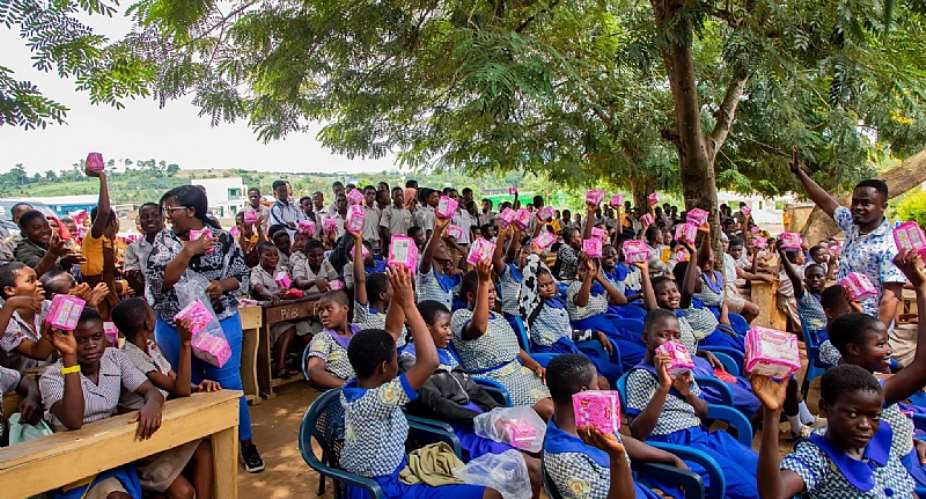
The Misplaced Priority of GH¢295 Million for Sanitary Pads
By Bala Ali
The government has spoken. In the 2027 budget, it has allocated GH¢295 million to purchase sanitary pads for school children. On the surface, it looks compassionate. It sounds like a policy for girls. But when you look deeper, it raises serious questions about priorities.
This country is not short of good intentions. We are short of good prioritization.
GH¢295 million is not small money. Anyone who understands industrialization will tell you that this same amount can build at least five modern sanitary pad factories in Ghana. If we had done that, we would have solved two problems at once. We would have produced pads locally and sustainably. We would have created permanent jobs for thousands of unemployed youth who roam the streets daily with certificates and no hope. Instead, we have chosen to import pads, share them for a term, and then return next year to budget another GH¢295 million to import again. That is not a solution. That is a cycle of dependency.
Meanwhile, the real crisis in our basic education stares at us. Travel to many rural communities and you will weep. Children wake up at dawn to cross dangerous rivers with their uniforms tied on their heads. Some walk over five kilometres on footpaths. When they finally arrive, they sit under trees or in dilapidated mud structures that we call classrooms. During the rains, lessons end. During the scorching sun, they cannot concentrate. Is this the environment where a sanitary pad will improve learning?
What about the teacher? We post young teachers to these places without accommodation, without electricity, without potable water. They have to improvise to teach. They write on cracked blackboards. They have no teaching aids. Yet we expect them to produce quality results. The GH¢295 million being used to buy pads could have built decent classroom blocks, provided dual desks, and constructed small teachers' bungalows to motivate them to stay.
The policy itself is flawed in its targeting. If we are honest, sanitary pads are not needed by every schoolgirl. Children of parents who live in Accra, Kumasi, and Takoradi and who attend well-endowed schools can already afford pads. Their parents buy them every month. Why should the taxpayer use scarce resources to give pads to children whose parents can afford them three times over? At the same time, the poor girl in a village in the Oti Region or Upper West who truly needs help does not only need a pad. She needs a safe classroom, a road to her school, and a teacher who is present.
We must ask whether this government has properly diagnosed the problem. The biggest barrier to girls' education in rural Ghana is not only menstruation. It is access, infrastructure, and poverty. If a girl has to cross a river that can drown her, a pad will not keep her in school. If her school has no toilet, no changing room, and no water, where will she change that pad we have given her? We are providing an answer to a question without first providing the environment that makes the answer useful.
There is also the question of sustainability and value for money. Who will procure these pads? At what unit price? How will they be distributed to every corner of Ghana without being diverted? We have seen many such free distribution policies collapse because of logistics and politicization. After a few months, the pads finish, the money is gone, and the girls are back to where they were. If we had built factories, the pads would be produced cheaply in Ghana, all year round.
No one is saying that menstrual hygiene is not important. It is very important. Every girl deserves dignity during her period. But dignity does not come from a handout that lasts for a day. Real dignity comes from building systems that work.
Therefore, the verdict is clear. This GH¢295 million allocation is a wrong priority. It is wasteful, it is not targeted, and it does not solve the structural problems of our education sector. The government may want to withdraw it and redirect the money into what will truly transform lives. Build five local sanitary pad factories to create jobs and ensure sustainable supply. Use the remainder to build classroom blocks, provide safe river crossings, and equip rural schools with water and toilets. That is how you keep a girl in school permanently, not by giving her a pad today and leaving her in a death trap tomorrow. If we fail to correct this mistake now, history will judge this decision as another expensive political gimmick that chose applause over impact.


 21-year-old Ghanaian man stabbed to death in north London
 Another phone snatcher jailed 11 years in Ashaiman, marking second conviction in...
 Defeated NDC Central Regional Chairman blames former secretary, threatens legal ...
 Haruna Iddrisu urges AG, CID for prosecution of culpable persons in Obuasi SHTS ...
 24-hour economy is private sector-led, New Economy is US$10 billion government-l...
 Nana Kwasi breaks down in tears after reclaiming NDC Ashanti Regional chairmansh...
 Benjamin Danso unseats Ashie-Moore as NDC Greater Accra Regional Chairman
 Ghana to ratify three key AU financial institutions by 2027
 Catholic Bishops want full implementation of Kalba-Gbinyiri conflict report
 For Christ’s sake ‘cocaine economy’ label could damage Ghana’s reputation, put G...


