




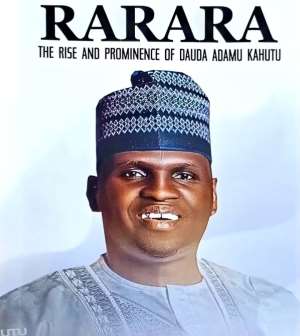
A new 516-page biography of Dauda Adamu Kahutu, known as Rarara, adds to the documentation of modern Hausa performing arts. The book, Rarara: The Rise and Prominence of Dauda Adamu Kahutu, is by Muttaqa Rabe Darma, Mukhtar El-Kasim, Bashir Usman Ruwangodia and Gambo Garba.
A reviewer who received a printed copy on Saturday, 14 November 2026, from Danjuma Katsina called it an excellent effort, though not a flawless one.
Katsina's culture of documentation
The reviewer praised Katsina's tradition of cataloguing its cultural history and noted that the state hosts some of northern Nigeria's most significant cultural interlocutors.
He said Katsina was first in almost everything, even if, in his view, Kano is where one goes to be the best. Rarara, he wrote, crafted a performance genre rather than creating it, since many came before him, and has earned a great deal of money from it over two decades. Whether he is the best is a matter of personal taste.
The research behind it
The book is heavily researched. The authors interviewed about 43 people from Kano to Zinder in Niger Republic, as well as contacts in Atlanta and London, by phone. The reviewer hopes those interviews were recorded for archives.
They also analysed about 196 of Rarara's songs by subject. Of these, 143 (about 73 percent) were classed as political, which fits Rarara's own description of himself as a political singer. The reviewer called this probably the largest collection of contemporary political songs in modern Hausa performance.
The book's roots may lie in a proposed first international conference on Rarara's songs. It was announced by Federal University Dutsin-Ma with Pleasant College of Advanced Studies for 2–9 October 2025. The reviewer said miscommunication scuttled the plan, with apologies issued. In his view, the conference's spirit went ahead in book form.
The reviewer's criticisms
Terminology: the authors repeatedly call Rarara a musician. The reviewer says he is a lyricist, songwriter and singer who, to his knowledge, plays no instrument. Studio session musicians compose his music on piano synthesizers.
References: the section says only that "some academic and quasi-academic literature" was used, a category the reviewer rejects.
Only five references are listed, each repeated twice, despite the book's scale. He expected university dissertations to have been consulted.
Index: it is good but excessive. "Hausa" and "Rarara" each have over 100 entries, and "Buhari" has dozens. An index should point to the most important passages.
Cover: it carries a large colour portrait but nothing to show what Rarara is prominent for, such as a stage image or microphone.
Photographs: many are poorly reproduced, and some are cropped so the subject is unclear despite captions. There are no stage performance shots and none from his early childhood. The images focus on his philanthropy and on him posing with prominent people, though the book is not about philanthropy.
What the book covers
According to the publisher's description, the book follows Rarara from his birth in Kahutu village in 1986, through Qur'anic schooling, farm work and village song, to his years in Kano as an almajiri. It then covers Kannywood and political anthems.
Later chapters cover his family, faith, philanthropy and place in Hausa society and Nigerian politics, drawing on more than 200 songs and many interviews.
The verdict
The reviewer had not read the whole book. He judged it an excellent effort to document one of the most visible voices in modern Hausa performance, and said Dr Darma and his team had done a very good job of cultural curating.
He urged that copies reach Hausa cultural repositories such as the University of Wisconsin in the US, SOAS in London, Cologne in Germany and Warsaw in Poland. He received his copy free. Interested readers are directed to the editors of Katsina Times and Katsina City News.
He also said a second post, on the companion book Mamman Shata Katsina: The Singer as an Oral Philosopher in Hausaland, will follow.
Mustapha Bature Sallama
Medical/ Science Communicator,
Private Investigator, Criminal Investigation and Intelligence Analysis,
International Conflict Management and Peacebuilding. (USIP)
[email protected]
+233555275880
References and sources
Reviewer's post on Rarara: The Rise and Prominence of Dauda Adamu Kahutu (15 November 2026). Abdullah Uba Adamu
Muttaqa Rabe Darma, Mukhtar El-Kasim, Bashir Usman Ruwangodia and Gambo Garba, Rarara: The Rise and Prominence of Dauda Adamu Kahutu (516 pp.), including its publisher's blurb.
Mamman Shata Katsina: The Singer as an Oral Philosopher in Hausaland, the companion title named by the reviewer.
Sahara Reporters, "Nigerian Federal University in Katsina hosts int'l conference, invites scholarly papers" (9 July 2025), on the planned FUDMA conference.
"Rarara's Invective Barbs: Innuendoes, Body Shaming, and Kano Politics," the monograph the reviewer cites. PRNigeria published it on 7 April 2023 under Abdalla Uba Adamu. The title matches the review, but the review does not name its author. Confirm before crediting. (prnigeria)
Credits
Dr Muttaqa Rabe Darma and co-authors: for the research and documentation.
Danjuma Katsina: for gifting the printed copy to the reviewer.
Katsina Times / Katsina City News: named as the contact for copies.
The reviewer: the observations and opinions summarised here are his.
Federal University Dutsin-Ma and Pleasant College of Advanced Studies: organisers of the proposed 2025 conference.


 21-year-old Ghanaian man stabbed to death in north London
 Another phone snatcher jailed 11 years in Ashaiman, marking second conviction in...
 Defeated NDC Central Regional Chairman blames former secretary, threatens legal ...
 Haruna Iddrisu urges AG, CID for prosecution of culpable persons in Obuasi SHTS ...
 24-hour economy is private sector-led, New Economy is US$10 billion government-l...
 Nana Kwasi breaks down in tears after reclaiming NDC Ashanti Regional chairmansh...
 Benjamin Danso unseats Ashie-Moore as NDC Greater Accra Regional Chairman
 Ghana to ratify three key AU financial institutions by 2027
 Catholic Bishops want full implementation of Kalba-Gbinyiri conflict report
 For Christ’s sake ‘cocaine economy’ label could damage Ghana’s reputation, put G...


