




Author's note: This is analysis based on reporting from BBC, AFP, Africanews, and AFRICOM's briefing on 10 November 2026. Quotes attributed to Brennan and Langley are from their public briefings and Senate testimony. Interpretations are mine.
United States Of America (US) Warned Madagascar: Do Not Copy The Sahel
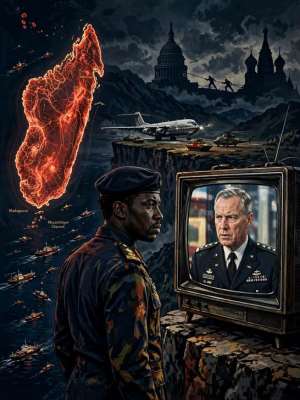
On 10 November 2026, Lt. Gen. John Brennan of AFRICOM did not call Moscow. He called a press briefing about Antananarivo. That choice tells you more about the new world than any speech from Washington.
- What Happened, In Plain English
Between 1 and 8 November, a US delegation visited Madagascar and Mozambique. On 10 November, Brennan briefed journalists online.
His message was simple: Do not copy the Sahel.
Mali, Burkina Faso, and Niger — all under military rule — kicked out France, distanced themselves from ECOWAS, and brought in Russia. They got weapons. They got Africa Corps instructors. They did not get security. Jihadist attacks did not stop.
Brennan said Russia wants to bring that same model to Madagascar and Mozambique. He said Russia's real motives are to control natural resources, predate on the population, and infringe on sovereignty. He said Madagascar sits on one of the most important waterways on earth — the Mozambique Channel — and America does not want that model applied there.
He also said, almost as an aside: partners are "free to partner with whom they wish".
Free. But warned.
That is multipolarity in one sentence. But let us be honest about what Brennan was really doing. He was not trying to prevent a pivot. The pivot has already happened. He was trying to slow one that is already moving.
2. Who Is Randrianirina? And How Far Has The Deal Already Gone?
Do not make Madagascar stupid in this story. And do not make its leader a simple junta general.
Col. Michaël Randrianirina came to power in October 2025, after weeks of Gen Z protests over water, electricity, and corruption. President Andry Rajoelina fled. The elite CAPSAT unit switched sides. The High Constitutional Court declared the presidency vacant and handed power to Randrianirina.
Analysts now call it a "coupvolution" — a popular revolution culminating in a coup. The African Union suspended Madagascar for unconstitutional change. SADC did not suspend it, arguing power was handed over, not simply seized.
That origin matters. Randrianirina is not just a Sahel general. He came to power on a popular revolt that even Western capitals sympathized with at first. That is why he can claim legitimacy at home.
And Russia does not lecture. Russia sends a plane — and then it sends hardware.
In one of Randrianirina's first official visits after taking power, he flew to Moscow in February 2026 on a plane chartered by Russia to meet Putin. That was not just another diplomatic visit. It was the first official visit to Russia by a Malagasy leader in nearly 50 years. He went again in October 2026 for the Russia-Africa Summit, where defence, trade and tourism deals were discussed.
This is not a warning about a future flirtation. Moscow has already delivered weapons, military equipment including BMP-3 infantry fighting vehicles and Mi-8 helicopters, and Africa Corps instructors are already in the picture. Signed cooperation agreements covering defence, trade and tourism are already on the table.
That detail matters because it shows Madagascar has already broken, decisively, from France and from the old Western orbit. Washington is not arriving early. Washington is arriving late, to an island that has already chosen a new patron — or at least, a new bargaining chip.
Russia offers what the West will not offer to a military ruler: weapons now, instructors now, no human rights lecture, no election timetable, no governance workshop. For a man who took power by force, that is a very good deal.
Madagascar is not choosing Russia because it loves Russia. Madagascar is choosing Russia because Russia is the only great power that does not make it beg for legitimacy.
That is multipolarity from below. Not from Moscow or Washington. From Antananarivo.
3. What Brennan Also Said — The Part Most Reports Missed
Brennan did not only warn. He also offered.
In the same visit, the US offered expanded cooperation: more joint exercises, maritime security help, intelligence sharing, and support against the ISIS-linked insurgency in Cabo Delgado, Mozambique.
That matters. America is not only lecturing. America is bidding.
The US is saying: Stay with us, and we will help you patrol the Channel, train your navy, share intelligence. Go with Russia, and you take the risk alone.
That is more multipolar than a simple warning. It is a competition. Two offers on the table. One from Washington, one from Moscow. Madagascar is not being told what to do. Madagascar is being courted — and warned at the same time.
Do not miss that. The warning is louder in headlines. The offer is quieter, but it is the real contest.
4. The Precedent: Langley Squared Off With Traoré — And Lost The Street
Brennan did not invent this playbook. His predecessor did. And it backfired.
On 3 April 2025, Gen. Michael Langley — then Commander of AFRICOM — sat before the US Senate Armed Services Committee and, answering a question about corruption and China, said this about Burkina Faso's Capt. Ibrahim Traoré:
"Captain [Ibrahim] Traoré in Burkina Faso... their gold reserves are just in exchange to protect the junta regime."
No evidence was offered. No documents. No proof. Just a four-star general, on the record, telling the US Senate that an African leader was stealing his country's gold to protect himself.
Traoré's government replied within days, calling the remarks "regrettable" and "gravely inaccurate". Traoré himself answered in an interview: "First of all, it's Burkina Faso's gold. It's not his gold. What is his business?"
That answer went viral.
On 30 April 2025, thousands marched in Ouagadougou, Accra, Lagos, Johannesburg, London, Paris, and New York — not for Langley, but for Traoré. Pan-Africanists, students, diaspora, even people who had never heard of Burkina Faso's mining code, took to the street to defend a 37-year-old captain they had never met.
Why? Because Langley did what Brennan has now done to Madagascar: he warned Africa about Africa, in Washington, to an American audience, without proof.
And Africa heard something else entirely. Africa heard: America thinks it can still decide who is corrupt, who is legitimate, who gets to keep his gold.
Langley thought he was calling out a junta. What he actually did was hand Traoré a bigger stage to play hero on.
Traoré was already pivoting to Russia. He had kicked out France in 2023. He had brought in Wagner / Africa Corps. He had nationalised gold before Langley ever spoke. Langley did not create the pivot. He amplified it.
That does not mean Traoré has delivered security. Attacks have continued. The gold has not yet fed the people. Journalists have been arrested, civil society has been squeezed, and Burkina Faso remains one of the most violent places on earth. Cheering for Traoré in the street is not the same as living under his rule. We must tell that truth too, or we are not Pan-Africanists, we are just fans.
Traoré went to Moscow in May 2025, met Putin, asked for relations to grow "exponentially." Around the same time, Burkina Faso granted a mining lease to Russia's Nordgold. The warning did not stop the pivot. It gave the pivot a crowd.
That is the lesson Brennan should have learned before he warned Madagascar.
When an AFRICOM general warns an African leader in public, he does not weaken that leader at home. He strengthens him. He gives him a villain, a story, and a crowd.
Langley squared off with Traoré and lost the street. Brennan is now squaring off with Randrianirina — and risking the exact same result, in the exact same way, in the exact same language.
Madagascar is not Burkina Faso. Randrianirina is not Traoré. But the script is identical.
5. How The Langley Story Connects Directly To Madagascar
In Washington's mind, Traoré is the cautionary tale: a young captain who nationalised gold, kicked out France, brought in Russia, and became untouchable at home because America attacked him in public.
In Antananarivo's mind, Traoré is the instruction manual: a young captain who stood up to AFRICOM, kept his gold, went to Moscow, and got cheered across the continent for it.
Same man. Same story. Two opposite lessons.
That is why Brennan's warning is so dangerous for America. He is not talking to Randrianirina in a private room. He is talking about Randrianirina on a public Zoom, to journalists, knowing it will be clipped, translated, and posted on TikTok in Antananarivo within the hour.
Randrianirina does not need to invent a response. Traoré already wrote it for him: "It's Madagascar's nickel. It's not his nickel. What is his business?"
And the Malagasy street does not need to invent a protest. The Burkinabè street already showed them how.
This is the loop AFRICOM keeps creating: Warn publicly → African leader answers back → African street cheers the leader → Leader goes to Moscow to prove he is not afraid → America warns the next country even louder.
Langley started the loop in Burkina Faso in April 2025. Brennan is continuing it in Madagascar in November 2026.
Madagascar is not the first episode. Madagascar is Season 2.
Different island. Different history. Different enemy. But same American reflex.
6. Why Can't America Just Warn Russia?
This is the question every African in the comments is asking. And it is the right question. But it misunderstands how power works now. America cannot warn Russia because Russia is not asking for America's permission.
Think about it like this:
"You warn the child, not the bully, when you pay the child's school fees".
America is not talking to Russia as a partner. It is talking to Madagascar as a client it thinks it can still lose.
Russia does not need US aid. Russia does not need US visas. Russia does not need AFRICOM training. Russia does not sit in Washington begging for a meeting. So a US warning to Russia would be theatre. Putin would laugh. Nothing would change.
Madagascar does need things. It needs AGOA trade access. It needs IMF loans. It needs World Bank money for water, roads, health. It needs US goodwill at the UN. It needs not to be labelled a pariah junta.
So America warns the one it can pressure, not the one it cannot control. That is not fairness. That is leverage. And leverage is the whole game in a multipolar world.
The old world was unipolar: America told everyone what to do, and everyone obeyed or was sanctioned. The new world is multipolar: America, China, Russia, EU, Gulf, India — all offering deals, all competing. But the competition is not equal. America still controls the dollar, the SWIFT system, the IMF vote, the AGOA list. Russia controls guns and Africa Corps instructors, and a willingness to work with juntas no one else will touch.
So America warns Madagascar because Madagascar is the swing state. Russia is already decided.
7. Why The Mozambique Channel Changes Everything?
Brennan did not talk about Madagascar because he cares about lemurs. He talked about the Channel.
The Mozambique Channel is the waterway between Madagascar and Mozambique. It carries a huge share of global trade, oil, gas, and container shipping between Asia, the Middle East, and Europe. Since the Middle East war forced shipping to reroute, the Channel has become even more important, with rising traffic and rising security worry. If you control the Channel, you can watch — or choke — the world's trade.
This is the precise shape of the American fear, and we must not miss it. Brennan did not just say Russia is bad. He said the Sahel model itself fails on its own terms. It does not improve stability. It does not stop the attacks. But it does let Moscow control resources, prey on populations and erode sovereignty. And he tied that failure directly to geography.
Mozambique has gas. Madagascar has nickel, cobalt, vanilla, rare earths, and a coastline that looks straight at the Indian Ocean. China is already in Mozambique building ports. India is watching. France still thinks Madagascar is its backyard. The US has Diego Garcia not far away.
If Russia gets a base, or a listening post, or just friendly ports in Madagascar, America loses eyes on the Channel. That is why Brennan said "extremely important." He was not being poetic. He was being geographic.
Put those two together and the warning stops sounding like a lecture about democracy and starts sounding like what it is: a fight over a chokepoint, over who gets to watch, guard, or choke the trade that passes between Asia, the Middle East and Europe, and over whether an island that has just changed its government will now change its patron too.
In the old Cold War, Africa was a chessboard. In the new Cold War, Africa is the board, the pieces, and the players — all at once. Madagascar is not a pawn. Madagascar is a port.
8. The Meaning: Sovereignty Is Now A Marketplace
Here is the meaning of 10 November:
Sovereignty is no longer given by the West. It is bought, sold, and auctioned.
In the unipolar world, sovereignty meant: Do what Washington says, and we will call you legitimate. Disobey, and we will call you a junta, a dictator, a pariah.
In the multipolar world, sovereignty means: If Washington calls you a junta, you call Moscow. If Moscow exploits you, you call Beijing. If Beijing indebts you, you call the Gulf. If the Gulf lectures you, you call Washington again.
Madagascar is doing exactly that. It is shopping for sovereignty.
Is that good? Not necessarily. The Sahel shows the risk. Mali, Niger, Burkina Faso traded French paternalism for Russian protection. They got new partners, not freedom. The attacks did not stop. They still have poverty. They still have juntas that have not left.
But is it understandable? Completely. When the West says "you are free to partner with whom you wish" and then warns you in public the next day, Africans hear the old language: You are free to choose us.
That is why Brennan's warning risks backfiring in parts of Africa. Not because Africans love Russia. Because Africans hate being warned like children. And because they have already seen what happens when an AFRICOM general warns a young captain: the captain gets stronger.
Pan-Africanism was never about loving Moscow or hating Washington. It was about this one thing: Africa deciding for Africa. Nkrumah said it. Lumumba died for it. Sankara lived it. Traoré is shouting it. Randrianirina, whether he knows it or not, is now testing it on an island.
- The Implications: Three Risks To Watch
a). A public warning makes a public climb-down harder.
As of 13 November, Madagascar has not publicly responded to Brennan. If history is a guide, a leader who has just been warned on TV is less likely to be seen to obey that warning at home. The risk is that the warning accelerates what it was meant to prevent — exactly as it did with Traoré.
b). The risk for Antananarivo may not be a sanction tomorrow, but slow punishment through paperwork.
No sanctions have been announced. But the risk is in the quiet places: AGOA reviews, IMF assessments, visa approvals, invitations to the next US-Africa summit. America does not always sanction with press releases. Sometimes it sanctions with paperwork.
c). The Sahel model will be tested in the Indian Ocean.
If Africa Corps fails in Madagascar like it has struggled in Mali — more attacks, more extraction, less security — then multipolarity will have a cautionary tale. If it succeeds, even briefly, then Mozambique, Comoros, and others may copy it. The Channel could become the new Sahel.
10. The Question We Should Be Asking
So, why can't the US warn Russia instead of being unfair to Madagascar?
Because the US is not talking to Russia. It is talking to us.
It is telling Africa: You may be free, but you are not free to choose wrong.
And Africa is answering, in Madagascar, in Mali, in Niger, in Zimbabwe, in South Africa: We will decide what wrong is.
Langley taught Africa that answer in Burkina Faso. Brennan is now teaching it again in Madagascar.
That is multipolarity. Not a theory in a textbook. A general on Zoom, warning an island about a continent, while the island books its next flight to Moscow.
Madagascar is not the story. Madagascar is the mirror.
And in that mirror, America looks like an empire that still thinks it can warn the child and ignore the bully — and Africa looks like a continent that has remembered how to shop around, and to remember what happened the last time a general tried to warn one of its captains.
- Madondo (African Teacher)

 Sir Sam Jonah appeals to Mahama for restoration of Acheampong's military rank of...
 Macron says limiting Ukraine aid would pave way to 'another war'
 Ukraine's relationship with NATO 'back on the table': Zelensky
 Agriculture will be a national security priority under my government – Bawumia
 Galamsey damage accumulated over years cannot be reversed immediately – Kwesi Sc...
 Government must fulfil 25,000 public sector recruitment promise – Kpebu
 Ken Ofori-Atta did better in his first two years as Finance Minister than Ato Fo...
 Ato Forson must acknowledge previous governments' contributions to economic reco...
 November 14: Cedi sells at GHS12.35 on forex market, GHS11.70 on BoG interbank
 'I never imagined my father was a Nazi': Born in a German-run 'baby factory'


