




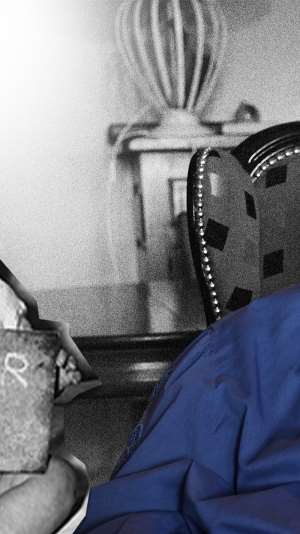
Adopted as a child, Édith Pagot had no idea she had been born in a Nazi-run Lebensborn (“fount of life”) maternity home until earlier this year, when her daughter began looking into their past.
“This photo is of a baby about 18 months old. It has my first name and surname on it,” says Édith, holding a black-and-white photo in her fingertips.
Until a few months ago, Édith had never seen a picture of herself as a baby. A photograph of Édith Pagot - when she was still known as de Vicar - in Indersdorf, Germany, at a former monastery and girls' boarding school that was converted in July 1945 into a children's centre following World War II.
“I look nice. I look very well-behaved,” she says, a little wistfully.
However, behind the image of the chubby-cheeked infant lies a dark story.
“It was taken at the Indersdorf orphanage in Germany in 1945. They photographed us holding a sign with our first names and surnames on it, to try to find our families," Édith says. "It's a bit difficult to see that sign,” she adds.
At the time, the baby girl in the picture was still called Édith de Vicar. It was the name under which she was born on April 11, 1944, in a Lebensborn home in France's Oise department, before a journey that would take her to Germany and then back to France. Photograph showing a child's baptism ceremony conducted by members of the SS at a Rhineland Lebensborn facility from between 1936 and 1944.
The Lebensborn project was created in 1935 with the aim of producing “perfect Aryan children”, according to the criteria of Adolf Hitler's regime.
“They were Nazi maternity facilities, and the man behind them was Heinrich Himmler. He wanted a 'pure race',” the 82-year-old explains. “There were French women who had affairs with Germans. That's how these babies came to be born.”
'I was never told anything else'
All her life, Édith was unaware of this painful chapter of her past. Placed with a couple in France's northeastern Lorraine region in 1948, she knew nothing of her origins.
“My adoptive parents told me right away that I'd been adopted, but nothing more. I asked several times, but I was never told anything else.”
With no answers, she simply imagined “a mother who had abandoned her”, without necessarily thinking of any connection with the war. She built her life around what was left unsaid, becoming a healthcare manager and the mother of two children herself, a boy and a girl.
Years later, her daughter decided to investigate.
“Ever since I learned she'd been adopted, I always wondered where she came from. So I asked Mum for permission to do some research,” says Émilie Ruffra, Édith's daughter, who also works in healthcare.
Watch more
The Lebensborn programme: When Nazi Germany sought to create an Aryan elite
One day, a friend told her about a book she had read. "Le Fardeau" (The Burden), by Matthieu Niango recounts his investigation into the past of his mother Gisèle, who was born in a Lebensborn home in Belgium. Émilie came across her own mother's birth name – the only information she had up until then – several times in the book.
“Through Matthieu's and his mother's stories, I discovered there were similarities with my own mother's story. So I contacted him in the spring of 2026, and he was the one who confirmed that Mum had also been born in a Lebensborn home.”
For Émilie, the discovery was a bombshell.
“It was difficult. It took me a little while to take it in, and certainly to accept it,” Émilie admits. “When I told Mum, I was afraid she'd hold it against me,” she adds.
For Édith, learning about the long-buried secret also came as a shock: “I'd never imagined my father was a Nazi.” Édith Pagot and her daughter Émilie at their home in Nancy on October 2, 2006.
From archive to archive
Despite the upheaval the discovery brought to the family, Émilie kept digging. She contacted the German archives and the local branch of the National Office for Veterans in the region where her mother had been placed with her adoptive parents. Little by little, piece by piece, she retraced her mother's path.
Édith was born in a manor house in the Lamorlaye commune of France, near Chantilly. It was there that the Nazis opened Westwald in February 1944, the only Lebensborn home on French soil. Around 10 such homes were set up in Germany, as well as in Norway, Poland, Denmark, Belgium, Luxembourg and the Netherlands. The Lamorlaye Manor in the Oise department, where Édith Pagot was born on April 11, 1944.
The racial origins of mothers who had relationships with SS officers were subjected to close scrutiny at these facilities, including genealogy and physical appearance. According to a report from French services in Germany and cited by journalist Boris Thiolay in his book, "Lebensborn, la fabrique des enfants parfaits" (Lebensborn: The Making of Perfect Children), “young women were admitted, at the father's request, six weeks before the due date and had to remain [at Lamorlaye] for six weeks after the birth to breastfeed their child. After that, they either had to sign a deed of abandonment in favour of the German authorities, or they agreed to leave for Germany.”
Twenty-three children were born at the facility in France. Nothing is known about Édith's mother, apart from the surname “de Vicar” and the fact that she was French. Her father's identity is a mystery, as is whether her mother had a love affair with a German soldier.
An identification card in the name of Édith de Vicar, issued in Indersdorf, stating that there is no information regarding her parents and that all documents have been destroyed.
“There are no documents. Everything was burned,” Émilie says.
A long journey home
As the Allies advanced and the Germans sensed the tide turning in the summer of 1944, the children at the Lamorlaye manor were taken to Germany. After a long journey, Édith arrived in April 1945 in Steinhöring, Bavaria, at the very first Lebensborn home the Nazis had created. After the war in Europe ended later that year, she was transferred in August to the refugee centre at Indersdorf, near Munich.
It was there that the photo of her was taken, along with footage shot by the United Nations Relief and Rehabilitation Administration, which provided aid in Europe after the Liberation. The little French orphan appears to be mischievous among other children her age, squabbling over a cake or a cuddly toy. Edith Pagot (on the right) with other children at the orphanage in Indersdorf, Germany.
But Édith's journey was not over. A year later, on August 5, 1946, she was finally repatriated to France, arriving in Commercy with about 10 other children. She has only a vague memory of that time: “I can see myself getting off a train, that's all.”
She and the other children were in poor health and were hospitalised for several weeks. They were also given new first names to erase their origins. Édith was now to be called Georgette. The French state also decided to change their places of birth: all of them were now recorded as having been born in Bar-le-Duc.
Two years later, after a stay with a foster family “where she felt happy”, the little girl was suddenly handed over to a childless couple. “I saw them once, and a month later they came back. My suitcase was packed and I left with them. It was hard.”
They formally adopted her in 1951 and decided to keep her original first name, Édith – a decision, she says, that continues to cause issues with routine administrative appointments in France.
“When I went to renew my identity card not long ago, they asked me whether I was actually Georgette.”
'Knowing where I come from'
By going through her mother's adoption file at the departmental archives, Émilie has been able to uncover new details and flesh out her timeline, but she has learned nothing more about the identity of her biological grandparents. With no other options, she has turned to DNA testing through a genealogy website.
“They confirmed that we have German ancestry. There are also matches with potential cousins. Will this reveal our origins and connect us with family? I don't know yet.”
Édith has let her daughter carry on the search. She understands her wish to know more but feels no “emotional need” to find her biological family. “What I mostly want is to understand what happened when my mother fled," she says. "Why was I abandoned?”
After months of intense investigation, Édith is shaken, but she also feels freed of a burden.
“It was hard to hear, but I'm not responsible for it, and I'd rather know where I come from,” she says.
'The story isn't complete'
Thanks to her daughter's research, Édith was able to meet Gisèle Niango, who arrived in Commercy on the same convoy in 1946. In an unlikely coincidene, both women live in Nancy.
“She's a year older than me. We've had the same life story. It's extraordinary. She now thinks of me as her sister.”
The two women speak on the phone regularly. They took part in commemorations in Commercy last October to mark the 80th anniversary of their return to France.
The experience has also brought Édith and Émilie closer.
“Mum has always been a strong, determined and courageous person. She amazes me. I really admire what she is still overcoming to this day,” Émilie says proudly.
In the meantime, mother and daughter continue to face the past together.
“The story isn't complete, because we're still missing a lot of pieces. But telling her story is already helping her a great deal, to accept the past and move on with her life.”
This article was translated from the original in French.


 Sir Sam Jonah appeals to Mahama for restoration of Acheampong's military rank of...
 Macron says limiting Ukraine aid would pave way to 'another war'
 Ukraine's relationship with NATO 'back on the table': Zelensky
 Agriculture will be a national security priority under my government – Bawumia
 Galamsey damage accumulated over years cannot be reversed immediately – Kwesi Sc...
 Government must fulfil 25,000 public sector recruitment promise – Kpebu
 Ken Ofori-Atta did better in his first two years as Finance Minister than Ato Fo...
 Ato Forson must acknowledge previous governments' contributions to economic reco...
 November 14: Cedi sells at GHS12.35 on forex market, GHS11.70 on BoG interbank
 'I never imagined my father was a Nazi': Born in a German-run 'baby factory'


