




A nation's money is more than a tool for buying kenkey and paying school fees. It is a small, folded declaration of who a people are and what they value. On Thursday, 12 November 2026, at Bank Square in Accra, President John Dramani Mahama unveiled the Bank of Ghana's new Heritage Series banknotes. Ghanaians were given a chance to look into their own wallets and see themselves.
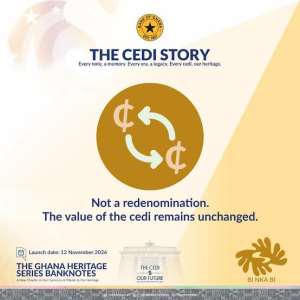
The facts deserve to be stated plainly, because rumour travels faster than any banknote. The Governor of the Bank of Ghana, Dr Johnson Pandit Asiama, has confirmed that the new notes enter circulation on 1 December 2026 through commercial banks. He has also stated clearly that the existing cedi notes remain legal tender and will circulate alongside the new series. Nobody needs to queue at a bank, and nobody needs to panic. This is also not a redenomination, so the value of your cedi does not change. The Bank has further confirmed that there will be no denomination above GH¢200 and no GH¢500 note.
Why now? The Governor has explained that the current designs have been in circulation for more than twenty years. In that time, technology has advanced, the way people handle cash has changed, and security standards have become far more demanding. A currency that stands still while counterfeiters learn new tricks is a currency that falls behind. The Bank's stated aims are enhanced security, improved durability and a modern design, under the theme "The Cedi, Our Future: Secure, Designed to Last." Any citizen who has handled a torn, soiled GH¢1 or GH¢2 note will understand why durability matters.
Now to the part that touches the heart. The series carries eight prominent Ghanaians on the front, paired with landmarks or scenes on the back, and each denomination is built around a theme. The GH¢1 note celebrates Commerce, with Agnes Oforiwa Tagoe-Quarcoopome and the market women who keep our economy breathing. The GH¢2 note speaks of Religious Freedom, through Cardinal Peter Dery and the Larabanga Mosque. The GH¢5 note honours Education through Dr James Emman Kwegyir Aggrey and Achimota School. The GH¢10 note stands for Justice and Equality, with Justice Annie Jiagge and the Supreme Court. The GH¢20 note salutes Arts and Entertainment through Dr Ephraim Amu and the National Theatre. The GH¢50 note carries Nationalism, with Theodosia Okoh, designer of our national flag, and the Jubilee House. The GH¢100 note carries Peace, with Kofi Annan and the training centre that bears his name. The GH¢200 note, the highest in the series, stands for Sovereignty, with Dr Kwame Nkrumah and his Memorial Park.
Look at that list again. A market woman, a cardinal, a schoolmaster, a judge, a composer, a flag designer, a global peacemaker and a founding president. Our money now tells a child that Ghana was built by traders, teachers, jurists, artists and believers as much as by politicians. A pupil handed a GH¢5 note can learn who Aggrey was. A child holding a GH¢50 note can learn who stitched our red, gold and green into a flag. Few classrooms teach this as effectively as a banknote that passes through a thousand hands a year. The Bank has added to this educational spirit by announcing a Cedi App to educate the public about the series and to assist persons with visual impairments, and by opening additional cash centres at its Ho and Tamale regional offices. Inclusion and reach of that kind are the marks of a central bank that remembers it serves every region.
I must also be honest about the debate, because honesty is the beginning of wisdom. Some of our compatriots have asked why only Dr Nkrumah, among the Big Six, appears on the new series, and some have appealed publicly for the others to be restored. This is a legitimate and patriotic conversation, and the sons of the soil who fought for independence will always deserve a place of honour in our memory. But a national debate about whom we honour is a sign of a living democracy, and it should be conducted with respect and facts. The Bank has said that its choices followed consultations with stakeholders. Let us keep asking questions, and let us ask them constructively. A currency can hold only so many faces, while a nation's gratitude has room for all of them. History books, monuments, school curricula and national days remain wide open for the heroes who are not on a note.
The timing also carries meaning. The Bank of Ghana marks its 70th anniversary on 4 March 2027. A central bank that reaches seventy by refreshing the national currency, rather than letting it grow old, shows institutional confidence. Confidence is the real raw material of any currency. Paper has no value except the trust placed in it, and trust grows when people feel the money is theirs, safe and truly Ghanaian.
What, then, is our duty as citizens? First, let us not spread panic or false information about the old notes. They are valid, and the central bank has said so repeatedly. Second, let us handle the new notes with care. Governor Asiama has described protecting the integrity of the cedi as a shared responsibility, and he is right. Third, let us learn the new series well, especially traders, drivers and market women, who handle more cash in a day than most officials see in a month. Fourth, let us insist that this exercise remains transparent, so that every pesewa spent on it can be accounted for to the people.
The cedi was born in 1965 as a symbol of sovereign pride, and it has weathered storms. This new series cannot, on its own, fix inflation or settle the exchange rate. Only sound economic management can do that, and we must keep demanding it. But identity and security are the foundation on which public trust is built, and the Heritage Series speaks to both.
So let us receive these notes with pride, confidence and a sense of ownership, as the Governor urged. Let us be educated by them and protect them. When the first crisp GH¢200 note reaches your hand on 1 December, pause for a moment and remember that a small piece of Ghana has been placed in your palm.


 Dangote Seeks Deal to Process 500,000 Tonnes of Ghana Cocoa Locally
 Portrait on new GH¢50 note was developed from Theodosia Okoh’s pictures, not her...
 Two Aduman SHS teachers remanded over alleged sodomy case involving two minors
 'What are the technical reasons for the new cedi notes?’ – Oppong Nkrumah questi...
 GES forwards 347 salary arrears cases of 2024 teacher recruits for payment
 No basis for rent increases in Ghana today – Kwakye Ofosu cites reduced building...
 2027 Budget: New Economy is ‘copy and paste’ of 24-hour policy – Amin Adam
 2027 Budget: Ato Forson contradicted himself on borrowing – Amin Adam
 Microsoft outage causes global chaos
 The Nvidia affair: Are markets about to fall out of love with AI?


