




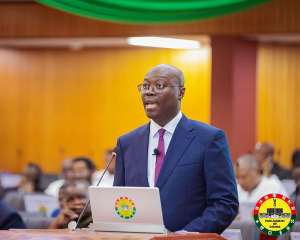
Finance Minister Dr Cassiel Ato Forson says Ghana's plan to establish a National Artificial Intelligence (AI) Centre is not intended to rival the technological capabilities of global leaders such as China and the United States, but to develop practical solutions to address the country's specific needs.
He said the government's immediate priority was to apply AI technology to sectors where it could improve service delivery and support professionals, particularly in healthcare.
“We don’t intend to challenge China or America, but we want to modestly have our own AI system,” Dr Forson said in an interview on the Citi Breakfast Show on Friday, November 13.
“The intention is to pay particular attention to certain models. Healthcare, for example. Doctors, for example, should be able to use artificial intelligence to assist them in their work, among other models,” he added.
His comments provide further insight into the government's vision for the proposed centre, which is expected to play a central role in expanding Ghana's technological capabilities and encouraging the use of emerging technologies across key sectors.
In the 2027 Budget presented to Parliament on Thursday, November 12, Dr Forson announced a US$300 million investment between 2027 and 2028 to establish the National AI Centre and upgrade rural 2G mobile networks to 4G connectivity.
The proposed facility will provide shared high-performance computing resources, secure data environments, applied research laboratories, model-testing infrastructure and professional training. It will also offer support to start-ups developing technology-based solutions.
The government expects the centre to make advanced technological resources accessible to local businesses, researchers, universities and public institutions that may not have the financial capacity to acquire such infrastructure independently.
Beyond healthcare, the Budget identifies agriculture, energy, mining, logistics, Ghanaian languages and public services as priority areas for developing AI applications.
The investment will also support skills development among young people, with training opportunities in software development, data analytics, artificial intelligence, computer networking and digital business services.
The initiative forms part of the government's four-year, US$10 billion economic transformation programme, dubbed The New Economy: New Ghana, Jobs and Prosperity, which is scheduled to run from 2027 to 2030.
The programme is expected to channel investment into eight priority sectors to boost production, strengthen domestic industries and expand employment opportunities.
Dr Forson's remarks indicate that Ghana's initial approach to artificial intelligence will centre on developing solutions tailored to local challenges and improving productivity across existing industries, rather than competing directly with established global technology powers.
 'Too early to discuss presidential bid’ – Dr. Ato Forson
 Ghana’s $250m AI centre to focus on practical applications; not competing US, Ch...
 'They did not even talk about the Women's Bank, where is it?' — Afenyo-Markin qu...
 Government to train over 2,000 scientists for Ghana's nuclear power programme – ...
 Elderly man reportedly apprehended by residents in Koforidua after travelling fr...
 ‘We are living within our means’ – Finance Minister defends no-new-taxes for 202...
 Global Microsoft outage knocks out Outlook and other services
 Govt to introduce Natural Resource Management Act to replace Petroleum Revenue M...
 In haste and hate to remove the Big Six, NDC used wrong image of Theodosia Okoh ...
 Disgraced Nvidia ex-CEO Jensen Huang to testify before US Congress


