




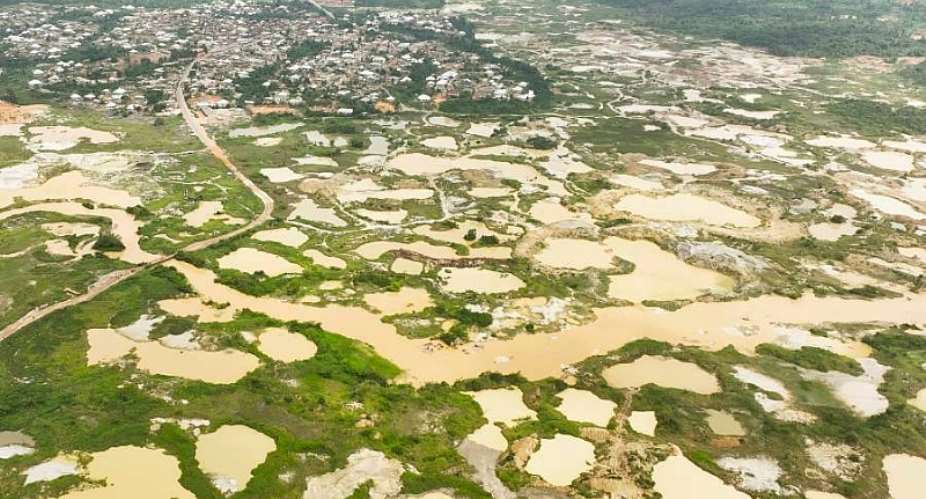
Ghana risks importing potable water as rivers face increasing pollution from mercury used in artisanal and small-scale mining, with miners struggling to afford mercury-free gold processing equipment.
Experts say that despite the Government commissioning about 100 mercury-free gold processing machines in June 2022, their adoption remains limited because many miners cannot afford the equipment, procured at US$113,000 each under a work-and-pay arrangement.
At a symposium organised by the U.S. Embassy in Accra, on behalf of the Regional Environment, Science, Technology and Health Hub for West and Central Africa, under the Ambassador's Water Experts Programme (AWEP), speakers called for a paradigm shift to address the challenge.
The two-day forum, which ended on Wednesday, brought together government officials, academia, civil society, development partners and private-sector representatives to discuss immediate measures to reduce mercury use and promote sustainable mining in Ghana.
A mercury-free gold catcher is a device that uses water to wash away sand and trap heavier gold particles from crushed ore without the use of mercury. It helps protect miners’ health, prevents toxic vapour emissions and water pollution, and enables miners to recover gold without exposing themselves and the environment to mercury.
The Minerals Commission has indicated that the Government spent US$10 million to procure the 100 mercury-free gold extraction machines for small-scale miners as part of efforts to promote responsible mining and environmental stewardship.
However, experts say the adoption of the technology has stalled across the country’s major gold-producing areas, despite the significant investment, threatening rivers and posing other environmental and public health risks.
They warned that without urgent intervention to address mercury pollution, communities in several mining areas, particularly Tarkwa and its environs, could be forced to import safe drinking water within the next two years.
Dr Sylvester Akpah, Chief Executive Officer of Smart Innovation Ghana Limited, said during a research presentation at the symposium that between 42.5 and 62 tonnes of mercury were used annually in Ghana’s artisanal and small-scale mining sector.
He said the sector, which supported more than 2.5 million people directly and indirectly, obtained most of its mercury through illicit imports that bypassed port controls.
He also noted that Ghana did not manufacture any of the mercury-free gold processing machines locally.
“The impact is already severe in the Western, Ashanti, Eastern, Central, Upper East and Upper West regions, where most of Ghana’s gold is mined and where water bodies have been heavily polluted,” Dr Akpah said.
“In the next one or two years, probably we will need to start importing water into Tarkwa. Everything is getting (polluted). It is very, very severe,” he said, calling for affordable access to the machines, practical demonstrations and effective enforcement of their use.
Professor Daniel Nukpezah of the Institute for Environment and Sanitation Studies (IESS), University of Ghana, explained why mercury pollution persisted, noting that the toxic substance did not break down but moved between the air, water, soil and living organisms.
He said bacteria in sediments converted mercury into methylmercury, which accumulated along the food chain, moving from phytoplankton to zooplankton, then to fish and eventually to humans who consumed the fish.
Prolonged exposure to the substance, he said, could damage the kidneys, lungs and brain.
He explained that wider adoption of mercury-free gold catchers could reduce mercury use, limit contamination of rivers such as the Pra, protect fish and food safety, and reduce the health burden on mining communities while preserving small-scale mining as an important source of livelihoods.
Prof. Nukpezah also called for capacity building to enable Ghanaian artisans to fabricate and repair the machines, alongside community-led education involving traditional leaders, queen mothers and miner associations.
He further stressed the need for effective enforcement of the Minamata Convention on Mercury.
“After ratification, enforcement has become a challenge,” Dr Akpah said, adding that banning mercury without providing viable alternatives could drive its use underground, while providing alternatives without enforcement would leave miners relying on the cheaper option.
Prof. Nukpezah reiterated that the main challenge was not the effectiveness of the technology but miners’ inability to afford it, their lack of confidence in its performance and the difficulty of repairing the machines when they broke down.
“There are challenges for the miners to adopt the gold catchers due to certain things that probably I might not be able to say,” he told participants, pointing to a combination of cost, established practices, trust and local dynamics.
Mercury remains relatively cheap, familiar and fast to use, while a new device presents uncertainties for miners who know how much gold they can recover using mercury but are unsure whether the gold catcher will deliver comparable returns, require more water or need spare parts that are not readily available locally.
He therefore called for measures to remove the financial barriers through subsidies, hire-purchase arrangements and cooperative ownership schemes.
He also recommended combining the distribution of the machines with practical demonstrations that would allow miners to compare the gold recovered using the mercury-free technology with that obtained through conventional mercury-based methods.
Such demonstrations, he said, should involve miners testing both methods side by side and publicly weighing the gold recovered to build confidence in the alternative technology.
He emphasised that until the gold catchers became affordable, reliable and readily available, they would remain a promising technology with limited adoption, while mercury continued to contaminate Ghana’s rivers, fish and human bodies.
GNA

 Ghana risks importing water as miners struggle to procure US$113,000 mercury-fre...
 Heritage Series: Here are prominent Ghanaian personalities featured on new Ghana...
 Akufo-Addo to lead ECOWAS election observer mission in Nigeria’s 2027 elections
 Justice Achibonga acquits Adu Boahen of two out of 11 charges
 Nvidia CEO Jensen Huang resigns after affair raises national security concerns
 Two Aduman SHS teachers arrested, interdicted over alleged sexual assault agains...
 Roads Minister directs establishment of bitumen testing facilities in Accra, Ash...
 Mercy Ships surgeries are free; beware of fundraising scams – Health Ministry to...
 Publish El-Wak recruitment stampede probe report – Akosua Manu demands a year af...
 Ghana Immigration Service introduces six-month rotational transfers for officers


