




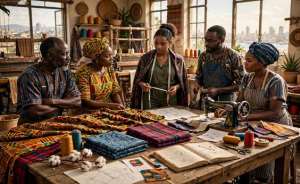
Africa is not poor in fashion. Africa is fashion. We have all seen the pattern: Ankara on a Paris runway. Kente on a global stage. Maasai beadwork on a Louis Vuitton bag. Adire on a European dress. The world is wearing Africa. Africa is not being paid. That is not influence. That is extraction dressed as appreciation [1][2].
The bleed is documented. Louis Vuitton’s Spring/Summer 2012 menswear included scarves and shirts described as inspired by the Maasai shuka, with no reported licence, consultation, or compensation [1]. Advocates estimate Maasai imagery is worth more than $10M a year in potential licensing value, while about 80% of Maasai people live below the poverty line with no documented benefit [2]. That is why the Maasai Intellectual Property Initiative was formed: if you use it, you licence it [3]. The same structure appears with Kente — but Kente now proves the blueprint can work.
Louis Vuitton’s Fall/Winter 2021 menswear under Virgil Abloh featured LV-monogrammed Kente-style cloth [2][4]. Abloh was Ghanaian-American, his father wore Kente, and he framed the collection as merging his Ghanaian heritage with Western tailoring. That heritage does not erase the licensing question: the collection was presented without a documented licence to Bonwire weavers, and without a fee paid under Ghana’s Copyright Act, 2005 (Act 690) for commercial use of folklore [2]. Mass-produced imitations then flooded markets and threatened Ghanaian artisans’ livelihoods [5].
Here is what changed: In 2021, there was no Geographical Indication for Kente. On 30 September 2025, Ghana got one.
Working with the Registrar-General’s Department and with technical assistance from WIPO, Ghana officially registered Kente as its first Geographical Indication [6]. Only cloth woven in defined communities — Bonwire, Adanwomase, Agotime-Kpetoe, Agbozume, Tafi Atome — using traditional methods may be marketed as authentic Kente [6]. In December 2024, UNESCO had already inscribed traditional Kente weaving as Intangible Cultural Heritage of Humanity [5][6].
That is the blueprint working. The question now is not whether Ghana can protect Kente. The question is whether Ghana will enforce it — and whether the rest of Africa will copy it.
Now the maths — with honest sources, not a shell game. Global apparel revenue was about _$1.79 trillion in 2024_, according to Statista [7]. UNESCO’s 2023 report, _The Fashion Sector in Africa_, finds Africa exports textiles worth _$15.5 billion_ a year and imports textiles, clothing and footwear worth _$23.1 billion_ a year [8]. UNESCO also confirms _37 out of 54 African countries produce cotton_ [8]. Separately, the Confederation of African Fashion (CAFA) estimates Africa’s fashion ecosystem at about _$60 billion_ and just _2% of the estimated $1.84 trillion global fashion ecosystem_, and is targeting $500 billion through coordinated policy and investment [9]. Those CAFA figures are estimates, not audited accounts — and CAFA itself has used different baselines in different announcements. Treat them as a target, not a fact.
We sell raw, we buy finished. We sell cotton, we buy shirts. We sell culture, we buy costume.
Thirty_seven (37) African countries produce cotton_ [8] — Mali, Burkina Faso, Benin, Zimbabwe, Egypt, Sudan, Tanzania, Uganda, Zambia, Malawi, Mozambique, Nigeria, Cameroon, Chad, Togo, Senegal, Côte d’Ivoire, and 20 more. Yet no African country sets the global price of cotton. The farmer gets cents. The factory gets dollars. The brand in Paris gets thousands. The African designer gets a screenshot.
It happens three ways. 1. Take the design, sell it back. A house sends a “research team” to Accra, Lagos, Dakar, Nairobi, copies the motif, changes one colour, calls it “inspired by.” No licence. No royalty. If an African copies a European brand, lawyers arrive in 24 hours. If a European brand copies an African village, it is called “a tribute.” 2. Keep the machines, leave us the hands. David Whitehead Textiles, once Zimbabwe’s biggest mill, collapsed in 2011 after judicial management since 2006 [10]. At its peak it produced about 20 million metres a year and employed 2,500 people. Cheap imports flooded the market, debt piled up, management failed, and the sector lost thousands of jobs. Government tried to revive it — $2 million via Zamco in 2018, a $20 million resuscitation plan announced in 2022 — but revival has not yet restored a functioning national mill [10]. Today a Harare designer must buy Ankara made in China because the African mill is dead. Our tailors sew 50 pieces by hand while a factory in Turkey makes 50,000 pieces of “African print.” Take a typical case: $40 to sew here, $400 to sell in Paris. She sees $40. They see $360. 3. Flood us with second-hand shame. Mitumba, okrika, bhero, bale clothes — used clothes dumped on Africa [8]. Yes, it clothes people today. But it kills the jobs that would let them afford new clothes tomorrow. How does a designer in Harare, Kampala, or Lusaka compete with a $0.20 T-shirt? She closes. The factory closes. The farmer stops growing. Then we import more.
For 30 years they told us: “We will give you a seat at the table.” A seat at Paris Fashion Week. A seat on a Vogue panel. A seat is not power. A seat is permission to beg politely while others eat. If you are given a seat, they can take it away. Africa does not need a seat. Africa needs to design the table: set the agenda, own the mill, own the IP, own the distribution, own the price. Inclusion says: Let me in. Ownership says: I built this.
LAGOS SHOWED THE SYMBOL. NOW WE BUILD THE SYSTEM.
That is what Design Africa means. Not a festival. A model — embodied by Design Week Lagos — to stop exporting raw materials, talent, and culture, and start exporting finished, branded, protected products made on the continent [11][12]. Under its 2026 theme, “Making a New Africa: From Material to Market,” it brings designers, weavers, manufacturers, buyers, banks, policymakers, and schools into one room and follows one journey: material → craftsmanship → prototyping → manufacturing → branding → market [11]. Artisans become co-designers and equity holders. Local manufacturing keeps jobs, skills, tax, and profit inside Africa. Heritage like Adire, Kente, and Shuka is protected by branding, licensing, and trade, not left open for imitation [11][12].
The Design Table founded and hosted by Chika Uwazie as an annual dinner during Lagos Fashion Week [13], and co-created with SoMe Solutions — led by Elizabeth Osho [14] — is that symbol in practice. It brings designers, investors, lawyers, editors, and founders together to fix Intellectual Property (IP), capital, distribution, and scale [13][14].
Let us be brutally honest about that symbol: *It is too early to judge it on deals.* There is no published deal-flow yet — no public record of how many hires, exports, or investments closed directly because of that dinner. The Design Table has also not published a public prize ledger as of November 2026. That is not a failure. That is a warning. A table without tracking is a party. A table with tracking is an industry.
If The Design Table publishes that ledger next year — who got funded, who got stocked, who got exported, who hired whom — it becomes a model. If it does not, it stays a dinner.
THE BLUEPRINT — STEP 0 FIRST, THEN 5 STEPS
This is no longer a complaint. This is a build plan. Copy it in Lagos, Accra, Nairobi, Johannesburg, Harare. Same table, different city.
STEP 0 — PROVE THE UNIT ECONOMICS IN 90 DAYS (BEFORE WE ASK FOR A DOLLAR
We do not yet have audited, Harare-specific cost-per-metre data. Saying otherwise would be lying to a bank. So Step 0 is: commission it.
What to commission: A 90-day, independent costing study for one Harare hub: cost per metre for (a) imported Ankara, (b) locally woven plain cloth, (c) locally dyed/printed cloth — including power (solar + generator + grid), labour, dye, transport, waste, and finance cost.
Owner: Designer cooperative + Ministry of Industry + one development bank as observer.
Deliverable: A 5-page public PDF: cost per metre, breakeven volume, payback period, jobs per $1M, default risk. No PDF, no pitch. No pitch, no mill.
Why this matters: A banker does not fund “margins exist.” A banker funds “Harare cloth costs $X per metre, imported costs $Y, breakeven is Z metres per month, payback is N months.” Until we have X, Y, Z, N, we are asking for faith, not finance.
1. ONE SHARED MILL PER HUB — THE BUSINESS CASE BANKS UNDERSTAND
Stop asking each designer to buy her own mill. Build one shared facility per hub: spinning, weaving, dye house, cutting, logistics. Multiple brands use it, pay per metre, share the cost.
Why a bank should care — _after_ Step 0: Textiles are labour-intensive manufacturing. A shared cut-and-sew hub creates direct jobs in sewing, dyeing, quality control, logistics, plus indirect jobs in cotton, transport, and retail — the exact number to be proven by Step 0. A hub that processes African cotton into African cloth captures the margin now lost to Asia and Turkey — the $360 in the $40 vs $400 illustrative case above. That is not charity. That is import substitution + export revenue + tax base. But we prove it with Step 0 numbers, not slogans.
Owner: Development bank + private investor + designer cooperative.
Target: 1 operational hub per country in 24 months _after_ Step 0. Publish: metres produced, jobs created, cost per metre vs imported Ankara.
Funders to invite: AfDB, Afreximbank, national development banks, pension funds. Pitch it as manufacturing, not culture.
2. ONE IP LEDGER — PROTECT THE PATTERN LIKE LAND, WITHOUT CREATING A NEW FIGHT INSIDE AFRICA
Ghana now has the model. Kente is a Geographical Indication (GI) [6]. Nigeria has copyright for folklore. But where is the enforced, collective licensing system that pays the Bonwire weaver when Kente is used in Paris? [2]
Build it — with one rule that prevents a new extraction:
THE COOPERATIVE RULE: Royalties go to registered cooperatives, not individuals, audited annually.
Kente is woven by Ashanti _and_ Ewe weavers. Adire is made by Yoruba women across Abeokuta, Ibadan, Osogbo. Ndebele beadwork is made by hundreds of women, not one designer. If we give the royalty to the loudest individual, we create a new fight inside Africa. If we give it to a registered cooperative — with a public member list, a public bank account, and an annual audit — the money reaches the hands that made it.
How it works: A national registry for Kente, Adire, Mudcloth, Aso Oke, Shuka, Ankara motifs, Ndebele geometry — who is in the cooperative, who can licence it, at what rate, how royalties are split (e.g. 70% to makers, 20% to cooperative operations, 10% to registry/legal defence). A standard 1-page licence: origin on label, fee paid, cooperative credited. No licence, no legal export of that motif for commercial use. Ghana’s Kente GI Book of Specifications — thread counts, loom types, traditional methods — is the template [6].
Owner: Ministry of Culture + IP Office + Weaver Cooperatives.
Target: AfCFTA cultural IP clause with teeth within 12 months. Publish: licences issued, royalties paid, infringements challenged.
Rule: If they want Kente, let them pay for Kente. If they want Adire, let them come to Abeokuta and negotiate.
3. ONE EXPORT-READY STANDARD — STOP LOSING ORDERS
Designers lose global orders not on talent, but on fit, labelling, barcoding, and delivery. Create an “Export-Ready” certification: standard fit blocks, proper labelling, barcoding, compliance, and delivery timelines — so any certified designer can plug into global retail without reinventing the factory floor.
Owner: Fashion councils + Standards Bureau + Logistics partners.
Target: 100 certified brands per hub in Year 1. Publish: orders fulfilled, return rate, repeat buyers.
4. ONE BUYER CONTRACT — STOP SELLING FOR EXPOSURE
No more “wear my dress for exposure.” The Design Table model must produce a standard buyer contract: minimum order, 50% deposit, payment terms, IP clause, origin clause. Buyers who sign get first access to certified brands. Brands who sign get working capital.
Owner: Fashion councils + Banks.
Target: Every Design Table dinner ends with signed LOIs, not just photos. Publish the number.
5. ONE HARARE TABLE — BECAUSE LAGOS IS NOT ENOUGH
This is where I stop reporting and start building. Lagos has cameras. Harare has cotton, weavers, tailors — and hours-long power cuts, a dead mill, and banks that do not understand fashion as manufacturing.
Harare’s table looks different, and it must:
Power first: A shared hub in Harare cannot run on hope. Solar + generator + dedicated industrial line, costed into the price per metre. If we do not solve power, we do not solve fashion. Step 0 must price power honestly.
Cotton to cloth, locally: Zimbabwe grows cotton. Partner with remaining ginneries and a revived small mill, not a mega-mill fantasy. Start with 1 weaving line, 1 dye house, 1 cutting room. Prove 10,000 metres, then scale.
Zimbabwean IP, under the Cooperative Rule: Register Shona stone patterns, Ndebele beadwork geometry, and local textile motifs under a cooperative licence — so a London brand cannot take Ndebele colour-blocking for free, and so no single Harare designer can privatise a communal pattern.
Zimbabwean buyers: Stop waiting for Paris. First buyers: Harare boutiques, South African retail, diaspora e-commerce. Prove local demand, then export.
Owner in Harare: Designer cooperative + local bank + City of Harare industrial park + Ministry of Industry. Not a conference. A hub with a roof, power, and a ledger.
If Lagos proves the symbol, Harare must prove the system works where power fails and banks are sceptical. If it works in Harare, it works anywhere in Africa.
CULTURE IS CAPITAL, NOT PERFORMANCE
Applause does not build factories. They want us dancing. They don't want us manufacturing. Fashion is oil without a well, gold without a mine. Treat it like industry and it will feed us like industry.
Own the full chain or own nothing. Cotton to cloth to cut to customer. If we only own the cut, we stay poor. Stop exporting talent, start exporting brands. Discovery is extraction. When our best leave, London, Paris, New York benefit. Lagos, Accra, Harare lose. Stay. Build here. Let the world come to us.
Africa wants $500 billion — CAFA’s target, not a confirmed reality [9]. Possible — only if we stop asking for seats. Build mills, not just mood boards. Write laws, not just captions. Publish ledgers, not just photos. Africa does not lack talent. Africa lacks ownership.
What must happen:
Designer: Register your pattern _through your cooperative_. Join a cooperative. Sign no contract without a deposit and an IP clause.
Buyer/Brand: Licence it. Pay the cooperative. Put origin on the label.
Government/Bank: Fund Step 0 first. Then fund one hub. Fund one dye house. Fund one ledger. Publish the jobs and the metres.
Consumer: Buy African-made, African-owned, even when it costs more. That price is the mill.
Organiser: Publish your deal-flow. How many funded? How many stocked? How many exported? No ledger, no scale.
The world has eaten from our table for 100 years while telling us we were not invited. Now we are designing our own table.
And this time, when they come, they will pay to sit — because we will have the mill, the licence, the contract, and the receipt to prove it.
Endnotes
1. Faris, Stephan. “Can a Tribe Sue for Copyright? The Maasai Want Royalties for Use of Their Name.” _Bloomberg Businessweek_, 24-25 Oct 2013. Confirms LV 2012 SS menswear included Maasai shuka-inspired scarves and shirts, and ∼10,000 companies using Maasai name.
2. Legal 500 / HGF. “Appropriation of culture v appreciation of culture.” Argues LV’s use of Maasai (2012) and Kente (2021) without authorisation/fee illustrates failure of current heritage protection; proposes GI and other IP tools. Cites Ghana’s Copyright Act, 2005 (Act 690) requiring fee for commercial use of folklore.
3. Mills & Reeve. “Maasai™? How the Maasai are seeking intellectual property rights.” MIPI, supported by Light Years IP, working to obtain licences, trademark rights, and authenticity for Maasai makers.
4. Okyere, E. & Denoncourt, J. “Protecting Ghana’s intellectual property rights in kente textiles: the case for Geographical Indications.” _Journal of Intellectual Property Law & Practice_. Argues GI is the appropriate IP tool to protect Kente as a communal, place-based textile.
5. Pulse Ghana. “Kente is Not a Costume: Cultural appropriation and the global spotlight” (Opinion, 29 May 2025). Notes mass-produced imitations threaten Ghanaian artisans’ livelihoods, and UNESCO inscription Dec 2024.
6. Nzuki, C. CIPIT Strathmore. “Ghana’s Kente Becomes a Geographical Indication” (26 Nov 2025); MyJoyOnline, “Ghana moves from legal victory to enforcement as Kente protections reshape global fashion.” Kente GI officially registered / launched 30 Sept 2025, La-Palm Royal Beach Hotel, Accra, with WIPO support. Covers Bonwire, Adanwomase, Agotime-Kpetoe, Agbozume, Tafi Atome. Book of Specifications codifies thread counts, loom types, traditional methods.
7. Statista, Apparel Market Worldwide Dossier (Dec 2025). Global apparel revenue ∼$1.79 trillion in 2024.
8. UNESCO. _The Fashion Sector in Africa: Trends, Challenges and Opportunities for Growth_ (2023), launched at Lagos Fashion Week. Africa exports textiles $15.5bn/year, imports textiles, clothing and footwear $23.1bn/year, 37 out of 54 countries produce cotton.
9. NAN / Radio Nigeria / FRCN. “FG, CAFA target $500bn African fashion industry growth” (6 Nov 2026, CANEX WKND Lagos). Federal Ministry of Art, Culture, Tourism and Creative Economy (FMACTCE) + CAFA pursuing reforms to grow Africa’s fashion industry from ∼$60bn to $500bn. CAFA: Africa accounts for only 2% of estimated $1.84 trillion global fashion ecosystem. _Note: CAFA estimates, not audited UNESCO figures. CAFA has used $30bn and $60bn baselines in different announcements._
10. Business Daily News Zimbabwe / NewsdzeZimbabwe / Zim Now. David Whitehead Textiles: under judicial management since 2006, collapsed 2011, ∼2,500 jobs, ∼20m metres/year at peak. Govt $2m injection via Zamco 2018 to resume operations; $20m resuscitation plan / new shareholder Agri Value Chain Zimbabwe announced 2022. Cheap imports cited as crippling the sector. _Note: Causes are synthesis from reporting, not a single source._
11. Design Week Lagos / EINPresswire. “Design Week Lagos 2026: 180 New Ideas and a New Vision for What Africa Makes Next” (13 Oct 2026). Theme “Making a New Africa: From Material to Market,” 18-25 Oct 2026, journey from raw material/craftsmanship through innovation, manufacturing, branding and market access.
12. Iroyin Yoruba Television. “Design Week Lagos 2026 Spotlights African Creativity and Industrial Opportunities” (25-26 Oct 2026).
13. ESSENCE. “Chika Uwazie Doesn’t Want You To Just Show Up To Lagos Fashion Week And Look Good: She Wants You To Invest In African Fashion” (29 Oct 2026). Uwazie founded Design Table, an exclusive annual dinner hosted during Lagos Fashion Week to turn interest into economic opportunity.
14. Uwazie, Chika. “Inside ESSENCE 55 Lagos: How The Design Table Merged Fashion, Culture, And Community” (6 Nov 2025). The Design Table, co-created by the Afropolitan Podcast and SoME during Lagos Fashion Week, convening designers, investors, media and policymakers.


 Ghana risks importing water as miners struggle to procure US$113,000 mercury-fre...
 Heritage Series: Here are prominent Ghanaian personalities featured on new Ghana...
 Akufo-Addo to lead ECOWAS election observer mission in Nigeria’s 2027 elections
 Justice Achibonga acquits Adu Boahen of two out of 11 charges
 Nvidia CEO Jensen Huang resigns after affair raises national security concerns
 Two Aduman SHS teachers arrested, interdicted over alleged sexual assault agains...
 Roads Minister directs establishment of bitumen testing facilities in Accra, Ash...
 Mercy Ships surgeries are free; beware of fundraising scams – Health Ministry to...
 Publish El-Wak recruitment stampede probe report – Akosua Manu demands a year af...
 Ghana Immigration Service introduces six-month rotational transfers for officers


