




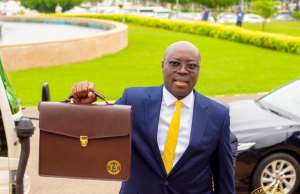
Finance Minister Dr Cassiel Ato Baah Forson is set to present the government's US$10 billion investment agenda to Parliament today, November 12, as part of the 2027 Budget Statement and Economic Policy, with attention focused on its financing arrangements and implications for Ghana's economic stability.
The budget presentation, scheduled for 1800 hours, is expected to provide details of the government's ambitious "New Economy" programme, which targets annual investments of approximately US$2.5 billion between 2027 and 2030.
The initiative is designed to accelerate domestic production, strengthen industrial capacity, create employment opportunities and position Ghana for sustained economic expansion.
Dr Forson will deliver the financial statement on the authority of President John Dramani Mahama, in accordance with Article 179 of the 1992 Constitution and the Public Financial Management Act, 2016 (Act 921).
The presentation comes at a critical stage in Ghana's economic recovery, following the completion of the country's three-year US$3 billion International Monetary Fund Extended Credit Facility programme.
Ghana has subsequently transitioned to a non-financing Policy Coordinating Instrument arrangement, signalling a shift towards investment-driven economic growth supported by domestic resources and private-sector participation.
Under the proposed New Economy programme, the government intends to channel investments into agriculture and agro-processing, manufacturing, infrastructure, energy, critical minerals and value addition.
Other targeted areas include textiles and garments, tourism, the creative economy and pharmaceutical manufacturing.
Dr Forson has indicated that the programme will prioritise expanding local production, increasing the processing of raw materials within Ghana and strengthening the ability of domestic businesses to compete in both local and international markets.
The government's investment proposals will be presented against a backdrop of improving economic indicators, with Ghana recording 6% economic growth in the second quarter of 2026.
Annual inflation also declined to 5.2% in September, reflecting an improvement in the country's macroeconomic conditions.
Despite these gains, developments in Ghana's external reserves remain a concern.
Figures from the Bank of Ghana indicate that gross international reserves declined from US$13.83 billion in December 2025 to US$11.07 billion in August 2026.
The reduction also saw the country's import cover fall from 5.7 months to 4.2 months over the same period.
Consequently, investors and financial market participants are expected to scrutinise the budget for clear indications of how the US$10 billion investment programme will be funded without undermining fiscal consolidation efforts.
Particular attention will be paid to the government's borrowing requirements, debt sustainability strategy and measures intended to attract private capital while preserving macroeconomic stability.
The budget is also expected to provide insight into how the administration intends to balance its development ambitions with expenditure controls and the need to maintain investor confidence.
Following its presentation, Parliament will undertake a detailed examination and debate of the government's fiscal proposals in the coming weeks.
A post-budget workshop has also been scheduled for Ho in the Volta Region as part of the parliamentary processes surrounding the 2027 financial statement.

 All six MDs under Akufo-Addo suffered instability, weakened operations – Managin...
 Minority seeks review of Speaker's ruling on presentation of 2027 Budget
 Police seize GH¢20m worth of counterfeit GTP fabrics smuggled from Nigeria
 Cedi strengthens at GH¢12.15 against major currencies as GoldBod boosts forex su...
 Bank of Ghana launches new currency notes today
 Ato Forson wants to present 2027 budget at 6pm when Ghanaians are asleep — Afeny...
 Ato Forson to unveil US$10billion ‘New Economy’ in 2027 budget today
 Mahama urges Thai investors to pursue 12,000-hectare oil palm project
 Ghana faces fresh scrutiny over cocaine trafficking after 2.6-tonne seizure in S...
 GES assures Funsi SHS students of action over water, electricity shortages


