




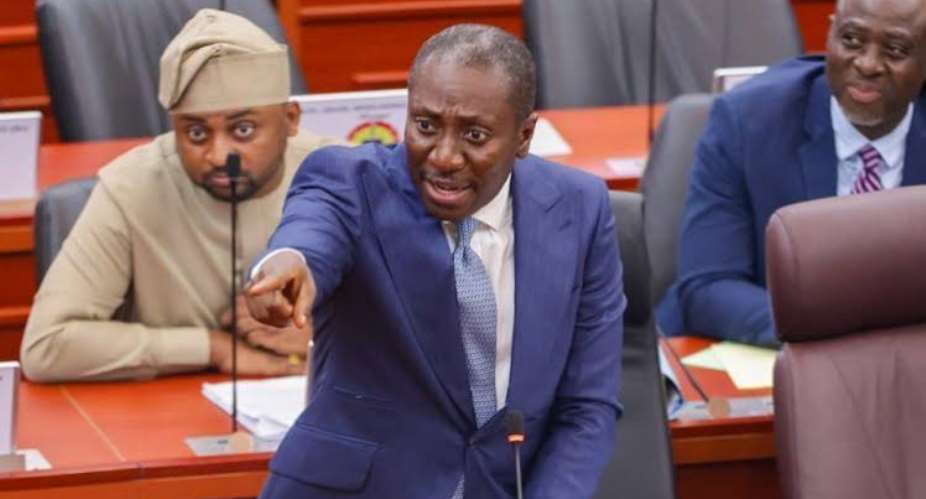
Minority Leader Alexander Afenyo-Markin has supported a private members' motion seeking a review of Speaker Alban Bagbin’s earlier ruling on the procedure for presenting the budget statement and economic policy to Parliament.
The motion, moved by the First Deputy Whip, Habib Iddrisu, challenges the Speaker's decision last year to allow the Finance Minister, Dr Cassiel Ato Forson, to present the budget before Parliament determines whether it should be debated as a statement or a motion.
The Minority Leadership maintains that the House must first decide the form in which the budget should be debated before the Finance Minister delivers the presentation, rather than making that determination afterwards.
Responding to the application, Speaker Bagbin sought clarification on the specific matter being raised, prompting Mr Iddrisu to interrupt on a point of order.
However, the Speaker was dissatisfied with the explanation provided by the Minority front bench and asked that the application be reconsidered and supported with additional particulars before it could be admitted for debate and a subsequent ruling.
Meanwhile, the 2027 Budget Statement and Economic Policy, themed "The New Economy", is scheduled to be presented to Parliament at 6 pm on Thursday, November 12.
Speaker Bagbin said the decision to hold the sitting in the evening followed a request from the Finance Minister, which he approved after being given compelling reasons.
The budget is expected to set out the government's economic priorities and policy direction, with emphasis on restructuring the economy, accelerating growth, creating jobs and improving living conditions.
Ahead of the presentation, the Director of the Institute of Statistical, Social and Economic Research (ISSER), Professor Robert Darko Osei, has called on the government to increase capital expenditure in the 2027 fiscal plan to support infrastructure development and improve business productivity.
Speaking on JoyNews' PM Express Business Edition, Professor Osei disclosed that capital expenditure fell more than 40% below its target in the first half of 2026, as the government reduced spending on projects to meet its fiscal consolidation objectives.
"We were down by the target by over 40 percent in terms of the capital expenditures, which clearly is not consistent with a big push to try and beef up infrastructure," he said.
He cautioned that relying heavily on cuts to capital spending to achieve fiscal targets could undermine the infrastructure needed to reduce operational costs for businesses.
According to him, the approach also runs counter to the government's US$9 billion New Economy programme for 2027–2030, which places emphasis on investment-led growth.
"We are not doing the infrastructure for the sake of infrastructure. We are doing the infrastructure to support the ecosystem within which businesses operate," he noted.
With the government operating under fiscal constraints and the requirements of its IMF programme, Professor Osei urged authorities to direct more of the fiscal space created through expenditure controls towards productive public investments.
He, however, stressed that increasing capital allocations must be accompanied by effective project supervision, accountability and value-for-money assessments to ensure that public funds deliver the intended results.
"It is not just the number of or the amount of cedis that we spend. It is also the efficiency of the spending," he stressed.

 All six MDs under Akufo-Addo suffered instability, weakened operations – Managin...
 Minority seeks review of Speaker's ruling on presentation of 2027 Budget
 Police seize GH¢20m worth of counterfeit GTP fabrics smuggled from Nigeria
 Cedi strengthens at GH¢12.15 against major currencies as GoldBod boosts forex su...
 Bank of Ghana launches new currency notes today
 Ato Forson wants to present 2027 budget at 6pm when Ghanaians are asleep — Afeny...
 Ato Forson to unveil US$10billion ‘New Economy’ in 2027 budget today
 Mahama urges Thai investors to pursue 12,000-hectare oil palm project
 Ghana faces fresh scrutiny over cocaine trafficking after 2.6-tonne seizure in S...
 GES assures Funsi SHS students of action over water, electricity shortages


