




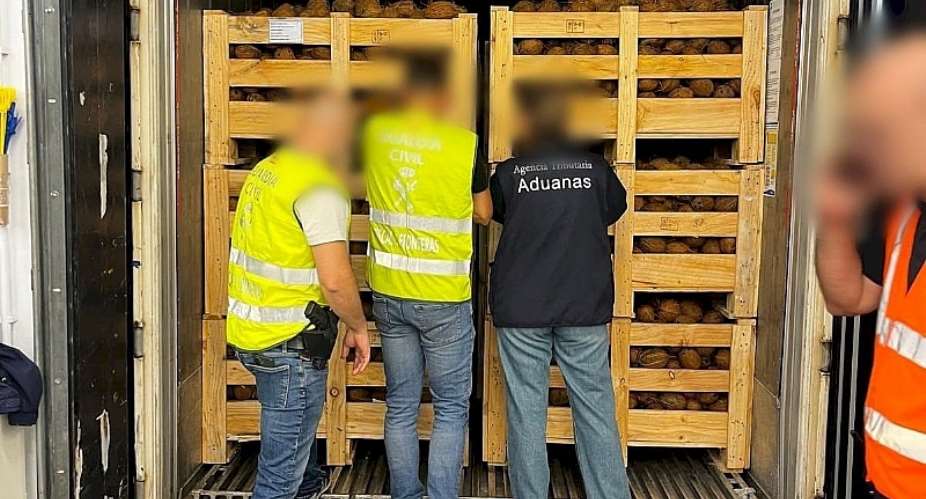
Ghana is facing renewed questions over the security of its ports and international trade networks following the seizure of approximately 2,600 kilogrammes of cocaine by Spanish authorities in a shipment of coconuts originating from the country.
The drugs were discovered in 2 shipping containers that left the Port of Tema in August 2026 and arrived at the Port of Valencia in Spain. The seizure, announced on November 11, has reignited concerns about the possible exploitation of Ghana's maritime infrastructure by international drug trafficking organisations.
According to Spain's Tax Agency and Guardia Civil, the containers were loaded at Tema Port on August 2 and arrived in Valencia on August 22 aboard a container vessel.
Investigators found the cocaine hidden in specially constructed compartments beneath wooden crates containing coconuts, which had been declared as the cargo.
Spanish authorities reportedly selected the containers for inspection after classifying them as high-risk consignments. Following the discovery, they allowed the shipment to proceed under controlled surveillance, eventually tracing it to a warehouse in Almería, where 2 people were arrested.
The suspects were identified as the alleged importer of the consignment and the individual responsible for overseeing its unloading.
Although the operation has resulted in arrests in Spain, the circumstances surrounding the shipment's departure from Ghana remain unclear.
The identity of the exporter, the parties responsible for handling the containers before they left Tema and the point at which the cocaine was concealed are among the issues requiring investigation. It is also necessary to establish whether the drugs were loaded in Ghana or introduced into the shipment at another stage of the supply chain.
These questions have become more pressing amid a series of reported cocaine interceptions involving consignments linked to Ghana in recent years.
On November 4, 2026, the New Patriotic Party called for the heads of the Narcotics Control Commission (NACOC), Ghana Ports and Harbours Authority (GPHA), Ghana Airports Company Limited (GACL) and National Security to step aside to allow independent investigations into what it described as recurring cocaine seizures. The party also demanded the resignation of the Interior Minister.
Figures presented by the NPP indicated that its assessment had identified at least 14 major cocaine and illicit drug seizures between March 2025 and October 2026.
According to the party, 7 of the incidents occurred in Ghana and involved approximately 4 tonnes of cocaine, while more than 12 tonnes reportedly linked to the country were intercepted at ports in Amsterdam, Antwerp, Dunkirk and Beirut.
These figures and allegations require independent verification, particularly because the description of a shipment as being linked to Ghana does not necessarily establish that the drugs originated from or were loaded in the country.
A consignment could be associated with Ghana because it was exported through a local port, originated from the country or involved a Ghanaian individual or company. It could also have merely passed through the country's logistics network.
Establishing these distinctions is essential before drawing conclusions about the effectiveness of Ghana's port security arrangements. Nevertheless, the number and scale of the reported interceptions make a comprehensive investigation necessary.
The latest seizure has placed particular attention on the effectiveness of cargo inspection and security procedures at Tema Port.
The 2 containers were cleared for export from Tema on August 2 before Spanish authorities identified them as high-risk consignments and uncovered the cocaine concealed inside the declared cargo.
This raises questions about the checks conducted before the containers were allowed to leave Ghana. Were they physically inspected or scanned? If scanning was undertaken, did the images reveal anything suspicious? Which institutions and private operators participated in clearing the shipment?
Cargo operations at Ghana's ports involve several agencies and businesses, including GPHA, the Ghana Revenue Authority's Customs Division, NACOC, terminal operators and shipping companies.
NACOC has previously acknowledged the importance of strengthening coordination among institutions responsible for port security.
On October 1, 2026, the Commission's Director-General, Major-General Maxwell Obuba Mantey, led a delegation to Tema Harbour, where they inspected several operational facilities, including the Mediterranean Shipping Company (MPS) export and import scanning facility and the ACS export terminal.
During the visit, Major-General Mantey stressed the need for stronger cooperation among agencies operating at the port, particularly in response to recent drug seizures associated with Ghana.
The engagement raises further questions about the operational weaknesses identified by the Commission and whether measures have since been introduced to address them.
It is also important to establish whether the country has adequate scanning equipment, trained personnel and effective systems for interpreting cargo images. More importantly, the authorities must clarify which institutions are responsible when containers carrying prohibited substances leave Ghana undetected.
The concerns also extend beyond maritime transportation to Ghana's aviation infrastructure, particularly Accra International Airport, which handles passenger and cargo traffic connecting the country to Europe, the Middle East and other parts of the world.
The NPP's call for an independent investigation included GACL, suggesting that the party believes the country's aviation security arrangements should also be examined.
However, the specific incidents or intelligence informing that demand have not been clearly established.
The relevant questions include whether there have been significant cocaine interceptions involving passengers, baggage, air freight or cargo departing from Ghana, and what records held by NACOC, Customs, Immigration and airport security reveal.
There are also concerns about whether the agencies share intelligence effectively and whether existing systems can identify suspicious movements across the country's aviation network.
Any investigation into the airport environment should therefore be guided by documented incidents and evidence rather than political claims.
Meanwhile, NACOC's enforcement record presents another dimension of the country's drug-control challenges.
Figures released by the Commission show that Ghana recorded 217 arrests in 165 drug-related cases in 2025, compared with 73 arrests in 2024, representing an increase of 197 per cent.
The Commission also reported seizing nearly 1,500 kilogrammes of narcotic substances during 2025.
Major-General Mantey has maintained that the country's drug-related challenges cannot be addressed through law enforcement alone.
Speaking in April 2026, he disclosed that 1,179 people sought treatment for substance-use disorders at centres affiliated with the Commission in 2025.
The figures highlight the need to pursue two related objectives: disrupting the operations of drug trafficking networks and addressing the public health consequences of substance abuse.
However, the overall seizure figure does not indicate how much of the 1,500 kilogrammes consisted of cocaine, cannabis, heroin or other narcotic substances.
There is also a need for information on how many of the arrests resulted in prosecutions and convictions and the extent to which the seized cocaine was connected to international trafficking networks.
Arrest figures alone cannot determine whether Ghana is making progress in the fight against drug trafficking. More meaningful indicators would include successful prosecutions, the dismantling of trafficking organisations, the recovery of criminal assets, the disruption of established routes and improvements in intelligence gathering.
The Valencia incident also brings into focus the possibility that legitimate businesses could be used as cover for international criminal activities.
The declared cargo in the containers was coconuts, an agricultural commodity with legitimate commercial export potential. Investigators will therefore need to establish the identities of the exporter, consignee, shipping agent, freight forwarder and companies connected to the consignment.
They must also determine whether the businesses involved were genuinely engaged in the coconut trade, whether the shipment was consistent with their previous commercial activities, who financed the consignment and who stood to benefit from its delivery.
A key part of the investigation will be whether Spanish authorities have shared relevant shipping documents and investigative findings with their Ghanaian counterparts.
Such cooperation could help determine whether any Ghanaian exporter or business knowingly participated in the operation or whether legitimate commercial entities were exploited by international criminal networks.
However, no business or individual should be presumed guilty solely because a shipment associated with them was used to conceal illegal substances. Their involvement must be established through evidence.
The incident also raises broader concerns about the possibility of international cocaine trafficking organisations increasingly exploiting Ghana as a transit point.
West Africa's geographical position between cocaine-producing regions in Latin America and major consumer markets in Europe has made the subregion vulnerable to international drug trafficking.
Ghana's strategic location, maritime connections and expanding international trade links make the protection of its ports and logistics infrastructure particularly important.
The authorities must determine whether criminal networks are exploiting legitimate export activities, using local companies and intermediaries or relying on established logistics operators to move cocaine through the country.
There is also a need to examine the extent of Ghana's cooperation with European law enforcement agencies, particularly those in Spain, Belgium, the Netherlands and France, where interceptions associated with West African trafficking routes have been reported.
Addressing the threat will require more than public announcements of seizures and arrests. Ghana needs a clearer understanding of the networks involved, their sources of financing, their local connections and the institutional weaknesses they may be exploiting.
The political debate surrounding the issue has intensified following the NPP's demand for the removal of the heads of four security institutions.
However, holding the heads of NACOC, GPHA, GACL and National Security responsible for every international interception involving a shipment linked to Ghana would be an oversimplification.
Institutional accountability must be grounded in evidence of negligence, complicity, failure to discharge statutory responsibilities or identifiable operational weaknesses.
At the same time, the government cannot dismiss the concerns simply because they have been raised by an opposition political party.
If multiple consignments associated with Ghana have been intercepted abroad, the public deserves to know what investigations have been conducted, what the findings are and whether public officials or private-sector operators are being investigated.
The government must also clarify whether it has commissioned an independent assessment of security arrangements at the country's ports and airports, whether any officers have faced investigations or sanctions over suspected negligence or complicity, and whether weaknesses in cargo screening, intelligence sharing and container tracking have been identified.
NACOC should also provide details of the operational gaps identified during its October 2026 visit to Tema Harbour and explain what has been done to address them.
Beyond the immediate incident, the authorities must establish who owned and exported the 2 coconut consignments, where the cocaine was introduced into the shipment and which agencies were involved in clearing the containers.
They must also clarify whether Spanish authorities have formally notified NACOC, Customs and other Ghanaian law enforcement agencies, and provide a breakdown of cocaine consignments linked to Ghana that have been intercepted abroad since 2025.
A distinction must be made between shipments that originated in Ghana and those that only passed through the country.
Further information is needed on NACOC's 2025 drug seizures by substance, the number of arrests that have resulted in convictions, and whether public officers, port workers, shipping agents or private-sector operators have been investigated for suspected involvement in trafficking.
The NPP, for its part, should provide the evidence supporting its claim that more than 12 tonnes of cocaine linked to Ghana were intercepted abroad. The government must also respond to the party's demand for an independent investigation.
At the institutional level, Ghana needs to demonstrate whether it has an integrated intelligence and cargo-risk management system connecting NACOC, Customs, GPHA, GACL, Immigration, the Police and National Security.
The stakes extend beyond the drugs being intercepted. Ghana has spent decades building its image as a stable democracy, a regional commercial centre and an attractive destination for international investment.
The possible exploitation of its ports, airports and commercial networks by international cocaine trafficking organisations poses a threat to that reputation.
The consequences could include criminal infiltration of legitimate businesses, corruption within public institutions, illicit financial flows, damage to the credibility of Ghanaian exports and declining public confidence in law enforcement.
The Valencia seizure could ultimately prove to be a case in which international traffickers exploited a legitimate Ghanaian export consignment without the knowledge or involvement of its owners.
Alternatively, investigations could uncover a more extensive network involving local facilitators and weaknesses in the country's cargo-control systems.
The available information does not yet establish which of these possibilities is the case.
What is clear, however, is that Ghana cannot afford to treat the incident as another isolated international drug seizure.
The government, NACOC, GPHA, Customs, GACL and National Security must account for what they know, what investigations have established and the measures being taken to prevent similar incidents.
The central issue is no longer simply the quantity of cocaine being intercepted abroad. It is whether Ghana fully understands the trafficking networks seeking to exploit its territory and whether its institutions possess the capacity, integrity and political will to dismantle them.

 Ghana faces fresh scrutiny over cocaine trafficking after 2.6-tonne seizure in S...
 Armed mob attacks NAIMOS task force at Manso Keniago; two injured
 GES assures Funsi SHS students of action over water, electricity shortages
 17-year-old arrested over fatal shooting of Ghanaian teenager Javits Frimpong in...
 New Economy: 'Is Mahama government abandoning its 2024 promises?' – Kwesi Pratt
 'God is not a rickety goat to let NPP come back to power' — Cape Coast Mayor on ...
 Govt rules out new taxes in 2027 budget
 Government targets improved foundational learning for children by 2030
 Goldplat suspends operations at Ghana plant after trench collapse kills contract...
 GACL targets end of year start for Wa, Bolga, Sunyani airports


