




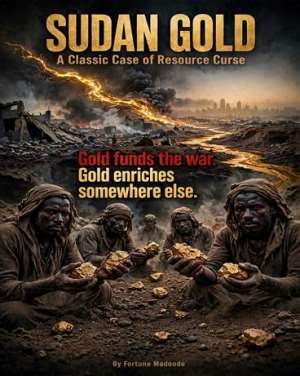
1. The Paradox: "Gold in the Middle of War"
Get this. In the middle of war, Sudan is producing immense amounts of gold. Sudan is being robbed in broad daylight, and the war is the cover-up for the robbery.
Sudan produced 70 tons of gold in 2025 [1]. Fifth in Africa. In the middle of a war. Just imagine!
And still, Sudanese children are starving.
Explain that to me. Explain how a country can dig 70 tons of gold a year [1] and cannot feed its own people, cannot stop its own war, cannot bury its own dead with dignity.
This piece will tell you why. Because the gold does not belong to Sudan. It belongs to the war.
2. The Thesis: "This Is Not a Civil War"
Gold is the fuel. Gold is the bullet. Gold is the drone.
Sudanese Armed Forces, (SAF,) uses gold to sustain its war machine. Rapid Support Forces,(RSF) uses gold to sustain its war machine. Both sides dig, both sides smuggle, both sides kill, and both sides get paid — though not in the same way: the SAF controls mining in the east, the RSF extracts through coercive capture in the west [6][8].
RSF seized the goldfields in Darfur and Kordofan early. SAF holds the east [6][7]. They are not fighting for Sudan. They are fighting for the pit. For the refinery. For the smuggling route.
This is not a civil war. This is a gold war, with Sudanese bodies as the price.
3. The Proof: "War Made Gold Bigger, Not Smaller"
Sudan's gold story is simple: in 2022, before the war, Sudan produced 41.8 tons of gold [2]. When war broke out in April 2023, official production fell to about 2 tons in the first six months of fighting [3]. But instead of staying down, it bounced back fast — to 64 tons in 2024 [1], and then to 70 tons in 2025 [1], the highest level since the war began and 13% above the government's own target [1].
In other words, war did not kill Sudan's gold industry. It made it bigger, while most of that gold never reached the official books.
4. How It Is Mined: "By Hand, By the Desperate"
It is mined almost entirely by hand, by desperate people, not by big machines. Artisanal miners accounted for more than 85% of Sudan's 70 tons in 2025 [4]. They use basic or improvised tools on unstable seams, crush the ore, then apply toxic mercury to create an amalgam which they heat with a torch or stove to evaporate the mercury and recover the gold, usually with little protective equipment, in densely populated camps where they live with their families [5]. Artisanal mining now occurs in 14 of Sudan's 18 states [6].
The geography is split by war. The RSF holds most goldfields in Darfur and Kordofan, including Jebel Amer in North Darfur which it took in 2017 [7], while the army oversees the north and east [6]. In the east, from al-Butana up to River Nile and Red Sea states, vast deserts are scarred by artisanal mining controlled by the SAF [6] and fuelled by IDPs from Khartoum and Al Jazirah plus migrants from Ethiopia and Eritrea [6]. In the west, at Songo in South Darfur, researcher Joshua Craze says the RSF rarely digs itself: around 100,000 local miners pay security fees to RSF actors who then buy much of the gold in what he calls coercive capture [8].
This is why this gold is bloody. It is dug by a sector on which 2 to 5 million people now depend [9], poisoned by mercury [5], including children in mining communities exposed to mercury in drinking water and biological samples [9], buried in collapsing pits [5], and then taxed, seized and sold to fund the war [6][8].
That is what researchers in Songo describe: miners dig, armed actors take, and the gold ends up in a vault in Dubai while brothers are buried in the pit [8].
5. The Looting: "The Gap Is the Crime"
50% to 70% smuggled. Every year [13].
Sudan produced 70 tons of gold in 2025 [1], but officially exported only 14.7 tons worth $1.536 billion [10]. That means 55.3 tons — nearly four out of every five tons dug — are missing from the official books [11], worth about $5.8 to $6 billion in one year alone at the Central Bank's own price [11].
This is not an accident. The UN Panel of Experts in 2024 found more than 50% of Sudan's gold is smuggled out [12]. SWISSAID found 40% to 70% leaves through unofficial channels [13]. And Sudan's own Finance Minister told AFP that of the 70 tons produced in 2025, only 20 tons were exported through official channels [14] — a higher figure than the Central Bank's, but one that still leaves a gap of 50 tons.
6. The Route and Destination: "Mapped, Not Hidden"
The smuggling route out of Sudan is not hidden. It is mapped [15].
The United Arab Emirates (UAE) took 17 tons directly from Sudan in 2023 and 29 tons in 2024 — up 70% in one year of war [15] — while more arrived via Egypt, Chad and Libya [15], with Chad and Libya named as exit points for RSF-controlled gold [15]. About 60% of production from Northern, River Nile and Red Sea states was smuggled to Egypt at more than 100 kg a day [16], even though official exports to Egypt in 2024 were only $16 million [17].
By 2025 the route simply shifted on paper, with Egypt's official imports jumping 20 times [10] while the UAE's official share fell from 99% to 56% [10]. The destination did not change, only the route did, with gold via Egypt re-exported onward to the UAE [11], the world's second-largest gold importer [18]. From there, the gold moves onward to Switzerland, which imported 420 tons worth CHF 38.9 billion from the UAE in 2025, almost three times the 2024 level [18].
Destination? One place: The UAE.
7. Resource Politics: "Who Cleans It, Who Looks Away"
Dubai does not dig gold. Dubai cleans gold. According to SWISSAID, Dubai is the world's main hub for African gold where origin is lost in refining and re-export, and where Sudanese gold can enter the world market without transparent proof of origin [19].
And the world buys it. And the EU writes a sanction that does not even mention the UAE. And America upgraded the UAE to Major Defense Partner [20]. In Sudan, women are raped [21] while miners die in collapsed pits [5].
8. Conclusion: Classic Case of Resource Curse
Sudan's gold is the resource curse in its crudest and cruelest form, Africa's lost birthright turned into a weapon against its own people: a country blessed with enough gold to build schools, hospitals and a sovereign future instead watches that wealth fund the very war that is destroying it, because plentiful resources plus deep poverty plus weak governance plus foreign exploitation equals ecocide and dispossession.
Here the numbers prove it. Sudan produced 70 tons in 2025 [1], yet officially exported only 14.7 tons [10], leaving 55.3 tons missing in one year [11], while gold flowed out through Egypt, Chad, Libya and directly to the UAE, 29 tons in 2024 alone [15], and onward to Switzerland [18]. That means the gold does not belong to the 2 to 5 million people who depend on artisanal mining [9]. It belongs to warlords, smugglers and foreign hubs. And so the horror is complete: an estimated 150,000 lives claimed and 13 million displaced [22], while the gold that should have been Sudan's sovereignty becomes the fuel for its own bleeding.
What Must Happen Now
No more silence. No more "recycled" lies.
- Sanction the launderers, not just the shooters.
The AU, EU and US must name the UAE refineries and traders handling Sudanese gold. No sanctions that skip Dubai are serious.
- Trace or ban.
No gold from Sudan, Egypt, Chad or Libya enters the world market without proof of origin, proof of no child labour, proof of no mercury poisoning, and proof of Free, Prior and Informed Consent from the community that dug it.
- Prosecute ecocide and war profiteering.
Gold mined with mercury, with child labour, with coercive capture, to fund war, is a crime against humanity. Try it at the ICC.
- Return the wealth.
Freeze, seize and return smuggled Sudanese gold revenue to Sudanese communities, not to generals in Khartoum or Port Sudan.
Prosecute or perish. Clean gold or blood gold. There is no middle.
Endnotes
1. Sudan Ministry of Minerals and Sudanese Mineral Resources Company (SMRC) via Xinhua, December 2025 - for 70 tons produced in 2025, 64 tons in 2024, and 13% above government's target. Corroborated by Eastleigh Voice, Arab News, and SWISSAID September 2026.
2. SWISSAID and Central Bank of Sudan data - for 41.8 tons produced in 2022, as total declared production.
3. Sudan Transparency and Policy Tracker, October 2024 - for official production falling to about 2 tons in the first six months after the outbreak of war in April 2023, with total 2023 production of 6.4 tons.
4. Sudanese Mineral Resources Company (SMRC) - for artisanal miners accounting for more than 85% of Sudan's 70 tons in 2025. Corroborated by SWISSAID: 91.5% of declared production in 2024.
5. CEOBS, November 2025 - for miners using basic or improvised tools on unstable seams, crushing ore, using toxic mercury to create amalgam heated with torch/stove, with little protective equipment, in densely populated camps, and for mercury poisoning and collapsing pits.
6. Adala / C4ADS and Sudan Peace Tracker - for artisanal mining in 14 of Sudan's 18 states, RSF holding most goldfields in Darfur and Kordofan, army overseeing north and east, SAF-controlled mining in the east fuelled by IDPs and migrants, and for miners being taxed and seized.
7. US Treasury - for RSF taking Jebel Amer in North Darfur in 2017.
8. Joshua Craze, researcher, cited in Adala / C4ADS research - for Songo in South Darfur, around 100,000 local miners paying security fees to RSF actors who buy much of the gold, described as coercive capture.
9. Sudan Tribune, via http://Mining.com, 2026, and UNESCO / CEOBS field surveys - for 2 to 5 million people now depending on the artisanal sector, and for mercury and cyanide detected in drinking water and in biological samples from children aged 4 to 11 in mining communities in River Nile State.
10. Central Bank of Sudan Foreign Trade data reported by Bloomberg, April 2026, and Sudan Events, March 16 2026 - for 14.7 tons officially exported worth $1.536 billion, Egypt's official imports jumping 20 times, and UAE's official share falling from 99% to 56%.
11. Sudan Transparency and Policy Tracker, calculation from SMRC and Central Bank figures - for 55.3-ton gap worth about $5.8 to $6 billion at the Central Bank's own price, and for analysis that destination did not change, only route did, with gold via Egypt re-exported onward to the UAE. Note on discrepancy: Central Bank reports 14.7 tons exported, Finance Minister told AFP 20 tons exported through official channels. Both imply a gap of 50+ tons. This piece uses the Central Bank figure as the official export record.
12. UN Panel of Experts on Sudan, 2024, cited by AP - for more than 50% of Sudan's gold smuggled out.
13. SWISSAID - for 40% to 70% leaving through unofficial channels, and 50% to 70% smuggled every year.
14. Sudan Finance Minister Gibril Ibrahim, to AFP, January 2026 - for statement that of 70 tons produced in 2025, only 20 tons were exported through official channels.
15. SWISSAID and UN Comtrade data, reported November 2025 - for UAE taking 17 tons directly from Sudan in 2023 and 29 tons in 2024, more arriving via Egypt, Chad and Libya, and Chad and Libya as exit points for RSF-controlled gold.
16. Chatham House - Soliman & Baldo, March 2025 - for about 60% of production from Northern, River Nile and Red Sea states smuggled to Egypt at more than 100 kg a day.
17. Central Bank of Sudan data cited by Chatham House, March 2025 - for official exports to Egypt in 2024 of only $16 million.
18. SWISSAID, November 2025 and September 2026 - for UAE as world's second-largest gold importer with 1,392 tons worth $105.4bn in 2024 including 748 tons from Africa, and for Switzerland importing 420 tons worth CHF 38.9 billion from the UAE in 2025.
19. SWISSAID, 2024 report and September 2026 release - for Dubai as main hub for gold from Sudan where imports from the UAE lack transparency to ascertain true origin.
20. US Government designation - for America conferring Major Defense Partner status on the UAE in September 2024, and signing Letter of Intent for comprehensive U.S.-UAE Major Defense Partnership in May 2025.
21. Independent International Fact-Finding Mission for the Sudan (UN Human Rights Council, established October 2023), report October 2024 and follow-up reports, and OHCHR report on Zamzam camp, December 2025 - for documenting large-scale sexual violence, including gang-rape and sexual slavery, committed mainly by RSF, with OHCHR documenting at least 104 victims of rape, gang-rape and sexual slavery in the Zamzam offensive alone.
22. SWISSAID, September 2026, and UNDP / Institute for Security Studies - for estimated 150,000 lives claimed and 13 million displaced. 150,000 is an estimate including indirect deaths; direct violent deaths counted by monitors are lower. d9346d0b


 Ghana risks importing water as miners struggle to procure US$113,000 mercury-fre...
 Heritage Series: Here are prominent Ghanaian personalities featured on new Ghana...
 Akufo-Addo to lead ECOWAS election observer mission in Nigeria’s 2027 elections
 Justice Achibonga acquits Adu Boahen of two out of 11 charges
 Nvidia CEO Jensen Huang resigns after affair raises national security concerns
 Two Aduman SHS teachers arrested, interdicted over alleged sexual assault agains...
 Roads Minister directs establishment of bitumen testing facilities in Accra, Ash...
 Mercy Ships surgeries are free; beware of fundraising scams – Health Ministry to...
 Publish El-Wak recruitment stampede probe report – Akosua Manu demands a year af...
 Ghana Immigration Service introduces six-month rotational transfers for officers


