




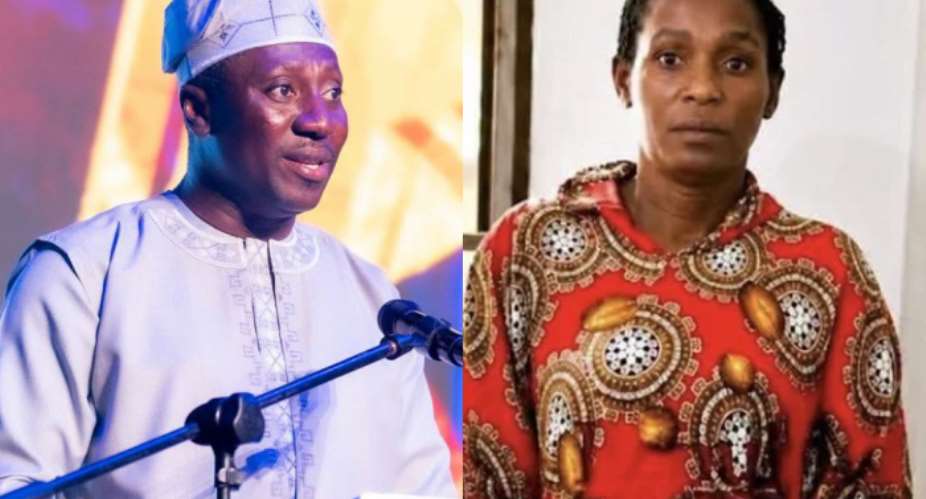
Minority Leader Alexander Afenyo-Markin has called on President John Dramani Mahama to grant presidential clemency to 43-year-old TikToker Camila Alhassan, who is serving a one-year prison sentence for offensive conduct.
He argued that her imprisonment raises important questions about the use of criminal prosecution to deal with speech-related offences and urged the President to consider granting her a pardon.
Afenyo-Markin made the appeal at the 30th Ghana Journalists Association (GJA) Media Awards in Accra on Saturday, November 7, where he also advocated stronger safeguards for freedom of expression and reforms to laws that criminalise certain forms of speech.
He said Ghana must protect the constitutional rights of citizens to express opinions, criticise public officials and contribute to national debates without facing intimidation or imprisonment.
Alhassan was handed a one-year jail term with hard labour by an Accra Circuit Court on July 16, 2026, after pleading guilty to offensive conduct conducive to a breach of the peace.
Her prosecution stemmed from TikTok videos she posted between June 30 and July 5, 2026, in which she made several allegations against President Mahama. Among other claims, she alleged that the President had sacrificed 32 cows to secure victory in the 2024 general elections.
She further claimed that the government's distribution of sanitary pads to victims of the June 29, 2026, floods was an attempt to cover up the alleged sacrifices.
Prosecutors told the court that her comments about the President and First Lady, Lordina Mahama, were offensive and derogatory and had the potential to provoke a breach of the peace.
The Media Foundation for West Africa (MFWA) subsequently condemned her arrest and prosecution, describing the case as evidence of what it called the “creeping criminalisation of speech”.
The organisation disclosed that Alhassan had initially faced charges under Sections 207 and 208 of the Criminal Offences Act, 1960 (Act 29), relating to offensive conduct and the publication of false news.
Her lawyer, Kwadwo Gyamfi-Bonsu, however, explained that the court convicted her only on the offensive conduct charge under Section 207 because it lacked jurisdiction to hear the false news charge.
The case has since fuelled public discussion about the limits of free expression and the responsibility of social media users to avoid abusive, threatening and unsubstantiated statements.
Speaking at the GJA awards, Afenyo-Markin maintained that imprisonment should not be the default response to public criticism, false claims or offensive comments.
He renewed calls for the repeal of Section 208 of the Criminal Offences Act and Section 76 of the Electronic Communications Act, 2008 (Act 775), arguing that disputes involving speech should, where appropriate, be addressed through civil remedies.
Such remedies, he suggested, could include public apologies, retractions and compensation instead of criminal prosecution and custodial sentences.

 Two Aduman SHS teachers remanded over alleged sodomy case involving two minors
 'What are the technical reasons for the new cedi notes?’ – Oppong Nkrumah questi...
 GES forwards 347 salary arrears cases of 2024 teacher recruits for payment
 No basis for rent increases in Ghana today – Kwakye Ofosu cites reduced building...
 2027 Budget: New Economy is ‘copy and paste’ of 24-hour policy – Amin Adam
 2027 Budget: Ato Forson contradicted himself on borrowing – Amin Adam
 Microsoft says it is 'deeply sorry' after widespread outages cause global chaos
 Microsoft outage causes global chaos
 The Nvidia affair: Are markets about to fall out of love with AI?
 'Too early to discuss presidential bid’ – Dr. Ato Forson


