




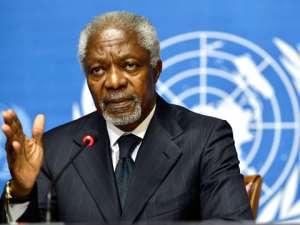
Kofi Annan never raised his voice. That was his power.
In a world where leaders now shout on television, post insults on social media, and treat diplomacy as a performance, Annan did the opposite. He listened. He paused. He spoke quietly, and because he spoke quietly, the whole world leaned in to hear him.
I grew up in Ghana hearing his name with pride. He was not just a Ghanaian who became Secretary-General of the United Nations. He was a Ghanaian who showed the world a different way to lead. A way that came from our own culture: listen first, speak later, and never humiliate your opponent.
That lesson matters more now than ever.
Today, diplomacy is in crisis. In the Sahel, in Ukraine, in Gaza, in our own elections in Ghana, we see the same pattern. Leaders talk, but nobody listens. Negotiations become press conferences. Peace talks become photo opportunities. Everyone wants to be heard, no one wants to hear.
Annan understood that listening is not a weakness. Listening is a strategy.
When he mediated in Kenya in 2008, after post-election violence had killed more than 1,000 people, he did not arrive with a ready-made solution. He arrived with questions. He met the government. He met the opposition. He met civil society, women leaders, religious leaders. He let each side feel heard, even when they disagreed completely. Only then did he propose a power-sharing deal. It worked because people felt listened to, not lectured to.
That is the Annan method: Listen locally, speak internationally.
It is a lesson Ghana still needs. In our 2024 elections, much of the disinformation that spread did not spread in English. It spread in Twi, Ewe, Ga, in voice notes on WhatsApp, in markets and tro-tros, in languages that fact-checkers in Accra did not monitor. The international community spoke about Ghana in English, but the real conversation was happening in local languages. Annan would have listened there first.
It is also a lesson the world needs in the Sahel. For years, international partners have arrived in Mali, Burkina Faso and Niger with plans written in Paris, Washington or New York. They speak about sovereignty, security and democracy in English and French. But mayors, chiefs and mothers in Mopti, Kaya and Tillaberi speak about those same issues in Bambara, Mooré and Hausa. If you do not listen in their language, you do not hear their truth.
Annan knew this because he was from here. He knew that in Ghana, when an elder is speaking, you do not interrupt. You wait. You nod. You show respect. Only a fool thinks silence means agreement. Silence means you are thinking. Annan turned that Ghanaian wisdom into global diplomacy.
There is another lesson: dignity.
Annan never humiliated anyone, even dictators. He believed you could be firm without being rude. You could condemn human rights abuses without closing the door to negotiation. Today, we have lost that art. We sanction, we shout, we cut off dialogue, and then we wonder why conflicts get worse. Annan would have kept the door open, even when it was difficult.
This does not mean he was soft. He was the man who called the invasion of Iraq illegal. He was the man who pushed for the Responsibility to Protect, the idea that the world cannot stand by while civilians are massacred. He was firm. But he was firm without arrogance. He made his point, then he listened to the reply.
As a young Ghanaian researcher, I think about Annan every time I write about mayors in the Sahel. Those mayors survive not because they shout the loudest, but because they listen the best. They listen to the junta in the morning, to armed groups in the afternoon, and to their community at night. They code-switch, they translate, they listen in three languages. That is Annan diplomacy at the local level.
So what should we do with his legacy?
First, teach listening in our schools of diplomacy. Not just international law and protocol, but how to sit, how to listen, how to translate between languages and cultures.
Second, invest in local-language diplomacy. If we want to fight disinformation, build peace, or run credible elections, we cannot do it only in English. We must listen in Twi, Ewe, Ga, Bambara, Hausa, Mooré.
Third, bring back quiet diplomacy. Not every negotiation needs a camera. Some of the best peace deals in history were made in small rooms, with no press, where people could speak honestly and listen fully.
Kofi Annan once said, "We need to think of the future and the planet we are going to leave to our children and their children." That future will not be built by those who shout loudest. It will be built by those who listen deepest.
Ghana gave the world Kofi Annan. The world still needs his lesson.
Maurice Mawugbe is a Lecturer and Former GBC Journalist covering ECOWAS. He holds MAs in International Affairs & Diplomacy, Strategic Public Relations, and Electoral Policy & Administration. Email: [email protected] | Tel: +233 244 727 646 | Accra, Ghana.


 Everyone travelling to Ghana must complete health declaration form from November...
 November 7: Cedi sells at GHS12.25 on forex market, GHS11.65 on BoG interbank
 'It is not fair for the police to review their own decisions' – Bright Simons on...
 Bright Simons questions TraffiTech-GH revenue model, demands transparency in con...
 Akufo-Addo's former counsel Kow Essuman eyes Ablekuma West parliamentary seat
 Moscow strikes Kyiv as Ukraine prepares for talks with Russia and the US
 Ousted Paraguay president under house arrest after bank collapse
 Trump announces immigration hardliner Stephen Miller as new chief of staff
 Pope Leo arrives in Uruguay for first stop on 12-day South America tour
 No proxy voting, strict 7am to 5pm schedule – NDC outlines measures for Northern...


