




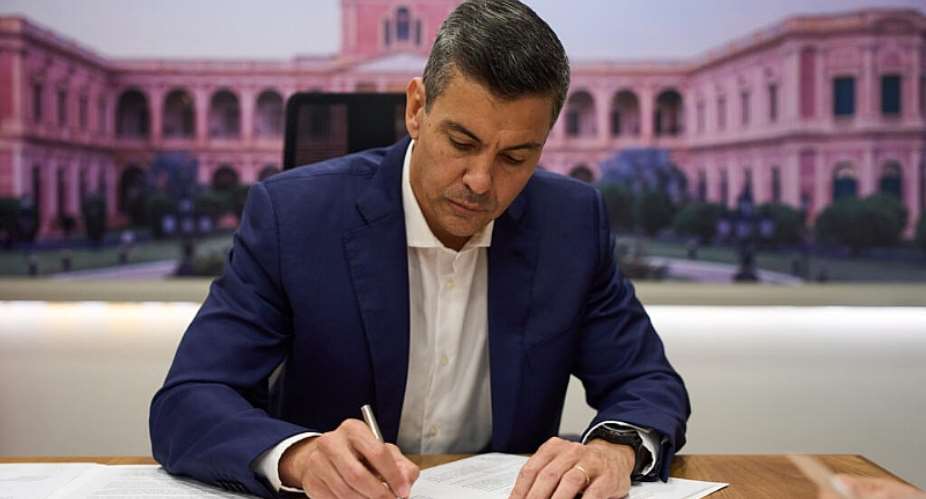
Ousted Paraguayan President Santiago Peña was placed under house arrest Friday on suspicion of breach of trust and influence peddling, among other charges, shortly after the Senate removed him from office over the collapse of a government-linked bank that locked nearly half the country's 6 million people out of their savings.
All 44 senators present voted to remove Peña for misconduct in office, making him the second Paraguayan president ousted by impeachment since the end of Gen. Alfredo Stroessner's 35-year dictatorship in 1989.
As the verdict came down, ending what had been seen as one of South America's most stable presidencies, a roar rose from the crowds packed into the plaza outside Congress. Depositors, retirees and students in national soccer jerseys waved Paraguayan flags, sang and hugged, chanting “Dictatorship never again!”
Regulators had seized Ueno Bank just three days earlier, sending shock waves through the financial system and setting off the country's worst political crisis in more than a decade.
Peña was ordered to remain at one of his homes in Asunción until he appears before prosecutors Saturday morning on charges of breach of trust, influence peddling and using public office for personal gain, the most serious of which carry up to 10 years in prison. Lawmakers accuse him of using his political influence to steer hundreds of millions of dollars in public funds into Ueno while regulators overlooked risky insider lending.
Read more Impeachment trial of Paraguay's President Peña begins after bank scandal resignation
Peña has denied wrongdoing.
Police ringed the house Friday night as crowds gathered outside, waving flags and vowing to keep vigil until morning to make sure he didn't escape.
Prosecutors also ordered the arrest of Carlos Carvallo, who ran the finance company that became Ueno until Peña named him central bank chief in 2023. It was not immediately clear whether Carvallo had been taken into custody.
Vice President Pedro Alliana was sworn in as president Friday to serve out the term, which ends in August 2028. “The Paraguay we receive today has urgent needs,” said Alliana, who is also under investigation in connection with the bank and inherits a government under pressure to return depositors' money and punish those responsible.
In a farewell message before the verdict, Peña said that he did not want his “presence to be a cause of greater division or instability".
“I say goodbye with gratitude, without ignoring the anguish of those who are waiting for answers today,” he wrote.
Public outrage has become more thunderous by the day. As senators deliberated Friday, protesters demanding their frozen savings back and accountability for Ueno's failure marched through downtown Asunción chanting, “Santi Peña to Tacumbú!” – a reference to the capital's main prison, where Ueno's founder and former CEO, Miguel Vázquez, is now being held.
“This was an enormous betrayal of trust,” said Yinal López, a worker at the state electricity company, whose employee pension fund also had money at Ueno. “The president has made a mockery of the people."
When regulators seized the bank, Ueno customers could no longer withdraw cash, access their savings or use their cards to buy anything. The digital lender had aggressively courted the poor and unbanked with generous supermarket rebates, and more than 1 million Paraguayans opened their first bank account there, according to Ueno. Even players on the national soccer team, which Ueno sponsored through its run to a World Cup upset of Germany this year, say they can't reach their money.
The fallout has spread well beyond savers. A ride-hailing app that relied on Ueno shut down, leaving 3,000 drivers without work. The state power company says $21 million in loans from the Inter-American Development Bank and Taiwan, earmarked for public works, is trapped at the bank. Paraguay's bonds have posted some of the worst losses in emerging markets this week, and the guaraní has slid against the dollar.
Some depositors began recovering their money Thursday, starting with those holding up to 10 million guaraníes (about $1,500). Deposits are insured up to about $35,000, which the central bank says covers 97% of Ueno's customers. It calls the collapse an isolated case and insists the broader financial system is safe.
In a separate case against Ueno's executives, prosecutors have charged 27 people, including Vázquez, with crimes such as breach of trust and attempted fraud. A judge has ordered six former directors, Vázquez among them, held in pretrial detention, and two others confined to their homes with electronic monitors. Authorities have seized luxury cars, a yacht and two small planes linked to Vázquez.
Ueno rose from obscurity to become one of Paraguay's largest banks by deposits in just a few years, with more than $800 million in public money turbocharging its expansion. It signed up more than two-thirds of the country's adults, its splashy logo appearing everywhere from the national soccer stadium to street vendors' bank cards.
The impeachment charges cite Peña's stake in Ueno's holding company, which he divested under pressure last year, and his appointment of Carvallo to run the central bank that regulated it. Lawmakers also accuse him of letting the state pension fund deposit $355 million at the bank, beyond legal limits.
Analysts say those high-level connections helped shield Ueno from regulatory scrutiny even as concerns about its finances grew.
“Under Peña, the central bank began to lose credibility, lose neutrality and then relax all its control mechanisms to favor the business group that had Ueno Bank as one of its pillars," said José Tomás Sánchez, a political theory professor at the National University of Asunción.
Peña defended the bank until mere weeks before it failed, telling reporters last month that a regulatory inquiry into Ueno didn't mean it would close and accusing the media of frightening people.
Watch more Paraguay, a tax and political haven for Brazil's far right
Peña's fall, from feted Washington ally meeting with Treasury Secretary Scott Bessent in late October to prisoner in his own home, came at dizzying speed.
Ueno was seized before dawn Tuesday. By Thursday afternoon, Peña had offered to resign as his conservative Colorado party turned on him, led by former President Horacio Cartes, the party chief and Peña's longtime mentor. By Friday, he was under arrest, with impeachment denying him the immunity he would have enjoyed if the Senate had accepted his resignation.
Peña, a former International Monetary Fund economist, owed his rise to Cartes, a tobacco magnate who made him finance minister and twice backed him for president.
Once in office, though, Peña sought to escape Cartes' shadow by quietly building his own power base, analysts say. Ueno, flush with public funds, became its linchpin.
“It's like a Shakespearean drama. He tried to displace his mentor, his political patron,” said Miguel Carter, director of DEMOS, a Paraguayan research center. “But he did so on very fragile grounds.”
Cartes struck back. In September, senators loyal to him began publicly questioning the central bank about Ueno's risky lending to related companies. When Ueno collapsed this week, so did Peña's leverage, and Cartes, once sanctioned by the US Treasury over alleged corruption, publicly called for the ouster of his erstwhile protégé.
“Cartes put the nail in the coffin,” said Andrew Nickson, a Paraguay expert at the University of Birmingham. “Peña had no political base to rely on, and he was left high and dry.”
(FRANCE 24 with AP)

 Moscow strikes Kyiv as Ukraine prepares for talks with Russia and the US
 Ousted Paraguay president under house arrest after bank collapse
 Trump announces immigration hardliner Stephen Miller as new chief of staff
 Pope Leo arrives in Uruguay for first stop on 12-day South America tour
 No proxy voting, strict 7am to 5pm schedule – NDC outlines measures for Northern...
 Efya marries Nigerian singer Tomi Thomas in traditional ceremony
 Motorists are becoming more responsible after TraffiTech deployment – NRSA
 Mahama to open Ghana Armed Forces critical care and emergency hospital
 Viral shoplifting suspect busted at Akode near Somanya
 What Trump’s midterms debacle could mean for US support for Ukraine


