




On Monday, negotiators begin arriving in Antalya for COP31, which runs from 9 to 20 November. They will argue over funds, targets and the wording of paragraphs. Most of the world will not be watching.
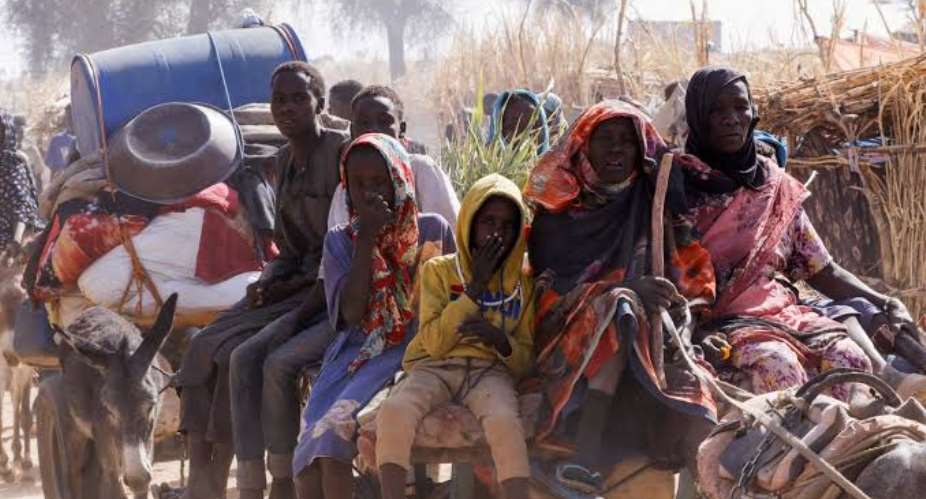
In Sudan, meanwhile, the United Nations says nearly 34 million people need humanitarian assistance, and UN agencies have warned that the aid response itself could collapse for lack of money.
I want to make one argument and I want to make it loudly.
The war in Sudan, the human labour hidden inside artificial intelligence, and the displacement of people by a heating planet are not three separate stories. They are one failure wearing three uniforms: the outsourcing of responsibility.
In each case, the person who supplies the weapon, trains the model or burns the carbon is separated by contractors, borders and voluntary pledges from the person who pays the price. That gap is not an accident. It is the system.
Describing that system is not enough. Readers have been told for years that bad things are happening. This article names the mechanism, connects the three crises through it, and ends with a plan with owners, deadlines and measures that any reader can check.
1. Sudan: A Genocide Documented in Real Time
The Reality
The war between the Sudanese Armed Forces and the Rapid Support Forces (RSF) passed 1,000 days early this year.
By the end of 2025, almost 12 million people had been displaced, making Sudan home to the largest internal displacement crisis on earth. The hunger-monitoring system known as the IPC declared famine in November 2025. The UN’s 2026 response plan asked for US$2.9 billion; early in the year it was reported as only 5.5 percent funded. In September, UN agencies warned that the humanitarian system in Sudan could collapse because of funding shortfalls.
In October 2025, the RSF took El Fasher after an 18-month siege.
In February 2026, the UN Independent International Fact-Finding Mission, after interviewing 320 witnesses and victims, reported that the RSF committed three acts of genocide against the Zaghawa and Fur communities and that the attack bore the “hallmarks of genocide.” It also found that the siege amounted to the war crime of using starvation as a method of warfare.
Whether a court will make a formal finding of genocide is still undecided. The evidence that it should be asked is not.
The killing has since moved to the sky.
The same mission reported in September that drone strikes killed more than 1,000 civilians in the first five months of 2026, and that both sides have used foreign-supplied drones. One RSF strike in Kalogi, South Kordofan, killed 114 people, around 60 of them children. An army strike in Ad-Da’ein, East Darfur, killed at least 70 people and destroyed a major hospital.
The mission also documented transnational networks that recruit, train and deploy foreign personnel and move weapons into the war.
The Human Rights Failure
The only UN arms embargo covering Sudan has applied to Darfur alone for about two decades, which leaves Kordofan, Khartoum and the rest of the country outside it.
When the United States proposed extending it nationwide, Russia and China reportedly opposed the move.
Common Article 1 of the Geneva Conventions obliges every state to ensure respect for humanitarian law, and the Genocide Convention obliges states to prevent genocide, not merely to condemn it. Neither duty is being enforced against the suppliers, financiers and brokers who keep the war supplied.
Sudan is not a local civil war. It is a stress test of the international order, and the order is failing it.
My Argument
Sudan is a symptom of a new world disorder in which the rules of war are treated as optional for anyone with a foreign patron.
Aid access is blocked, hospitals and displacement camps are struck, funding collapses, and the accountability machinery, including sanctions, embargoes and courts, moves slower than the drones.
When the law cannot reach the supply chain, it cannot protect the civilians at the end of it.
That is why the remedy has to target the supply chain, not only the battlefield.
2. The New Frontier: The Human Labour Inside “Artificial” Intelligence
The Reality
Every polished answer from an AI system sits on a stack of human work that the public never sees: people who label images, rank responses and review the most violent and abusive content on the internet so that the rest of us do not have to.
Much of that work is outsourced to Africa and South Asia through contractors.
In Kenya, around 185 former content moderators sued Meta and its contractor Sama over low pay, trauma and inadequate mental-health support. The Kenyan Court of Appeal rejected Meta’s attempt to block the case on jurisdiction.
Moderators there have reported earning about US$2 an hour, and some data workers as little as US$0.89.
In Ghana, my own country, content moderators employed by Meta’s contractor Teleperformance in Accra were the subject of a second legal case prepared by the UK non-profit Foxglove in 2025. Reporting on the case said basic wages in Accra were below the cost of living, which pushed moderators into overtime at even lower rates. The company disputed the claims.
These are allegations before courts, and I treat them as such, but they come in the same pattern from two countries.
The Human Rights Threat
Three rights are at stake:
- The right to just and favourable conditions of work.
- The right to the highest attainable standard of mental health.
- The right to non-discrimination.
The discrimination runs in two directions.
Workers in the Global South absorb the psychological cost of making products safe for users elsewhere.
Researchers have also documented that language and content-moderation systems perform unevenly across languages and communities, so the people who clean up the system are often the people it serves worst.
Weaponisation
The same dual-use logic reaches the battlefield.
The drones now killing civilians in Sudan depend on commercial components, software and navigation systems that cross borders through ordinary trade.
A technology company that sells without asking where its product ends up has made the same choice as a company that outsources trauma without asking who carries it.
The Law Is Retreating
The law is retreating exactly when it is needed.
In 2026, the EU’s Omnibus I Directive (2026/470), in force since 18 March, narrowed the Corporate Sustainability Due Diligence Directive to the very largest companies, with estimates of a cut of around 70 percent or more in the number of firms covered.
The Digital Omnibus on AI (Regulation 2026/1744), in force since 27 July, pushed back the EU AI Act’s high-risk obligations to 2 December 2027 for stand-alone systems and 2 August 2028 for those embedded in products.
Speed, scale and profit are moving faster than the rules.
My Argument: Mandatory AI Human Rights Due Diligence
Voluntary ethics statements have had their chance.
I am calling for a binding legal duty on the companies at the top of the AI supply chain, built on the UN Guiding Principles on Business and Human Rights, with six elements:
- Disclosure: Publish the vendors, countries, pay rates and headcount behind data labelling, training and moderation.
- A Pay Floor: Wages benchmarked to an independent living-wage standard in the country where the work is done.
- Mental-Health Protection: Caps on exposure to graphic material, trained counselling on the clock, and no punishment for opting out.
- The Right to Organise: Protection for worker groups such as the African Content Moderators Union, formed in Kenya in 2023.
- Liability and Remedy: The lead company answers for harm in its chain, and workers can sue where they live.
- Export and End-Use Screening: Companies must assess whether their products and components are likely to be used in violations of humanitarian law and stop sales where the risk is substantial.
Why I Am Writing This
Readers deserve to know who is making these arguments and what stake I have in them.
I am Chief Tutu Baffour Asare Brownsy Williams, an author, columnist and filmmaker based in Accra, Ghana, and the founder of Brownsy Silva Company, a creative platform that spans novels, films, opinion writing and engineering content.
I write an opinion column on Modern Ghana, where my readers include Ghanaians at home and in the United Kingdom, the United States, Canada and Germany.
My reasons for calling myself a human rights defender are practical and checkable.
I serve as a United Nations Online Volunteer through the United Nations Volunteers programme. I am a member of Amnesty International. I am a public health advocate. And I use a public platform, week after week, to write about rights in a country where most people never read a UN report.
I do not offer these as titles. I offer them as the record against which you can judge whether my words match my work.
I also have a personal reason to care about the second crisis in this article.
I am a student at Accra Technical University, studying engineering, in the same city where content moderators say they were underpaid to protect the world from the worst of the internet.
I will be graduating into the technology economy those workers are already holding up.
I would like it to have rules before I enter it.
3. The Intersecting Crisis: Climate Injustice and Legal Accountability
The Reality
According to the Internal Displacement Monitoring Centre, disasters caused 29.9 million internal displacements across 140 countries and territories in 2025, and almost 480 million have been recorded since systematic monitoring began in 2008.
Conflict and violence caused a record 32.3 million displacements in 2025, passing disasters for the first time.
By the end of the year, 82.2 million people were living in internal displacement worldwide.
Those two numbers are not rivals. They feed each other.
In October, the UN’s humanitarian office warned that extreme heat and heavy flooding are making Sudan’s crisis worse.
A family displaced by gunfire who then lose their shelter to a flood is one human being counted twice and protected by no one.
The Human Rights Shift
On 23 July 2025, the International Court of Justice gave a unanimous advisory opinion that changed the terms of the debate.
It confirmed that states’ duties to protect the climate system come from treaties, customary international law and human rights law, and it linked climate harm to the rights to life, health, food and a healthy environment.
It found that these duties are owed to the international community as a whole and that breaching them can carry legal consequences, including reparation.
The opinion is advisory, not a judgment, but it is the most authoritative statement of the law that now exists.
In 2020, the UN Human Rights Committee had already accepted, in the case of Teitiota v. New Zealand, that climate impacts can in principle trigger a state’s obligation not to return someone to a threat to their life.
Climate displacement is not an environmental inconvenience. It is a threat to the right to life, and it has a legal address.
My Argument
Climate displacement belongs in human rights law, not only in climate negotiations.
Three things follow:
- Displacement caused by climate harm should be treated as a protection issue, with the Kampala Convention serving as the starting point in Africa.
- States with the largest historic emissions should be held to the ICJ’s reasoning when they negotiate finance.
- The Fund for Responding to Loss and Damage, which is on the COP31 agenda, must pay out as grants to displaced communities rather than loans to governments.
From Awareness to Systems Change
The difference between speaking about a crisis and ending it is the difference between asking for sympathy and asking for a mechanism.
The comparison below sets out how I approach each area.
Table 1: Traditional Activism vs. Systems Change
| Focal Area | Awareness Only | Systems Solution |
|---|---|---|
| Armed Conflict | Condemning violence in war zones such as Ukraine, Gaza or Sudan. | Demanding an independent global remedy fund and legal accountability for the corporate and state actors who fund and supply these wars. |
| Technology | Campaigning against online bullying and hate speech. | Forging a global treaty on AI ethics and digital slavery, with tech companies subject to mandatory human rights audits. |
| Education and Youth | Asking for more schools in impoverished regions. | Championing education for civic participation, giving young people the legal and digital literacy to resist authoritarianism. |
Table 1. Adapted from a comparison of traditional activism and systemic approaches.
4. The Fix: A 24-Month Plan With Owners, Deadlines and Measures
No plan can promise to end every injustice.
What a plan can do is close the specific gaps that let these abuses continue without consequence, and tell us in advance how we will know if it worked.
Each action below has an owner, a deadline and a test that anyone can verify.
The targets are my proposals; they are ambitious but within reach of governments and institutions that choose to act.
Table 2: Ten Actions, Owners, Deadlines and Measures
| # | Action and Owner | Deadline | How We Measure Success |
|---|---|---|---|
| 1 | Extend the UN arms embargo to all of Sudan, explicitly covering drones and their components. Owner: UN Security Council. | 31 Mar 2027 | Resolution adopted; sanctions panel mandated to investigate the whole country; suppliers named by UN investigators designated. |
| 2 | Fund the Sudan humanitarian response through multi-year pledges. Owners: Donor governments, development banks. | 30 Jun 2027 | At least 60% of the 2027 appeal funded, tracked on OCHA’s public funding tracker. |
| 3 | Put money and people behind accountability. Expand ICC jurisdiction to all of Sudan; open universal-jurisdiction cases. Owners: Security Council, ICC member states. | 31 Dec 2027 | ICC jurisdiction extended; arrest warrants issued for El Fasher commanders; cases opened in at least five states. |
| 4 | Send aid through local responders, who reach areas that international agencies cannot. Owners: UN agencies, donors. | 31 Dec 2027 | At least 25% of Sudan response funding delivered directly to local and national organisations. |
| 5 | Enact an AI Human Rights Due Diligence law with the six elements in Section 2. Owners: The EU, the UK, a US state or an African Union member. | 31 Dec 2027 | At least one major jurisdiction has passed a binding law covering data labelling and content moderation in the supply chain. |
| 6 | Set workplace standards for data work in Ghana: living-wage benchmark, exposure limits and independent counselling. Owners: Ministry of Labour, Parliament. | 30 Sep 2027 | Directive or regulation published; outsourcing firms in Accra report pay and exposure hours annually. |
| 7 | Publish the AI supply chain. The ten largest AI and social media companies disclose vendors, countries, pay and trauma-support provision. Owners: Companies; regulators if they refuse. | First annual report after 1 Jan 2027 | Public reports published and checkable by worker unions and journalists. |
| 8 | Adopt an African Union guideline on data work as a model law for member states. Owner: AU Assembly. | AU Assembly Session, Feb 2028 | Guideline adopted; at least five member states begin domestic drafting. |
| 9 | Pay out the Loss and Damage Fund to displaced communities as grants, with human mobility as a standing negotiation track. Owners: COP31 parties, the Fund’s Board. | First disbursements by 31 Dec 2027 | Grant-based disbursements made; displacement a standing agenda item from COP31 onwards. |
| 10 | Apply the Kampala Convention to climate displacement and report annually on progress. Owners: AU member states. | 31 Dec 2027 | Ratifying states publish annual displacement reports covering disaster and climate-related movement. |
Table 2. Ten actions, owners, deadlines and measures. Targets are the author’s proposals.
Notice what these ten actions have in common.
None of them asks anyone to feel more concern.
Each one makes a specific actor answer for what happens in the chain they profit from: the arms supplier, the platform and the emitter.
That is the principle that connects all three crises, and it is why one framework can address them together.
What You Can Do in the Next 30 Days
- Write to your representative and ask them to support Actions 1 and 5 by name. Specific asks are far harder to ignore than general concern.
- Support Sudanese-led responders such as the Emergency Response Rooms and other local mutual-aid networks, rather than only large intermediaries.
- Ask the companies you use whether they publish their data-labelling and moderation vendors. Silence is an answer.
- Follow COP31 and ask whether your country’s delegation supports grant-based loss-and-damage payments to displaced communities.
Conclusion
The people at the centre of these crises are the ones we hear from least: Sudanese volunteers feeding neighbours under siege, moderators organising despite threats to their jobs, and families rebuilding after the second flood.
They are the human rights defenders of this decade, and most of them have no platform, no protection and no pay.
The least the rest of us can do is build the rules that would protect them, and measure ourselves against the deadlines above.
Sources and Data Notes
- OCHA via Radio Tamazuj, “Talks resume in Geneva as Sudan war deepens humanitarian crisis,” 22 Oct 2026.
- Al Jazeera, “Families forced into displacement by famine in Sudan,” 28 Apr 2026.
- OCHA/ReliefWeb via Action Against Hunger, “Sudan becomes the world’s hungriest country as famine spreads to two new areas of Darfur,” 2026.
- UN News via GlobalSecurity.org, “UN agencies warn humanitarian system in Sudan ‘could collapse’,” 14 Sep 2026.
- UN Independent International Fact-Finding Mission for the Sudan, “Hallmarks of Genocide in El-Fasher” (A/HRC/61/77), Feb 2026.
- UN Fact-Finding Mission, “Fuelling Sudan’s Conflict: Weapons, Fighters and External Support Networks” (A/HRC/63/23), Sep 2026.
- Joy Online/BBC, Amnesty International, Arab News reports on Sudan arms embargo proposals, 2026.
- CBC, Temple University ILIT, Business & Human Rights Resource Centre, The Guardian reports on content moderation labour practices.
- Directive (EU) 2026/470 and Regulation (EU) 2026/1744.
- Internal Displacement Monitoring Centre, Global Report on Internal Displacement 2026.
- International Court of Justice Advisory Opinion on Climate Change (23 Jul 2025); Teitiota v. New Zealand (2020).
- United Nations and UNFCCC documentation on COP31, Antalya, 9-20 Nov 2026.
- OCHA via DW/allAfrica, “Climate change, drone attacks exacerbate Sudan’s humanitarian crisis,” Oct 2026.


 November 7: Cedi sells at GHS12.25 on forex market, GHS11.65 on BoG interbank
 'It is not fair for the police to review their own decisions' – Bright Simons on...
 Bright Simons questions TraffiTech-GH revenue model, demands transparency in con...
 Akufo-Addo's former counsel Kow Essuman eyes Ablekuma West parliamentary seat
 Moscow strikes Kyiv as Ukraine prepares for talks with Russia and the US
 Ousted Paraguay president under house arrest after bank collapse
 Trump announces immigration hardliner Stephen Miller as new chief of staff
 Pope Leo arrives in Uruguay for first stop on 12-day South America tour
 No proxy voting, strict 7am to 5pm schedule – NDC outlines measures for Northern...
 Efya marries Nigerian singer Tomi Thomas in traditional ceremony


