




Israel's President Isaac Herzog is expected to announce on Sunday whether Benjamin Netanyahu, now the country's caretaker prime minister, or his rival Gadi Eisenkot will be given the first opportunity to form a government, following the inconclusive general election on 27 October.
Eisenkot, a former army chief, has emerged as the frontrunner after securing the backing of 67 lawmakers in the 120-seat Knesset, compared with 46 for Netanyahu, whose Likud party nevertheless won the most seats.
Crucially, Eisenkot's advantage rests on the support of two Arab-led parties, which secured a record 19 seats following a surge in Palestinian voter turnout.
Their endorsement could prove decisive in ending Netanyahu's grip on power. Yet the prospect of Arab participation in a future government remains deeply contentious, exposing divisions that have shaped Israeli society since the state's creation in 1948.
Netanyahu bloc leads after half of Israeli votes counted but no majority
Contradiction exposed
Herzog warned on Thursday that while the outcome appeared clear, political divisions could still prevent a government from emerging.
"The results of the consultations seem, at first glance, clear. However, it is my duty to determine who is in a position to form a government," he said.
If Eisenkot receives the mandate, he will initially have 28 days to assemble a coalition, with a possible 14-day extension.
While the Arab parties have endorsed Eisenkot, in order to prevent Netanyahu's return, several of his prospective Jewish coalition partners oppose governing with them.
The Arab-led Joint List has indicated it could support an alternative government from outside the coalition, while the Islamist Ra'am party is more open to participation.
Speaking to RFI, Karim Émile Bitar – a Middle East specialist and research associate at the French Institute for International and Strategic Affairs – believes the situation exposes a fundamental contradiction in Israeli democracy.
"What is the point of voting if not a single party is genuinely prepared to reach out to [the Arab parties] to form a coalition?" he asks. "It is as if they have become even more toxic than Netanyahu."
Equal citizens, unequal treatment
The roots of this contradiction stretch back nearly eight decades.
Israel's Declaration of Independence in May 1948 promised "complete equality of social and political rights to all its citizens, without distinction as to faith, race or sex".
Yet for the approximately 150,000 Palestinians who remained within Israel's borders following the war surrounding its creation, that promise proved difficult to reconcile with reality.
Hundreds of thousands of other Palestinians were expelled or fled their homes during the 1947-1949 conflict, in what Palestinians call the Nakba, meaning "catastrophe".
Those who remained became Israeli citizens, entitled to vote and stand for election. Today, Arab citizens account for roughly a fifth of Israel's population, the vast majority identifying as Palestinian.
They are distinct from most Palestinians in Israeli-annexed East Jerusalem, who hold permanent residency rather than Israeli citizenship, and from those living under occupation in the West Bank.
Three years on from the 7 October attacks, war has redrawn the map of Palestine
Although they enjoy formal political rights, Palestinian citizens of Israel have long faced inequalities in land ownership, housing, employment and public resources.
Between 1948 and 1966, much of Israel's Arab population lived under military administration, subject to restrictions on movement and political activity that did not apply to Jewish citizens.
On 30 March 1976, six Palestinian citizens were killed during protests against government plans to expropriate land in Galilee. The anniversary is still commemorated as Land Day.
In October 2000 – at the beginning of the Second Intifada – Israeli police killed 13 people during demonstrations involving Palestinian citizens of Israel. The events further damaged relations between the Arab minority and the state.
These inequalities have persisted despite the emergence of Arab political parties and the appointment of Arab citizens to parliament, government and the judiciary. Israeli left-wing activists call for a government with Arab parties outside Gadi Eisenkot's residence in Herzliya, Israel, 29 October.
The right to self-determination
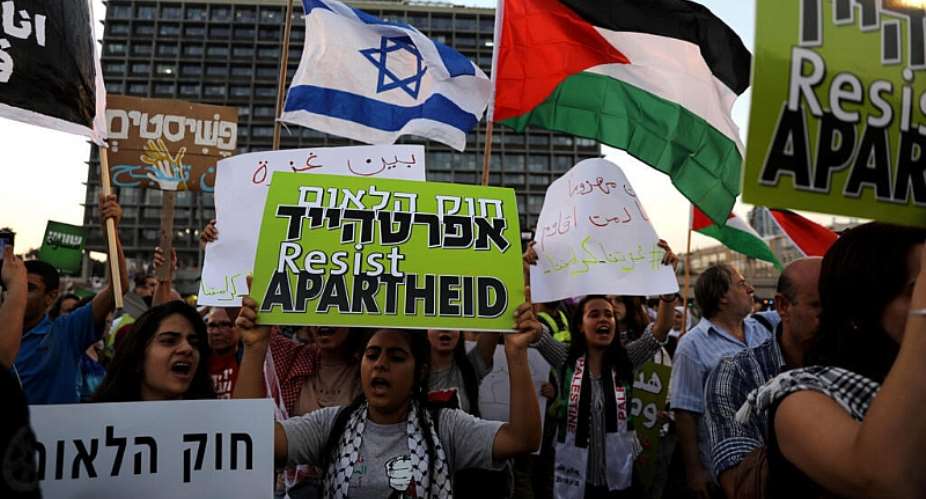
A significant turning point came in July 2018, when the Knesset passed the Nation-State Basic Law, declaring that the right to national self-determination in Israel is unique to the Jewish people.
The legislation also established Hebrew as the state's language, assigning Arabic a special status rather than its previous official standing.
While its supporters defended the law as an affirmation of Israel's Jewish identity, critics argued that it entrenched the unequal status of the country's non-Jewish citizens.
"For a long time, there has been a contradiction between these two imperatives sought by Israel's founding fathers: a Jewish and democratic state," Bitar tells RFI.
"We have seen that ethnic nationalism and religious exclusivism have prevailed over Israel's Declaration of Independence, which, on paper, was supposed to guarantee equality for all citizens."
Discrimination also extends to family life. Legislation introduced in 2003 and renewed in subsequent years has severely restricted family reunification between Israeli citizens and Palestinian spouses from the occupied territories, with Israeli authorities citing security concerns.
The contrast with the Law of Return, which facilitates immigration and citizenship for Jews from around the world, has long drawn criticism from Palestinian rights organisations.
Killing of Palestinian children and teens by Israel surges in West Bank
The situation has deteriorated further since the Hamas-led attacks on Israel on 7 October, 2023 and the subsequent war in Gaza.
Palestinian citizens in Israel have reported arrests, dismissal from employment and disciplinary proceedings over expressions of solidarity with Gaza or criticism of Israel's military operations.
"In theory, Palestinian Arabs are equal to Jewish citizens," Bitar says. "But very often, the devil is in the detail – in these discriminatory laws, in the reluctance of residents in certain neighbourhoods to mix with Palestinians in Israel."
He describes an increasingly oppressive atmosphere in which the expression of opposition to Netanyahu's policies can expose Palestinian citizens of Israel to accusations of sympathising with Hamas.
Economic inequality remains widespread. In 2024, almost 38 percent of Arab families in Israel were living below the poverty line – nearly twice the national average, according to Israel's National Insurance Institute.
Since 2022, racist acts against Arab citizens in Israel have increased steadily. In 2025, according to Israeli police, 241 out of 309 murder victims nationwide were Arab Israelis.
'Apartheid under international law'
Whether these inequalities amount to apartheid remains one of the most contentious questions surrounding Israel.
In a major report published in 2022, Amnesty International concluded that Israel maintained a system of domination and oppression of Palestinians amounting to apartheid under international law.
Its findings covered Palestinian citizens within Israel, Palestinians living under occupation and refugees whose rights remain affected by Israeli policies.
Israel has rejected the accusation, arguing that its Arab citizens enjoy democratic rights, including representation in parliament and access to the courts, and that the apartheid comparison misrepresents the country's political and security circumstances.
Amnesty accuses Israel of 'ethnic cleansing' of West Bank Bedouin communities
For Bitar, however, the latest election illustrates the limitations of formal democratic participation when political exclusion remains entrenched.
"The vast majority of Palestinians in Israel felt from the outset that the rhetoric about citizenship and equal rights was steeped in hypocrisy," he says. "They see themselves as second-class citizens."
He warns that the exceptional turnout by Arab voters seen in the latest election could prove a short-lived phenomenon if Eisenkot refuses to acknowledge their role in securing his parliamentary advantage.
"If Eisenkot does not move towards a coalition with these Arab MPs, this exceptional mobilisation will never happen again because they will have received definitive confirmation that they are, in a sense, regarded as pariahs by the Israeli political system."
That leaves Sunday's decision carrying significance well beyond the question of who succeeds Netanyahu.
For Israel's Palestinian minority, the test is whether its newfound electoral influence can translate into genuine political power – or whether it will remain confined to the margins of a democracy in which its place remains contested.
This article has been adapted from the original version in French by Anne Bernas.


 No proxy voting, strict 7am to 5pm schedule – NDC outlines measures for Northern...
 Efya marries Nigerian singer Tomi Thomas in traditional ceremony
 Motorists are becoming more responsible after TraffiTech deployment – NRSA
 Mahama to open Ghana Armed Forces critical care and emergency hospital
 Viral shoplifting suspect busted at Akode near Somanya
 Finance Minister to present 2027 budget on November 12
 Mahama announces emergency bed expansion at four major hospitals to tackle 'No-B...
 President Mahama has kept faith with Volta Region in infrastructure development ...
 'We will buy 100 new ambulances, procure parts to bring another 100 ambulances b...
 What Trump’s midterms debacle could mean for US support for Ukraine


