




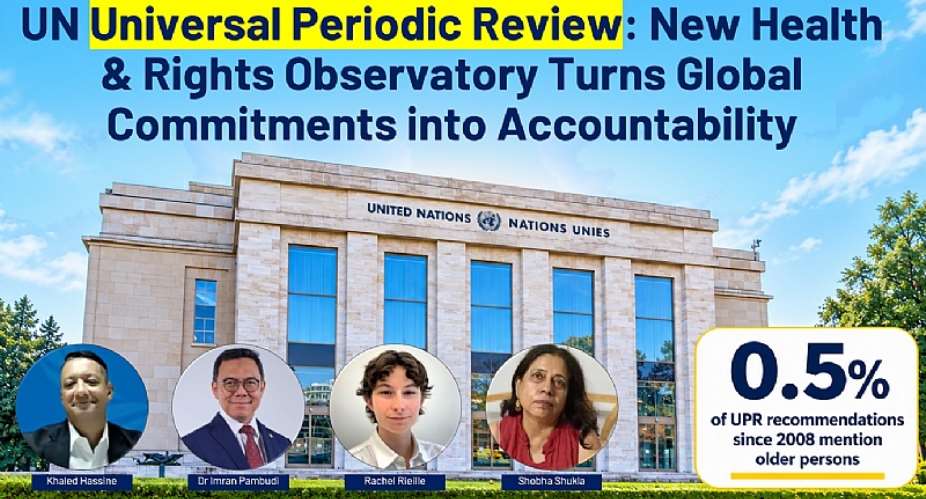
As the Universal Periodic Review enters another round in November 2026, a new public data platform is helping governments, diplomats and civil society connect human rights recommendations with health outcomes, track state commitments and identify gaps in implementation. Its findings also expose how some of the world's most vulnerable populations remain overlooked.
The Universal Periodic Review (UPR) is a unique process by the United Nations Human Rights Council where the human rights records of all 193 countries (UN member states) are reviewed every 4.5 years. It provides an opportunity for governments to scrutinise one another's performance, make recommendations and encourage improvements in human rights protection.
Human rights commitments are only as meaningful as their implementation. Yet, across countries and regions, a persistent challenge confronts governments, policymakers and advocates: how can they track whether promises made at the international level are translating into measurable improvements in people's lives?
One initiative seeking to bridge this accountability gap is the Health and Rights Observatory, developed by the Global Center for Health Diplomacy and Inclusion (CeHDI). The free, public and interactive platform connects UPR recommendations with health indicators and national legal frameworks, offering users a way to examine human rights commitments alongside real-world health outcomes.
Presenting the Health & Rights Observatory, Rachel Rieille, Data Manager at CeHDI, demonstrated how accessible data can transform the way governments, diplomats, civil society organisations and advocates engage with the UPR process. Rachel was speaking in SHE & Rights session held recently.
Turning UPR recommendations into accessible evidence
While international human rights mechanisms generate thousands of recommendations, the real challenge lies in tracking what happens after governments make their commitments. But navigating the enormous volume of recommendations, identifying recurring concerns and assessing government responses can be challenging.
The Health and Rights Observatory seeks to make this process more accessible by bringing together UPR recommendations and health-related data in one platform. Rieille explained that the Observatory organises UPR recommendations according to health themes derived from the World Health Organization (WHO)'s thematic framework. These include issues such as mental health, gender-based violence and harmful practices, maternal health and the health of older persons.
The platform is designed to serve diplomats, policymakers, civil society organisations and advocates who need evidence to prepare for reviews, monitor state commitments and identify gaps.
Its country-level dashboard allows users to select a country and access recommendations issued to that country. They can examine the number of health-related recommendations, explore the complete set of recommendations and download selected datasets for further analysis.
Users can also filter recommendations by specific health themes and examine how attention to particular issues has evolved across successive UPR cycles.
An especially useful feature is the ability to distinguish between recommendations that governments have supported and those they have merely noted. Through visualisations, users can track whether governments are becoming more receptive to particular human rights concerns over time.
The Observatory is not restricted to individual countries. Its regional and global dashboards allow users to examine recommendations across geographical groupings, compare trends and download data for independent research and advocacy.
Connecting human rights commitments with health outcomes
Beyond tracking recommendations, the Observatory addresses another important question: are human rights commitments reflected in improvements in people's health?
To explore this, CeHDI has incorporated health indicators covering universal health coverage, maternal health, cervical cancer and family planning, among other areas.
The platform also displays relevant national legal frameworks, including socioeconomic provisions and constitutional recognition of the right to health. This helps users understand not only what governments have been recommended to do but also the legal commitments they have undertaken.
Rieille demonstrated this approach in SHE & Rights session through the Observatory's maternal health section. Users can explore a country-level map showing maternal mortality estimates for 2023, compare trends over time and examine neighbouring countries. The dashboard also provides a breakdown of causes of maternal deaths, alongside global averages.
Such information can help advocates examine whether improvements in health outcomes are occurring alongside human rights commitments and where further action may be necessary.
By bringing together recommendations, health indicators and legal frameworks, the Health & Rights Observatory offers a more comprehensive picture of the relationship between human rights obligations and public health performance.
Its usefulness also extends beyond the immediate UPR review process. Civil society organisations can use the data to prepare submissions, identify neglected issues and question governments about implementation.
Importantly, the platform's code is open source and its datasets are publicly accessible, allowing independent scrutiny and further analysis.
The data exposes a glaring gap in older persons' rights
One of the most striking findings from the Health & Rights Observatory concerns older persons - a population group that remains significantly underrepresented in international human rights recommendations.
CeHDI's Rachel Rieille reported that approximately 29,000 health-related recommendations have been issued through the UPR globally. Of these, only 144 address the health of older persons. Among the population groups examined through the Observatory, older persons have received the fewest health-related recommendations. The nature of some recommendations also raises questions about whether older persons are being recognised as rights-holders.
Rieille cited a recommendation made by Venezuela to Chad during the third UPR cycle, calling for the strengthening of national health policy, particularly for women, children and older persons. While older people were mentioned, they appeared as one group in a broader list rather than being the specific focus of a recommendation addressing their health needs.
There are, however, encouraging signs. Governments support approximately 92% of recommendations concerning older persons' health, compared with 82% of health-related recommendations overall.
Attention has also increased across successive cycles. The first cycle recorded seven recommendations concerning older persons out of 2,956. In the ongoing fourth cycle, the number has risen to 76 out of approximately 10,000 recommendations. For Rieille, these trends suggest that states are beginning to recognise the issue, although much more attention is needed.
"When older persons are absent from data and reporting, they are absent from policy priorities. The scale of exclusion of older persons is also evident in the Universal Periodic Review (UPR). Since its establishment in 2008, only 681 of more than 124,539 UPR recommendations have addressed older persons, representing around 0.5%. This is why we urge the States to fully utilise the Health and Rights Observatory," said a statement made by Shobha Shukla, a person with lived experience, and who spoke at the Inter-Governmental Working Group meeting to draft a legally binding treaty for human rights of older persons. "Human rights of older persons, like those of people in all their diversities, are non-negotiable and must never be treated as an afterthought."
UPR: A mechanism for cooperation, not just scrutiny
Khaled Hassine emphasises that the UPR should not be understood merely as a mechanism for reviewing states' human rights records. UPR is also an important entry point for cooperation, engagement and actionable recommendations that governments can follow up. Because the process involves states reviewing one another, its recommendations can have considerable influence, encouraging governments to engage with human rights concerns raised by their peers.
Khaled Hassine serves as the Secretary, Intergovernmental Working Group on the Human Rights of Older Persons, Equality and Non-Discrimination Branch, Office of the United Nations High Commissioner for Human Rights.
For Hassine, the increasing visibility of older persons in UPR recommendations reflects greater awareness and a more coherent recognition of intersectionality.
He also points to the 2016 report of the UN Independent Expert, which provided the first comprehensive global analysis of the human rights situation of older persons across all regions. The report recommended a global framework of cooperation and a legally binding international instrument dedicated to older persons' rights.
The UPR, he argues, can contribute to building momentum towards such a framework by encouraging more substantive engagement and follow-up.
Indonesia's experience: Taking health commitments to communities
The importance of translating human rights commitments into practical policies is reflected in Indonesia, where more than 35 million people are now aged over 60, representing nearly 12% of the population. Dr Imran Pambudi, Director of Vulnerable Groups Health Services at Indonesia's Ministry of Health, describes ageing as a defining public health and social challenge.
Indonesia has adopted a life-course approach to healthy ageing through its Integrated Primary Care programme (ILP), now being implemented across more than 9,200 government-run Puskesmas community health centres. The programme brings health promotion, prevention, early detection, treatment and rehabilitation closer to communities.
Complementing this is the free health check programme, which has reached more than 12 million older persons. Screenings assess cognition, mobility, nutrition, vision, hearing and psychological wellbeing, helping identify risks early and preserve independence. Dr Pambudi stresses that healthy ageing is not simply about preventing disease or extending life expectancy. Older persons must have opportunities to remain independent, active and engaged in society.
He calls for stronger primary healthcare, sustainable long-term care financing, caregiver support, accessibility for persons with disabilities and greater attention to the voices of older persons themselves.
Human Rights Day: The test is implementation
As the November UPR cycle brings renewed attention to international human rights commitments, the Health and Rights Observatory developed by CeHDI offers a practical resource for examining what governments have promised, how they have responded and where gaps remain.
With International Human Rights Day on December 10 approaching, the challenge is to move beyond declarations and recommendations towards measurable improvements in people's lives.
Human rights commitments must be more than promises on paper. They must translate into dignity, equality, better health and justice for everyone.
Shobha Shukla – CNS (Citizen News Service)
(Shobha Shukla is a feminist, health and development justice advocate, and an award-winning founding Managing Editor and Executive Director of CNS (Citizen News Service). She serves as Chairperson of Global AMR Media Alliance (GAMA), Host and Coordinator of SHE & Rights (Sexual Health with Equity & Rights), President of Asia Pacific Media Alliance for Health, Gender and Development Justice (APCAT Media), and founder leader of DJOP (Development Justice for Older Persons) initiative. She is the author of 2026 book "Justice Unbound: Feminist Voices on Gender Equality, Health Rights, and Inclusive Futures" and was also the Lead Discussant for SDG-3 at United Nations inter-governmental High Level Political Forum 2025. GAMA , led by her, received the AMR One Health Emerging Leaders and Outstanding Talents Award at UN High Level Ministerial Conference on AMR 2024. Follow her on X @shobha1shukla or read her writings here www.bit.ly/ShobhaShukla)


 45 tonnes of cocaine were brought in by two Gulfstream jets in 2023 under Akufo-...
 22 drug seizures under Mahama means NACOC operations improved, intelligence now ...
 'NPP withdrawal of NACOC from port inspection teams in 2018 was major cause' – A...
 'NPP not morally qualified to lecture NDC on cocaine issues' — Akwatia MP hits b...
 Former Head of Civil Service explains why corruption is high in civil service
 SA evacuation: 'Some got GH¢2,000 instead of GH¢5,000; where is their money?' – ...
 Takoradi NPP MP threatens to boycott 2027 budget over stalled market circle proj...
 November 5: Cedi sells at GHS12.25 on forex market, GHS11.67 on BoG interbank
 Foreign Affairs Ministry pledges support to family of Ghanaian PhD graduate kill...
 How father and son allegedly beat 31-year-old man to death over cocoa beans at A...


