




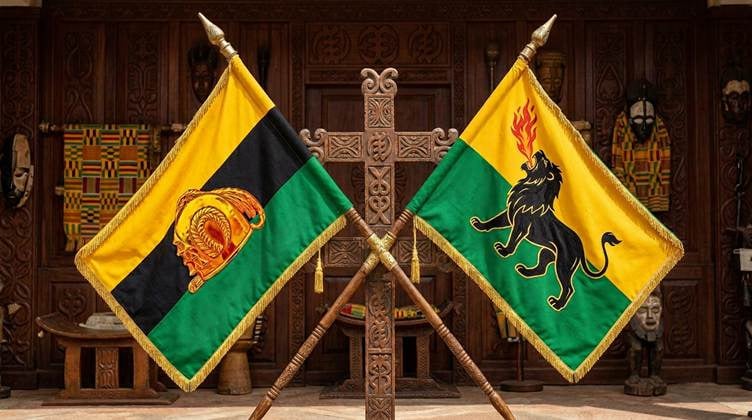
In the rich tapestry of West African history, few alliances match the geopolitical depth and emotional resonance of the bond between the Akwamu and Asante kingdoms. Rooted in the sacred Akan principles of brotherhood and reciprocity, their connection is defined by a deep ancestral pact: an 18th-century sanctuary that birthed an empire, and a late 19th-century intervention that saved a royal dynasty from total erasure.
The 17th-Century Shield: How Akwamu Saved the Asante Founder
The foundation of this unbreakable bloodline covenant began in the late 17th century during a time of intense political turmoil among the forest polities of the Gold Coast. Opemsuo Osei Tutu I, then a young prince and heir to the stool of Kwaman (which later became Kumasi), found himself fleeing for his life from the heavy-handed overlordship of the Denkyira kingdom.
Seeking a safe haven, the young prince fled eastward to the sophisticated court of Akwamuhene Nana Ansa Sasraku. Instead of surrendering the fugitive prince or treating him as a political pawn, the Akwamuhene chose to protect him.
Nana Ansa Sasraku brought Osei Tutu into the inner fabric of Akwamu statecraft. It was at the Akwamu capital of Nyanaoase that Osei Tutu met the legendary spiritual leader Okomfo Anokye. Under the tutelage of the Akwamuhene, Osei Tutu was mentored in advanced diplomacy, grand strategy, and military organization.
When the elders of Kumasi eventually recalled Osei Tutu to assume the throne, the Akwamuhene finalized his protection by providing a massive military escort of 1,000 elite Akwamu warriors to guarantee the prince's safe passage. These warriors chose to stay in Kumasi, forming the core of the foundational Asante military wings (the Adum and Asafo quarters). Armed with Akwamu’s tactical blueprints, Osei Tutu went on to defeat Denkyira and establish the mighty Asante Empire.
The 19th-Century Peril: Bloodlines Under Fire
By the late 19th century, the geopolitical scales had shifted, bringing a dark period of betrayal and existential threat to the Akwamu nation. As the direct descendants of the ancient Queen Yaa Ansaa—the indigenous, foundational bloodline custodians of the sacred Akwamu Black Stool (Amanpong Gua)—the royals faced a looming extinction.
In the wake of signing the 1886 and 1887 treaties with encroaching colonial forces, the Akwamuhene was tragically murdered. Following this assassination, an orchestrated campaign began to systematically wipe out the Akwamu royal family, threatening to extinguish the ancient lineage completely.
Faced with the political annihilation of his house, the successor to the sacred Black Stool, Nana Okra Akoto (who reigned as Akwamuhene from 1887 to 1909), realized he had to act dynamically to preserve their heritage. To shield the lineage, he secretly sent his sister's two royal children—a prince and a princess—into hiding.
Remembering the centuries-old debt of gratitude owed to the house of Akwamu, the Asantehene stepped forward to return the favor. Throughout the entirety of Nana Okra Akoto’s turbulent reign, these two royal children were granted absolute sanctuary and protection deep within the Asante kingdom, keeping the seed of the Akwamu dynasty safe from colonial forces and local adversaries.
The Return of the Prince and the 1910 Defiance
The protected prince, Nana Kwadwo Akoto, spent his youth in exile under the wings of the Asante throne. When his uncle, Nana Okra Akoto, passed away in 1909, the prince emerged from hiding to return home and rightfully occupy the Akwamu Black Stool.
Nana Kwadwo Akoto’s reign was defined by fierce, uncompromising bravery. He became the very first ruler to openly challenge the British Gold Coast administration regarding the forceful ceding of Akwamulands and the tactical absorption of the remaining territories into the British colony. His fierce defense of his people's sovereignty made him an immediate target; shortly after his pivotal meeting with colonial authorities, Nana Kwadwo Akoto was assassinated in 1910.
Though his life was cut short, the protected prince's lineage survived to shape global history. In the years that followed, Nana Kwadwo Akoto posthumously became the grandfather of Kofi Annan, the iconic former Secretary-General of the United Nations and global peace diplomat.
A Transatlantic Bloodline: The DNA of a Kingdom
Together, this historic union of Akwamu and Asante royalty bore six children. The eldest daughter of that sacred marriage, Nana Afia Serley, would grow up to become the direct grandmother of HRH Princess Barbara Vandross of Akwamu, keeping the ancient, unbroken covenant alive in the veins of the royal family today and fuelling the contemporary #QueenVictoriaSaidNo campaign.
To date, this monumental royal union has generated over 650 living descendants. Furthermore, recent autosomal and mitochondrial DNA (MtDNA) testing has revealed a profound global legacy: 126 African Americans have been identified as tracing their maternal lineage directly back to the Akwamu Princess, Nana Ofosuwaa.
This genetic link binds them directly as legal heirs to the historically sovereign, legally unincorporated Akwamu Kingdom—a legacy that stretches seamlessly across modern-day Ghana, Togo, and Benin. This remarkable lineage proves that the bond between the Asante and Akwamu is not just a matter of ancient history found in textbooks—it is a living reality, carried forward through generations of royal survival, sacrifice, and unbreakable family ties.
About the Author:
The author is HRH Princess Barbara of Akwamu, a direct descendant of the historic alliance between the Akwamu and Asante stools. As the granddaughter of the union between the Asantehene’s nephew, The Great Nana Kwame Tano I, and the protected 19th-century Akwamu princess, she serves as a modern guardian of her family's living heritage and champions the contemporary #QueenVictoriaSaidNo campaign.


 'NPP not morally qualified to lecture NDC on cocaine issues' — Akwatia MP hits b...
 Former Head of Civil Service explains why corruption is high in civil service
 SA evacuation: 'Some got GH¢2,000 instead of GH¢5,000; where is their money?' – ...
 Takoradi NPP MP threatens to boycott 2027 budget over stalled market circle proj...
 November 5: Cedi sells at GHS12.25 on forex market, GHS11.67 on BoG interbank
 BoG Governor tells Queen Máxima about Ghana’s digital finance gains for business...
 Foreign Affairs Ministry pledges support to family of Ghanaian PhD graduate kill...
 Number of Ghanaians living abroad rises to 293,416 in 2021
 How father and son allegedly beat 31-year-old man to death over cocoa beans at A...
 Ghana, Trinidad and Tobago explore joint mechanism for reparatory justice engage...


