




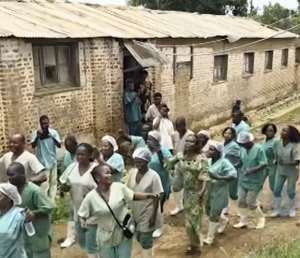
In Mongbwalu, a gold-mining town in the Democratic Republic of Congo's Ituri province, health workers in head-to-toe protective suits sang and danced outside an Ebola treatment centre.
With the discharge of its last remaining patients, the Doctors Without Borders (MSF)-run facility had, for the first time since May, no confirmed Ebola patient under treatment. Local residents joined the celebration.
Video of the scene, shared by Al Jazeera on TikTok on 30 October, spread quickly online, and viewers across Africa praised the health workers.
A milestone, not an ending
MSF itself has been careful. The discharge of the final patients is an important milestone for the Mongbwalu facility, but it does not mean the outbreak has ended or that new cases cannot emerge. The announcement also concerns patients at this particular centre, not the wider situation across Ituri province or the country.
The outbreak, declared in May, has by your account passed 10,000 confirmed cases. I could not verify that figure in the sources I found, so confirm it against the latest WHO or DRC Ministry of Health situation report before publication.
Why Mongbwalu matters
Mongbwalu was hit hard. A WHO official was there in June for the discharge ceremony of one of the first Ebola survivors in the town. At one point there were around 30 Ebola patients at Mongbwalu General Hospital.
The town also had been spared the 2018-2020 Ituri outbreak, so when deaths spiked, many residents doubted the virus was real. That disbelief is one of the hardest obstacles in any Ebola response, and the empty treatment ward is a sign that trust, care and community work have counted for something.
What the 42-day rule means
An outbreak is not declared over when the last patient goes home. WHO's standard is 42 days since the last patient was discharged, twice the maximum incubation period, with no new cases.
Uganda, whose cases were all linked to Ituri, was declared Ebola-free after that 42-day period. Mongbwalu has not reached that point. Until the whole province and country do, surveillance, contact tracing and survivor follow-up must continue.
Lessons for West Africa
For readers in Ghana and West Africa, the lesson goes beyond Congo. Ebola does not respect borders, as Uganda's imported cases showed. Early isolation, trained frontline staff, community engagement and rapid testing decide whether an outbreak stays local or spreads. The health workers who sang in Mongbwalu did so after months of risking their own lives, and they deserve credit. The region should use their example to strengthen its own readiness.
Mustapha Bature Sallama
Medical/ Science Communicator,
Private Investigator, Criminal Investigation and Intelligence Analysis,
International Conflict Management and Peacebuilding. (USIP)
[email protected]
+233555275880
Sources
Africanews, "DR Congo: MSF celebrates Ebola patient discharges in Ituri province" (30 Oct 2026)
Euronews video report on the Mongbwalu discharges (30 Oct 2026)
Briefly News, on the Al Jazeera video (30 Oct 2026)
Africanews, "Uganda officially Ebola-free, 42 days after last patient discharged" (29 Jul 2026)
WHO/UN Media, DRC Ebola survivor discharge, Mongbwalu (12 Jun 2026)


 24-year-old Ghanaian found dead in New York, days after teenager’s murder
 Melania Trump to host Ukrainian, Russian officials at White House
 Bread shortage threatens to plunge more Sudanese into hunger
 South Korea to deploy military mission to keep Strait of Hormuz open
 How Chinese AI is censoring the controversy around Mbappé’s Chairman Mao comment...
 'Ghana should also organise midterm elections to boot out lazy MPs' – Solomon Ow...
 ‘We tasted death’ – Lil Win recounts terrifying PassionAir flight incident with ...
 Ghana demand justice over second citizen killed in New York within a week
 TraffiTech-GH: 'If the fines are too expensive, then do not speed' – Mahama
 GFA President urges Parliament to reverse ban on alcohol sponsorship of sports


