




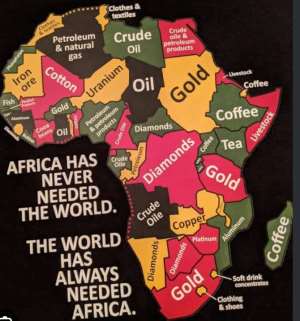
Africa's resource story is a paradox. The continent owns the minerals, yet too little of their value stays here. Africa holds about 30 per cent of the world's mineral resources. One report estimates US$29.5 trillion in mine-site mineral wealth, while the continent captures only a small share of the downstream value.
Owning the ore is not owning the value
The gap is in processing. Africa captures under one per cent of the value created when critical minerals are refined into products such as magnets and battery materials. By one estimate, about 70% of the continent's minerals leave in raw form, along with about 70% of its crude oil and 45% of its natural gas.
Meanwhile, Africa imports finished parts, battery packs, solar panels and electric vehicle modules. Analysts describe this as paying twice for its own wealth. Africa sells cheap and buys back dear.
Who captures the value
Refining sits mostly outside Africa. China processes a majority of the minerals from Africa, and its share of global cobalt refining is large. Uganda shows the exposure of raw dependence: gold made up 76.6% of its 2026 export earnings, over $5.8 billion. Dependence on one raw commodity leaves an economy at the mercy of prices set elsewhere.
Why the barriers persist
Experts point to limited investment in exploration, processing facilities, transport infrastructure and downstream industry. Intra-African trade is also thin: only about 2% of exports are traded within the continent.
Signs of change
Governments are pushing back. Zimbabwe has restricted raw lithium exports, and Gabon has set 2029 to stop exporting raw manganese. The DRC has suspended exports of copper and cobalt concentrates. Over 13 African nations now restrict raw mineral exports.
In July 2026, the African Development Bank urged countries to halt raw critical mineral exports and focus on local processing and regional value chains. Zimbabwe's policy aims to create jobs and retain export earnings.
What must follow
Export bans alone are not enough. Processing plants need reliable power, transport and finance, and Africa needs trained technicians and fair contracts that keep more value at home.
Success depends on combining mineral resources with infrastructure, capital, technology and coordinated policies. Regional cooperation matters too, since no single small market can build a refinery alone.
Conclusion
Africa's resources are not useless. We have simply not yet made them work for us. Until the continent processes, manufactures and trades what it mines, the minerals will keep building prosperity elsewhere. Ownership must become industry, jobs and bargaining power.
Mustapha Bature Sallama
Medical/ Science Communicator,
Private Investigator, Criminal Investigation and Intelligence Analysis,
International Conflict Management and Peacebuilding. (USIP)
[email protected]
+233555275880
References
AfDB via AllAfrica / ThisDay, "Africa Must Utilise Its 30% Global Share of Minerals, Halt Export" (21 July 2026)
News Agency of Nigeria, "Reshaping Africa's mineral future through value addition"
Energy News Network, "Why Africa is done exporting its minerals raw" (6 July 2026)
Down To Earth, report on Africa's US$29.5 trillion mineral wealth
UNECA, talking points on critical minerals and green industrialisation (27 April 2026)
Mining Focus Africa, on the UN General Assembly minerals roundtable
Standard Media (Kenya), "How Africa plans to protect its green wealth"
China Global South, on Zimbabwe's raw lithium export ban


 24-year-old Ghanaian found dead in New York, days after teenager’s murder
 Melania Trump to host Ukrainian, Russian officials at White House
 Bread shortage threatens to plunge more Sudanese into hunger
 South Korea to deploy military mission to keep Strait of Hormuz open
 How Chinese AI is censoring the controversy around Mbappé’s Chairman Mao comment...
 'Ghana should also organise midterm elections to boot out lazy MPs' – Solomon Ow...
 ‘We tasted death’ – Lil Win recounts terrifying PassionAir flight incident with ...
 Ghana demand justice over second citizen killed in New York within a week
 TraffiTech-GH: 'If the fines are too expensive, then do not speed' – Mahama
 GFA President urges Parliament to reverse ban on alcohol sponsorship of sports


