




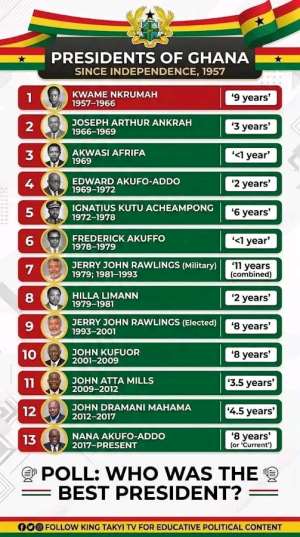
Nearly seven decades after independence, Ghana has experienced visionary leadership, military interventions, economic transformations, political instability and democratic progress. But which of the country's leaders made the greatest contribution to national development?
Since gaining independence from British colonial rule on 6 March 1957, Ghana has been governed by different political leaders, each leaving a distinctive mark on the nation's history. Some are remembered for bold development programmes, others for economic reforms, political stability, democratic consolidation or controversial decisions that continue to shape public debate.
Ghana's leadership journey began with Dr Kwame Nkrumah, who became Prime Minister at independence and the country's first President when Ghana became a republic in 1960. Nkrumah championed industrialisation, education, infrastructure development and African unity. Major initiatives associated with his administration included the Akosombo Dam, Tema Harbour, industrial enterprises and the expansion of educational institutions. However, his government also faced criticism over authoritarianism, economic difficulties and the introduction of a one-party state before his overthrow in February 1966.
Following Nkrumah's removal, Lieutenant General Joseph Arthur Ankrah led the National Liberation Council from 1966 to 1969. His administration sought to stabilise the economy and reverse some of the policies of the previous government. He was succeeded briefly by Lieutenant General Akwasi Afrifa, who oversaw the transition to civilian rule in 1969.
Edward Akufo-Addo became President of Ghana's Second Republic in 1970, serving as a largely ceremonial head of state under the parliamentary government of Prime Minister Kofi Abrefa Busia. The administration pursued economic reforms but struggled with financial pressures and public dissatisfaction before the military coup of January 1972.
Colonel Ignatius Kutu Acheampong subsequently assumed power and governed from 1972 to 1978. His administration introduced the popular Operation Feed Yourself programme to encourage domestic food production and reduce dependence on imported food. However, the period also witnessed growing inflation, economic deterioration, shortages and allegations of corruption.
Lieutenant General Frederick W. K. Akuffo replaced Acheampong in July 1978 but remained in power for less than a year before the military uprising of June 1979.
Flight Lieutenant Jerry John Rawlings emerged as a major political figure during that uprising. His Armed Forces Revolutionary Council governed briefly before handing over power to the elected government of President Hilla Limann in September 1979.
President Limann attempted to restore democratic government and address Ghana's economic challenges. However, his administration was overthrown by Rawlings on 31 December 1981, ending the Third Republic.
Rawlings subsequently governed through the Provisional National Defence Council until January 1993, when Ghana returned to constitutional democracy. His leadership was associated with economic recovery policies, decentralisation, rural development and the restoration of multiparty government. Nevertheless, his military years remain controversial because of political repression, executions and human rights abuses.
As the first President of the Fourth Republic, Rawlings served two elected terms from 1993 to 2001. His peaceful handover of power to opposition leader John Agyekum Kufuor in January 2001 became a significant milestone in Ghana's democratic development.
President John Agyekum Kufuor governed from 2001 to 2009. His administration introduced the National Health Insurance Scheme, the School Feeding Programme and other social interventions. Ghana also benefited from debt relief under the Highly Indebted Poor Countries initiative. His government is remembered for economic expansion and institutional reforms, although concerns about corruption, public expenditure and inequality persisted.
Professor John Evans Atta Mills became President in January 2009. His administration emphasised political stability, economic management and social development. Ghana began commercial oil production during his presidency in December 2010. Mills was widely regarded by supporters as a calm and modest leader, but his presidency ended prematurely following his death in July 2012.
John Dramani Mahama succeeded Mills and subsequently won the December 2012 presidential election. During his first administration, from 2012 to January 2017, Ghana experienced infrastructure expansion in roads, energy, health and education. However, his government also faced serious economic challenges, including currency depreciation, fiscal pressures and the electricity shortages popularly known as dumsor.
Nana Addo Dankwa Akufo-Addo assumed office in January 2017 and served until January 2025. His administration introduced Free Senior High School education, pursued digitalisation initiatives and implemented programmes such as One District, One Factory. However, his government also faced criticism over rising public debt, inflation, the economic crisis of 2022, corruption concerns and the domestic debt exchange programme.
John Dramani Mahama returned to office on 7 January 2025 after winning the 2024 presidential election, becoming the first former President of Ghana's Fourth Republic to regain the presidency after leaving office. His current administration faces the challenge of restoring economic confidence, creating jobs, strengthening public institutions and delivering sustainable development. As his second presidency is ongoing, its full legacy cannot yet be assessed.
Looking across Ghana's political history, every administration has operated under different economic, social and international circumstances. Some inherited severe economic crises, while others benefited from favourable commodity prices, external financial support or periods of relative stability.
It would therefore be unfair to judge national leadership solely by popularity, length of service or the number of projects undertaken. A meaningful assessment must consider economic performance, education, healthcare, infrastructure, industrialisation, agricultural development, employment, corruption, human rights, institutional strength and democratic accountability.
For example, Nkrumah's industrialisation agenda laid important foundations for national development, while Kufuor's social interventions expanded access to healthcare. Rawlings played a central role in Ghana's transition to the Fourth Republic, although his military record remains deeply contested. Mills is remembered for his leadership style, Mahama for infrastructure development, and Akufo-Addo for expanding access to secondary education.
Yet Ghana continues to face many of the challenges that confronted earlier generations: unemployment, inadequate industrial development, corruption, weak maintenance culture, dependence on imported goods, rising living costs and uneven development between urban and rural communities.
This raises an important question: After nearly 70 years of independence, has Ghana achieved the level of development its founding leaders envisioned?
The answer requires more than praising or criticising individual presidents. It demands an honest examination of how successive governments have used national resources, strengthened institutions and improved the living conditions of ordinary citizens.
Good leadership should ultimately be measured by lasting improvements in people's lives, not merely by political speeches, election victories or personal popularity.
Ghana's history reminds us that no leader is perfect and no administration is without achievements or failures. The responsibility of citizens is to recognise genuine progress, question poor decisions and demand accountability regardless of political affiliation.
WHO WAS GHANA'S BEST NATIONAL LEADER SINCE INDEPENDENCE?
Was it Kwame Nkrumah for his vision of industrialisation and African unity? Kutu Acheampong for promoting domestic agriculture? Jerry John Rawlings for his emphasis on discipline and political transformation? John Agyekum Kufuor for social interventions and economic reforms? John Evans Atta Mills for his leadership style? John Dramani Mahama for infrastructure development? Or Nana Akufo-Addo for expanding access to secondary education?
Perhaps the most important question is not simply who was the best, but which leader left Ghana stronger, more prosperous, more united and better prepared for the future?
Let us discuss this important part of our national history with facts, fairness and respect.
Ghana belongs to all of us, and its development must remain greater than any political party or individual leader.
By Frank Ayim Damptey

 BoG Governor tells Queen Máxima about Ghana’s digital finance gains for business...
 Foreign Affairs Ministry pledges support to family of Ghanaian PhD graduate kill...
 Number of Ghanaians living abroad rises to 293,416 in 2021
 How father and son allegedly beat 31-year-old man to death over cocoa beans at A...
 Ghana, Trinidad and Tobago explore joint mechanism for reparatory justice engage...
 24-year-old Ghanaian found dead in New York, days after teenager’s murder
 Bread shortage threatens to plunge more Sudanese into hunger
 South Korea to deploy military mission to keep Strait of Hormuz open
 How Chinese AI is censoring the controversy around Mbappé’s Chairman Mao comment...
 ‘We tasted death’ – Lil Win recounts terrifying PassionAir flight incident with ...


