




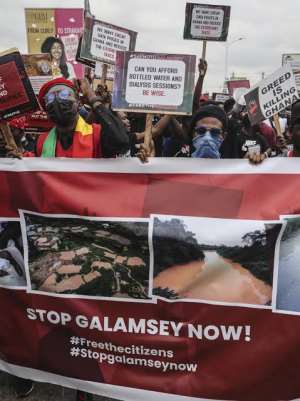
You can smell the Pra before you see it.
Those who have stood on its banks in the Western Region describe the same thing: wet clay, diesel, and something faintly metallic underneath. A river that fed grandmothers, baptised children and watered cocoa for generations now carries the colour of weak tea mixed with mud, and nobody in power seems to find that unbearable.
I do.
And I am tired of being told, politely, that this is "an economic issue" or "an environmental challenge" to be handled by a committee.
Let me say it plainly, the way I would say it at a funeral: galamsey is a human rights crisis.
It is the slow, daily violation of the right to clean water, to health, to livelihood and, in the end, to life. It is happening with the knowledge of the state, and in too many places with the help of people the state pays.
This is not a partisan article. I belong to no party and I want nothing from any of them. I want Ghanaian children to drink water that does not hurt them.
The Numbers Do Not Lie, Even When We Do
Start with the water, because everything else starts there.
The Ghana Water Company has recorded turbidity at intake points along the Pra, Birim, Ankobra, Tano and Offin of between 12,000 and 14,000 NTU. Its treatment plants were designed to cope with about 2,000. A safe level for drinking water is measured in single digits.
Read that again: the rivers we depend on arrive at the plant many times dirtier than the plant was ever built to handle.
The consequences are not abstract.
The company has shut down or throttled plants at Kyebi on the Birim and Daboase on the Pra. It has told the public that treatment costs keep climbing and that equipment keeps breaking down. It has said that more than 140,000 people around Odaso and Obuasi in the Ashanti Region received sharply reduced water supply because illegal mining was choking its operations.
Experts quoted by the Institute for Security Studies warn that if nothing changes, Ghana could be importing water by 2030.
Let that sink in.
A country with the Volta, the Pra and the Ankobra, importing water.
To be fair and accurate, because honest advocacy has to be both: galamsey is not the only polluter.
In August 2026, scientists at the CSIR Water Research Institute reported that around 60 percent of Ghana's water bodies are polluted, with illegal mining named as a major contributor alongside farming, industry and household waste.
But in the mining belt, the damage from galamsey is the most visible and, in many basins, the most severe. Readings of tens of thousands of NTU have been reported on the Birim and the Ayensu.
Nobody can honestly call that a minor contributor.
The Poison You Cannot See
Mud is ugly, but mud is not the worst of it.
Gold miners who work without regulation use mercury to catch fine gold, and cyanide and other chemicals to extract more. What they do not catch washes downstream.
The World Health Organization is clear that mercury, even in small amounts, can seriously harm health and is especially dangerous to a child in the womb and in early life. Arsenic and lead carry their own long list of harms.
In September 2025, Pure Earth and Ghana's Environmental Protection Agency published a study of artisanal gold-mining communities that found heavy metals such as lead and arsenic in food.
Other research, cited in analyses of the crisis, links mining-polluted water to kidney failure, birth defects and cancer in mining communities.
These are the kinds of illnesses that do not make headlines because they arrive one family at a time.
Now consider cocoa, the crop Ghana likes to call its pride.
COCOBOD has reported that more than 19,000 hectares of cocoa farms have been destroyed or damaged by illegal mining. In the areas it assessed, mining had affected 81 percent of cocoa farmland in the Eastern Region, 74 percent in the Western Region and 68 percent in Ashanti, the regions that produce the overwhelming share of our cocoa.
Here I owe you precision, because a loud voice that misleads is worth nothing.
A 2025 study in the Fanteakwa District, an area hit by galamsey, found mercury, arsenic, cadmium and lead in the soil of cocoa farms, while the beans tested were within international safety limits.
So I will not tell you that our chocolate is poisoned.
I will tell you that the soil under our farmers' feet is carrying a toxic load, that mercury is known to linger for years once it enters the ground, and that Ghana's farmers are watching their land and their incomes ruined.
When a country dismisses such findings as not alarming, it is gambling with its export market and with its people's bodies.
It is also worth being honest that cocoa is struggling for other reasons too, including weather, swollen shoot disease and ageing trees. Galamsey is one blow among several, but it is a blow we chose to allow.
Why I Call It a Violation of Rights, Not Just Damage
Words matter, so let me defend mine.
In 2010, the United Nations General Assembly recognised the right to safe drinking water and sanitation as a human right.
In 2022, it went further and recognised the right to a clean, healthy and sustainable environment.
Ghana's 1992 Constitution directs the state to protect and safeguard the national environment.
When a state knows that its citizens' drinking water is contaminated, has the laws to act, and does not act, we are no longer talking about bad luck.
We are talking about a failure of duty.
A fisherman who can no longer fish, a mother boiling river water that no kettle can clean, a farmer on land that a digger reached first: these are not statistics.
They are rights-holders.
And the people who did this to them are not faceless forces.
They have names, phones and sponsors.
Education Is a Health Issue, and a Child's Mind Is a Public Resource
I write as a storyteller and a filmmaker, and I want to widen the lens, because the damage does not stop at the riverbank.
In the cities we talk about artificial intelligence and digital transformation. In rural and underserved communities, a great many children still struggle to read a simple paragraph.
According to figures cited by Ghanaian education experts in 2024, about 53 percent of 10-year-olds in Ghana lack proficiency in literacy and numeracy, and World Bank research suggests the average knowledge of a senior high school graduate sits around the level of a Year Six pupil.
Across sub-Saharan Africa, the World Bank and UNESCO estimate that nearly nine in ten 10-year-olds cannot read and understand an age-appropriate text.
Learning poverty, as they call it, is a prison with no walls.
What has this to do with galamsey?
Everything.
A child who drinks unsafe water misses school. A family that loses its farm to a pit cannot afford books. A community whose river is dead loses the thing that held its economy together.
Poverty, poor health and poor learning feed each other in a circle, and rural children are the ones trapped inside it.
Education is a public health determinant.
A literate mother reads the label on the medicine. An educated community demands clean water and knows how to organise for it.
When we fail the classroom, we are also failing the clinic, and the other way around.
So my call is not only to government.
I am challenging my own industry too.
We in the creative world, the writers, filmmakers, musicians and influencers who make good money from this country's attention, must stop waiting for state budgets and put real money and real time into grassroots literacy and community health.
If we can afford a launch party, we can afford a reading corner in a village school.
Who Protects the Pits?
Ask yourself a simple question:
How does an excavator, a machine you can see from the road, work for months on a riverbank in a country with soldiers, police, district chief executives and a Minerals Commission, and nobody stops it?
The answer, repeated again and again by Ghanaians who have no reason to lie, is protection.
In February 2026, a civil society network expressed grave concern over revelations that galamsey was being systematically taxed, receipted and shielded by people appointed to stop it.
A report covered in the Ghanaian press said political actors, police officers, customs agents and even chiefs are reportedly profiting from illegal mining across several regions.
The President of the National House of Chiefs himself has called for the naming and shaming of every chief and political actor involved.
University teachers have said that Operation Vanguard failed because of corruption and political interference.
In 2026, a municipal anti-illegal mining task force was inaugurated in Kyebi with a warning to political actors against shielding or benefiting from galamsey.
I must be careful here.
These are allegations and reports, and in a country that respects due process, allegations must be investigated and proven.
That is exactly my point.
Ghana needs independent investigations by bodies that no party can switch off, and courts that do not blink.
And please do not let anybody turn this into a football match between two colours.
As one editorial put it plainly, both major parties have presided over the decay of the Pra and the Ankobra.
The crisis has outlived every government that promised to end it.
With gold at several thousand dollars an ounce, a single season of mining can bring in more than a junior civil servant earns in a lifetime.
When the reward is that high and the punishment that rare, only fools expect restraint.
There is a bright spot, and I want to name it because honesty includes credit.
Otumfuo Osei Tutu II has stood against galamsey, and his authority has been used to destool chiefs involved in it.
That is what accountability by example looks like.
It proves that when leaders decide, things happen.
It also shows how rare the decision is.
Principled Voices or Purchased Silence
Now I come to the part that makes some of my own colleagues uncomfortable.
A country does not lose its rivers only to the people holding the excavators. It loses them also to the people who could have shouted and did not.
There is a quiet trend in Ghana that nobody likes to discuss: intellectuals, creatives, activists and commentators who start out sharp, then receive a contract, an appointment, a board seat, a consultancy, and slowly discover that their conscience has become more diplomatic.
No one has to be threatened.
A comfortable chair is enough.
I am not accusing anyone by name, and I do not claim that everyone who serves in government has sold out. Many serve honestly.
My point is about the pattern and the danger of it.
A critic who owes his income to those in power is no longer a critic.
He is a spokesperson who has not yet admitted it.
So, on my own account, here is my manifesto, short enough to remember:
My loyalty belongs to citizens, not to manifestos. I will praise whoever does right and condemn whoever does wrong, whatever colour they wear.
I will not take what silences me. If a favour has strings, I will not touch it.
I will check my facts before I raise my voice, because a movement built on exaggeration collapses at the first fact-check.
I will stay an uncomfortable mirror to whoever holds power, because that is what patriotism actually costs.
I invite every writer, preacher, lecturer, filmmaker and influencer reading this to adopt the same rules or write better ones.
What Must Happen Now
Anger without demands is just noise, so here are mine.
Publish the Truth
The Ghana Water Company, the Water Resources Commission and the EPA should publish turbidity and heavy-metal results regularly and in plain language, with maps of hotspots. Communities have a right to know what is in their water.
Test the People and the Food
Fund independent testing of water, fish, soil and crops in mining areas, and offer free screening and treatment to affected communities, with pregnant women and children first.
Open the Licence Books
Create a public digital register of every small-scale mining licence and permit, so any citizen can see who is allowed to dig where. Support the promised reform of mining licensing laws and see it through.
Prosecute the Protectors, Not Just the Diggers
Arresting poor young men with shovels while the financiers and gatekeepers sleep soundly is theatre. Empower the Office of the Special Prosecutor and the courts to pursue officials, chiefs, security personnel and sponsors with evidence, regardless of party.
Give Young People an Alternative
Many galamsey workers are desperate, not wicked. Pair enforcement with real jobs, land restoration work and support for farmers. Otherwise, the pits will refill as fast as they are closed.
Treat Education as Health Policy
Move books, trained teachers and clean sanitation to the rural schools that have none, and measure success by whether children can read, not by buildings opened.
Restore What Was Destroyed
Make the polluters and their backers pay for land and river rehabilitation instead of leaving the bill to the next generation.
The Last Word
Ghana does not have unlimited rivers.
Gold can be mined again in another form; a river that dies does not come back in our lifetime.
We are the generation that will be asked, by our own children, what we did while the water changed colour.
I do not want to answer that I wrote a clever column and went home.
Speak. Investigate. Vote with open eyes. Refuse the envelope and the comfortable chair.
And remember that a nation does not fall because bad people are loud.
It falls because good people were bought, or just tired.
The Pra is still flowing.
Barely.
Let us not wait until the day we have to import our own water to find our voices.


 BoG Governor tells Queen Máxima about Ghana’s digital finance gains for business...
 Foreign Affairs Ministry pledges support to family of Ghanaian PhD graduate kill...
 Number of Ghanaians living abroad rises to 293,416 in 2021
 How father and son allegedly beat 31-year-old man to death over cocoa beans at A...
 Ghana, Trinidad and Tobago explore joint mechanism for reparatory justice engage...
 24-year-old Ghanaian found dead in New York, days after teenager’s murder
 Bread shortage threatens to plunge more Sudanese into hunger
 South Korea to deploy military mission to keep Strait of Hormuz open
 How Chinese AI is censoring the controversy around Mbappé’s Chairman Mao comment...
 ‘We tasted death’ – Lil Win recounts terrifying PassionAir flight incident with ...


