




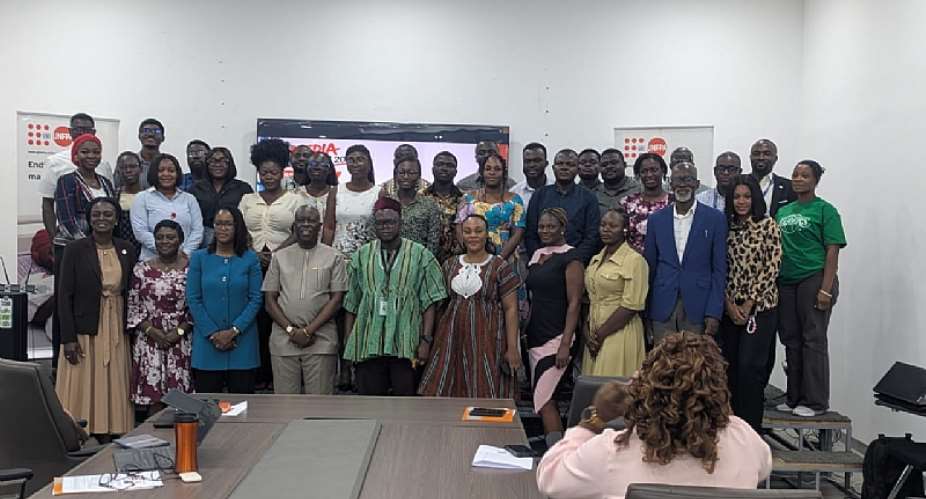
The United Nations Population Fund (UNFPA) Ghana has urged journalists to go beyond reporting incidents and examine the impact of development programmes on the lives of women, girls and young people.
The call was made by the UNFPA Country Representative, Dr Wilfred Ochan, at a media forum held at the Ministry of Finance in Accra on Wednesday, November 4.
The forum, held under the theme “Conversations beyond the headlines”, brought together journalists from broadcast, print and online media to discuss the organisation’s programmes, partnerships and interventions in Ghana.
Addressing the participants, Dr Ochan said the media had a crucial role in holding institutions accountable and helping the public understand how policies and development initiatives affect their lives.
“We do not expect you to become the publicity arm of UNFPA. That is not your responsibility. We want you to ask questions: Are the partnerships producing results? Are we reaching those who need support? Are we listening to the communities we work with? What could we do better?” he said.
Dr Ochan said UNFPA’s work in Ghana is anchored in partnerships with government institutions, traditional authorities, civil society organisations, young people and development partners.
He cited interventions in family planning, maternal health, adolescent and youth development, population data and efforts to end harmful practices such as child marriage.
“As you tell the stories of women, girls and young people, let accuracy, dignity and independence guide your work,” he said, urging journalists to protect the privacy of survivors of violence and vulnerable young people.
The forum also featured a presentation on UNFPA Ghana’s 8th Country Programme by the organisation’s Deputy Representative, Emmily Kamwendo Naphambo.
Dr Naphambo explained that the programme, which began in 2023, was designed to reduce preventable maternal deaths and address unmet needs for family planning through three main areas: quality health services, gender and social norms, and adolescent and youth development.
She said the programme was built on the understanding that improving reproductive health outcomes required an integrated approach, including access to information, quality healthcare and contraceptives.
“If we remove the provision of services, it means that the adolescent girl does not have the necessary tenets to enable her survive, and we cannot achieve the goal that we want to achieve at the end of the day,” she said.
The Deputy Representative presented some of the programme’s targets for 2027, including increasing modern contraceptive use from 25 per cent in 2022 to 40 per cent and improving skilled birth attendance from 79 per cent to 91 per cent.
The programme also seeks to reduce unmet need for family planning from 29.9 per cent to about 19.4 per cent, while reducing the proportion of women in unions experiencing sexual and domestic violence from 27 per cent to 22 per cent.
On maternal health, the programme’s target is to reduce maternal deaths from a baseline of 310 per 100,000 live births to 120 per 100,000 live births by 2027.
The forum also featured sessions on youth participation, reproductive health progress, gender-based violence, child marriage and population trends in Ghana.
It formed part of UNFPA Ghana’s engagement with the media to strengthen access to evidence, promote public understanding of its programmes and encourage sustained scrutiny of development outcomes.


 NPP accuses Mahama govt of abandoning Bolga–Bawku–Pulmakom road while prioritisi...
 Close to 300 unqualified persons including drug traffickers hold diplomatic and ...
 US midterm elections must serve as a lesson to NDC – Osahen Afenyo-Markin
 Sammi Awuku earns LL.M. in international energy law
 Speaker Bagbin defends decision to eject Abu Jinapor, dismisses Minority walkout...
 'I cannot be intimidated by any caucus' – Speaker Bagbin warns
 Sam George pushes for probe into Ningo-Prampram military brutalities
 Democrats warn Trump camp to ‘lawyer up’ as anger over corruption drives midterm...
 'They must be sacked now' – NPP demands dismissal of NACOC, GACL, GPHA, National...
 AMA gives traders 48 hours to vacate unauthorised bus stops ahead of enforcement


