




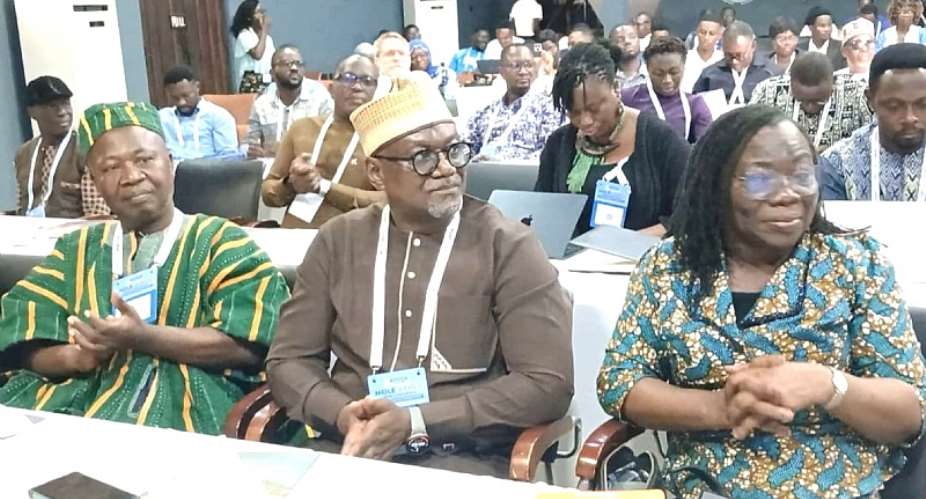
Ghana cannot achieve clean, safe, and climate-resilient environmental sanitation until it creates an independent National Sanitation Authority (NSA) to regulate, license, and enforce standards, participants at the 37th MOLE WASH Conference (MOLE XXXVII) have declared.
Speaking on the sub-theme “WASH as a Political Priority—Leadership, Governance, and Accountability" at the ongoing MOLE Conference, Mr. Kweku Quansah, Deputy Director at the Ministry of Local Government, Chieftaincy, and Religious Affairs, said the proposed NSA would be a dedicated independent regulator focused on quality, safety, fairness, and reliability of environmental sanitation services.
He said since 2017, the WASH sector has proposed practical structures to strengthen regulation, financing, and enforcement: the National Sanitation Authority, the National Sanitation Fund, and a strengthened enforcement regime. Political commitment, he stressed, must now be backed by institutions, funding, and enforceable systems.
The conference organized by CONIWAS is being held from November 1 to 6 on the theme “Accelerating Climate-Resilient WASH Service Delivery for Last-Mile Communities: Options, Strategies, and Actions,” building on the deliberations of MOLE XXXVI.
The Media Coalition Against Open Defecation (M-CODe), through the empowerment of World Vision Ghana, is providing a strategic and targeted communication platform for the conference, ensuring national visibility and citizen engagement.
Mr. Quansah said environmental sanitation must be treated as a public good and kept as a national priority, not as a favour or periodic clean-up campaign.
He said Ghana’s main challenge is not the absence of policies but a weak delivery system characterized by four failures.
First, unclear accountability. Responsibilities overlap, and in some cases the same local authority helps deliver services and oversees performance. Policies exist, but tariffs, service standards, monitoring, and enforcement are weak or absent. There is no enforceable authority over performance and standards.
Second, unpredictable financing. No predictable financing mechanism exists. Public financing causes delayed payments, weak accountability, and payments decoupled from performance.
Third, weak performance measurement. Without consistent service measures, it is difficult to compare providers, identify gaps, reward improvement, or sanction non-performance.
Fourth, service disputes. Different terms and monitoring arrangements create disputes and uneven service expectations.
“We therefore need to separate policy from regulation, stabilize financing, and link payments to performance,” Mr. Quansah declared.
“This separation is standard in health, education, energy, water, and telecoms. The Ministry sets policy and strategy. An independent agency handles regulation, enforcement, and performance control—but not in sanitation,” he stated.
Mr. Quansah explained why an independent regulator is needed: one set of service expectations so residents and providers understand the minimum standard; fair oversight so public and private operators are assessed against the same standards; and credible enforcement so poor performance leads to corrective action, not only repeated warnings.
He stressed that “it should not replace Metropolitan, Municipal, and District Assemblies (MMDAs) as day-to-day service planners; it should not directly manage the National Sanitation Fund; it should not award penalties without due process or transparent evidence; and it should not set tariffs without considering affordability and service costs.
“Independence must be matched by transparency, public reporting, and accountability.”
The session proposed a clear separation of powers to end conflicts of interest.
Under the model, policy, strategy, and sector leadership would rest with the MLGCRA, which sets direction and oversight.
Regulation, licensing, and tariff approval would rest with the regulator, the NSA, for independent enforcement. Service delivery and contracting would rest with MMDAs, supported by Regional Coordinating Councils, for local implementation and coordination.
Financing and disbursement would rest with the National Sanitation Fund, with support from the Ministry of Finance, for performance-linked funding.
Proposed core functions of the NSA include setting standards for collection coverage, frequency, cleanliness, worker safety, and environmental compliance; licensing providers, including collectors, transfer stations, treatment facilities, and disposal sites.
It should have the power to review tariffs by assessing service costs, affordability, subsidies, and clear tariff-adjustment rules; monitor results through inspections, service data, audits, complaints, and performance scorecards; enforce compliance by requiring improvement plans and applying proportionate sanctions where justified; and protect integrity by publishing rules and results, managing conflicts of interest, and protecting consumers.
Mr. Quansah said benefits to service beneficiaries would be tangible: for household collection—published collection days, missed pickups recorded and corrected; for markets and lorry parks—adequate bins, frequent removal, clean-up responsibilities, and peak-day plans.
For liquid waste—licensed desludging operators delivering to approved treatment and disposal facilities; for transfer and disposal sites—operating records, environmental safeguards, worker protection and maintenance; and for customer service—a complaint channel, response time target, and a record of resolution.
The session stressed leadership through regulation and enforcement: regulate and monitor providers to ensure they meet required standards; enforce public health laws consistently to protect the populace; set clear standards and rules; establish an institution to provide oversight to ensure compliance; and ensure public protection for a healthier and safer populace.
Participants concluded that without an independent regulator, Ghana will continue to invest in sanitation without accountability, and last-mile communities will continue to pay the price in disease, lost dignity, and environmental degradation.
The call at MOLE XXXVII, they said, is for Parliament and Government to move from proposal to legislation—to establish the NSA as a transformational step to make sanitation a public good that delivers dignity, health, and economic opportunity for all, especially those furthest behind.

 'Ghana should also organise midterm elections to boot out lazy MPs' – Solomon Ow...
 Learn AI or risk being left behind – A Plus advises Ghanaians
 ‘We tasted death’ – Lil Win recounts terrifying PassionAir flight incident with ...
 I wouldn’t be surprised if motorists challenge TraffiTech-GH in court – Martin K...
 Ghana demand justice over second citizen killed in New York within a week
 TraffiTech-GH: 'If the fines are too expensive, then do not speed' – Mahama
 Roads not perfect in UK yet they have speed cameras; we can't wait for perfect r...
 Council of State needs revamp — Cletus Avoka
 GFA President urges Parliament to reverse ban on alcohol sponsorship of sports
 Minority accuses Bagbin of parliamentary bullying over Jinapor’s ejection


