




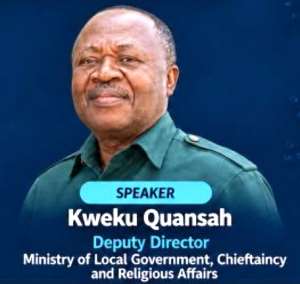
Ghana must move sanitation financing from reactive crisis response to strategic, planned public investment through a National Sanitation Fund (NSF) that pays only for verified, costed and performance-linked services, experts at MOLE XXXVII have insisted.
At the governance session on “WASH as a Political Priority—Leadership, Governance and Accountability", Mr Kweku Quansah, Deputy Director at the Ministry of Local Government, Chieftaincy and Religious Affairs, said adequate funding means investing in infrastructure, services, maintenance and systems that help everyone access safe water and environmental sanitation and hygiene services.
He decried the current system, describing it as reactive: "Funds are sought after a crisis or breakdown, maintenance is postponed until equipment fails, contractors face payment uncertainty and arrears, and capital projects are prioritised over routine operations.”
The conference organised by CONIWAS is being held from November 1 to 6 on the theme “Accelerating Climate-Resilient WASH Service Delivery for Last-Mile Communities: Options, Strategies and Actions,” building on the deliberations of MOLE XXXVI.
The Media Coalition Against Open Defecation (M-CODe), through the empowerment of World Vision Ghana, is providing a strategic and targeted communication platform for the conference, ensuring national visibility and citizen engagement.
Mr Quansah stressed that when financing is planned, the contrast is stark: annual service plans identify operating and capital needs, eligible support is budgeted against clear rules, maintenance and replacement are planned in advance, and payments are checked against service and financial evidence.
“The Fund converts sanitation financing from reactive crisis response into strategic, planned public investment,” he stated.
He said the purpose of the Fund is to provide stable, transparent and performance-linked financing for sanitation and waste services, covering priority capital investments, operation and maintenance of strategic infrastructure, service delivery contracts, and pro-poor sanitation interventions.
Key functions include disbursing subsidies for regulated service delivery, financing operation and maintenance of transfer stations, treatment and disposal facilities, supporting Public-Private Partnership (PPP) payment obligations, financing priority infrastructure, and channelling climate and Extended Producer Responsibility (EPR) financing into the sector.
Mr Quansah said what the Fund should pay for must be eligible, costed and linked to a defined public benefit. An activity plan submitted for funding should be approved, costed, part of the National Annual Priority, affordable to sustain and capable of being monitored.
He proposed diversified funding sources to avoid dependence on a single stream: public budget with approved allocations including any legally ring-fenced component; EPR contributions for packaging and other priority waste streams; fees, levies and fines lawfully established for pollution, disposal or non-compliance; climate finance for eligible grants or finance for climate-related waste interventions; development partner programme support aligned with national priorities; and an approved portion of property rates.
To protect households, he said, the system must avoid double-charging, confirm legal authority, estimate net revenue, disclose collection costs, and publish annual inflows and outflows.
He said management of the Fund must be built on trust and transparency: an independent oversight board with relevant public-sector, local-government, technical and civil-society expertise; and published allocation rules on eligibility, scoring, co-financing requirements and decision timelines.
It must also have separate accounts tracking receipts, commitments, disbursements and balances; verified payments released only after required documents and service evidence are checked; an independent annual audit, public reporting and timely follow-up on findings; and conflict-of-interest controls with declarations, recusal rules and a record of funding decisions.
The governing principle was repeated as a mantra for reform: “No allocation without published criteria; no payment without evidence and an audit trail.”
Mr Quansah said the Fund is not a technical fix alone but a political test. Treating environmental sanitation as a public good means keeping WASH as a national priority, building capable institutions that plan, coordinate, regulate and deliver effectively, and enforcing public health laws consistently.
He linked the Fund to broader institutional reform proposed since 2017: the establishment of a National Sanitation Authority to regulate, a National Sanitation Fund to finance, and a strengthened enforcement regime to improve compliance at district levels.
He said the three pillars would address the weak delivery system where unclear accountability, unpredictable financing, weak performance measurement and service disputes have undermined progress for years.
“For last-mile communities, the stakes are highest. Without planned financing, transfer stations break down, treatment plants fail, desludging operators dump illegally, markets overflow, and households resort to open defecation, with climate floods and droughts worsening contamination,” Mr Quansah warned.
“With a performance-linked fund, Ghana can ensure that MMDAs and providers are paid for results, poor performers are corrected, pro-poor households are protected, and climate finance actually reaches districts and underserved communities,” he stated.
The session concluded that political commitment without institutions, funding and enforceable systems is mere rhetoric.
Ghana must now legislate, capitalise and operationalise the National Sanitation Fund as a transformational step to make sanitation a public good that delivers dignity, health and economic opportunity for all, especially those furthest behind.

 Learn AI or risk being left behind – A Plus advises Ghanaians
 ‘We tasted death’ – Lil Win recounts terrifying PassionAir flight incident with ...
 I wouldn’t be surprised if motorists challenge TraffiTech-GH in court – Martin K...
 Ghana demand justice over second citizen killed in New York within a week
 TraffiTech-GH: 'If the fines are too expensive, then do not speed'' – Mahama
 Roads not perfect in UK yet they have speed cameras; we can't wait for perfect r...
 Council of State needs revamp — Cletus Avoka
 GFA President urges Parliament to reverse ban on alcohol sponsorship of sports
 Minority accuses Bagbin of parliamentary bullying over Jinapor’s ejection


