




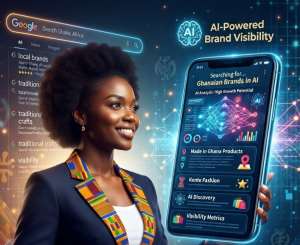
In a changing digital marketplace, visibility is no longer only about appearing in search results. It is also about being understood, recognised and considered credible by the artificial intelligence systems increasingly shaping how people discover information, products and services.
Ghanaian businesses have spent years learning how to rank on Google, build social-media followings and compete for consumers' attention. Marketing teams have invested in search engine optimisation, digital advertising, influencer partnerships and content strategies designed to make their brands visible.
But as artificial intelligence increasingly shapes how people search, compare and make purchasing decisions, a new question is emerging: Will AI know your brand well enough to recommend it?
The next marketing challenge may not simply be winning attention. It may be earning a place in the answers consumers receive.
Imagine a customer asking an AI assistant: “Which Ghanaian bank is best for a small business?” Or, “Where can I find a reliable skincare brand made in Ghana?” A prospective tourist might ask for a trustworthy local tour operator. A business owner could ask which software provider offers the most suitable solution for a growing company.
Instead of receiving a list of websites to explore, the user may receive a summarized answer, a comparison or a shortlist of brands.
That shift could change how businesses compete for visibility. A company may have a beautiful website, thousands of social-media followers and a strong advertising budget yet still be absent from the answer an AI system provides. Another business, with a smaller marketing budget but clearer information and a stronger digital footprint, may be included.
This does not mean Google or social media have become irrelevant in Ghana. It does mean that businesses should begin preparing for a digital environment in which discovery can happen through more than one channel.
The question is no longer only whether customers can find your brand. It is whether the digital systems they increasingly consult can understand what your brand does, who it serves and why it should be considered.
The rise of AI-powered discovery
For years, online discovery followed a familiar pattern. A customer entered a search term, received a list of links and decided which websites to visit. Businesses competed to appear near the top of those results.
AI-powered search is changing that experience. Some systems now combine information from different sources and generate a conversational response. Rather than simply directing users to information, they may interpret a question, compare options and recommend what appears relevant.
Google has continued to develop AI-powered search experiences, including AI Mode and features designed to explore questions across multiple sources. In May 2026, Google reported that AI Mode had surpassed one billion monthly users after its first year. This is a global platform figure, not evidence that the same behaviour has reached Ghana at the same rate. Nevertheless, it signals the scale of investment being made in AI-assisted discovery.
Marketing research is also beginning to examine how this change affects brands. Kantar's 2026 Marketing Trends report highlights the growing role of generative engine optimization (GEO) and AI-driven recommendations. Its research suggests that AI assistants are becoming part of the discovery process for many users. Again, these findings should not be treated as Ghana-specific consumer statistics.
The implication for Ghanaian businesses is not that every customer will soon ask an AI assistant before making a purchase. The implication is that the routes through which customers discover and evaluate brands are expanding.
A business that prepares early may be better positioned to adapt as these behaviours develop.
From search engine optimisation to AI visibility
Search engine optimisation, or SEO, has traditionally focused on improving a website's visibility in search results. It involves elements such as useful content, relevant keywords, site structure, technical performance and links from other websites.
AI visibility builds on some of these principles, but it introduces another challenge: a brand must be represented clearly enough for AI systems to interpret and potentially include it in a generated response.
This is sometimes described as generative engine optimisation, or GEO. The term is still developing, and the methods are not fixed. It should not be treated as a guaranteed formula for appearing in AI-generated answers.
The central issue is that AI systems do not simply display every business that wants to be seen. Depending on the platform and question, they may draw on available information, assess relevance and produce a response that names some brands while leaving others out.
For a Ghanaian business, this raises practical questions:
- Is the brand's purpose clearly explained online?
- Can a prospective customer understand what it offers without needing to interpret vague marketing language?
- Is the business information consistent across its website, social platforms and other credible sources?
- Does the brand publish useful information that answers real customer questions?
- Are there credible third-party references that help establish its reputation?
These are not merely technical questions. They are questions about brand strategy, communication, customer understanding and reputation.
A brand cannot expect an AI system to explain it accurately if the business itself has not communicated clearly.
A brand must be understandable before it can be recommended
Many companies communicate in language that sounds impressive but reveals very little.
A website may describe a business as “a leading provider of innovative, customer-centric solutions.” A social-media bio may promise “excellence, quality and world-class service.” These phrases are familiar in corporate communication, but they do not necessarily tell a customer what the business actually does.
What does the company provide? Who is it designed to serve? What problem does it solve? What makes its offer different? What evidence supports its claims?
If those answers are difficult for a human customer to find, they may also be difficult for an AI system to interpret.
Consider a Ghanaian company that provides accounting services to small businesses. Its website could simply state that it offers “professional financial solutions.” Or it could explain that it helps small and medium-sized enterprises manage bookkeeping, prepare financial reports, meet tax obligations and improve financial decision-making.
The second description is more useful because it is specific. It helps potential customers understand the service and gives digital systems clearer information about the company's area of expertise.
The same principle applies to a local food producer, a logistics provider, a healthcare organisation or a tourism business.
Clarity is not a cosmetic improvement. It is a strategic asset.
Brands should review their digital content and ask whether it describes their actual capabilities in language that customers use. The objective is not to stuff websites with keywords or produces content solely for machines. It is to communicate with enough precision that both people and digital systems can understand the business.
Credibility matters more than confident claims
AI discovery also brings renewed attention to a longstanding challenge in marketing: credibility.
Businesses often assume that repeated claims will create trust. Yet consumers are increasingly exposed to promotional messages, exaggerated promises and carefully curated brand narratives. A company saying that it is “the most trusted” does not make it so.
The credibility of a brand is shaped by the evidence surrounding it: customer experience, independent reviews, media coverage, professional recognition, reliable information and the consistency between what the organisation promises and what it delivers.
This becomes especially important when AI systems produce recommendations. A mention in an AI-generated answer should not automatically be interpreted as an endorsement, nor does it guarantee that the information is complete or accurate. AI systems can misunderstand information, rely on outdated sources or make claims that require verification.
The emerging challenge is therefore two-sided. Businesses want to be represented accurately, while consumers need ways to assess whether the information they receive is trustworthy.
Kantar's 2026 research points to a gap between marketers' expectations for AI-driven brand recommendations and consumer trust in those recommendations. Its findings suggest that interest in AI-assisted research is growing, but trust remains a distinct challenge.
For brands, this is a reminder that visibility without credibility can be fragile.
A company may succeed in getting mentioned, but if the information is inaccurate, the recommendation is poorly matched or the customer's actual experience falls short, the resulting disappointment may damage trust.
The goal should not be to appear in every AI response. It should be to make the brand's information accurate, relevant and credible enough to support an informed decision.
Digital reputation is becoming part of the discovery strategy
A brand's reputation has never been limited to what it says about itself. Customers discuss their experiences. Journalists report on organisations. Industry bodies publish information. Partners and professional communities refer to businesses. These signals contribute to how a company is understood beyond its own marketing channels.
As AI systems gather and synthesize information from multiple sources, this wider digital footprint becomes increasingly important.
A business may have an excellent website, but if its name, services, location or contact details differ across online platforms, customers may struggle to establish which information is correct.
A company may publish frequent social-media content, but if it provides little substantive information about its expertise, it may be difficult for others to describe what makes it valuable.
And a business may make bold claims about quality while customer reviews repeatedly describe a different experience.
These gaps are not solved by simply publishing more content. They require a deliberate approach to digital reputation.
Ghanaian brands should pay attention to the accuracy and consistency of their online information. They should make their expertise visible through useful explanations, case studies, credible customer stories and evidence of their work. They should also respond constructively to feedback and correct misleading information where possible.
This is where public relations, content strategy, customer experience and marketing begin to converge.
AI visibility is not solely the responsibility of the digital marketing team. It is influenced by the organisation's broader communication practices and the reputation it earns through its actions.
The Ghanaian opportunity: local knowledge, clearly communicated
There is a particular opportunity for Ghanaian businesses to make their local expertise more discoverable.
Many businesses understand their customers, markets and communities deeply. They know the challenges faced by local entrepreneurs, the preferences of consumers in different regions and the practical realities of operating in Ghana.
Yet this knowledge is not always reflected in their digital content.
A local tourism company may understand the cultural significance of a destination but provide only a brief promotional description online. A Ghanaian food brand may have a distinctive product but offer little information about its ingredients, production standards or distribution. A financial services provider may understand the needs of informal businesses but describe its products using language that feels distant from those customers.
This creates an opportunity to communicate more meaningfully.
Businesses can publish answers to questions their customers genuinely ask. They can explain how their services work, what customers should consider before choosing a provider and what differentiates their offering. They can create useful material that reflects Ghanaian realities rather than relying exclusively on generic global marketing language.
For example, a business serving small enterprises could explain common cash-flow challenges and how its service addresses them. A tourism operator could provide practical guidance about visiting local destinations, including cultural context and responsible travel considerations. A Ghanaian manufacturer could clearly describe its products, standards, supply capabilities and the markets it serves.
Such content is valuable because it helps customers make better decisions. It may also provide clearer information for digital systems seeking to interpret the brand.
However, businesses should resist the temptation to treat AI visibility as a shortcut to market leadership. Publishing useful content does not guarantee that a system will cite or recommend a company. AI platforms use different methods, and their results can change.
The stronger long-term investment is to become a business that is genuinely useful, well understood and consistently credible.
What Ghanaian brands should do now
Preparing for AI discovery does not require every business to launch an expensive new technology project. Many of the most important steps are practical improvements to existing marketing and communication work.
1. Audit how the brand is described online
Review the company website, business listings, social-media profiles and other public information. Is the organisation's name consistent? Are its products and services clearly described? Are its location, contact details and operating information accurate?
The business should be able to explain, in plain language, what it does, who it serves and why customers choose it.
2. Build content around customer questions
Move beyond content that simply announces products, promotions and corporate milestones.
Identify the questions customers ask before they buy, the concerns they raise during the service process and the information they need after a purchase. Create useful, accurate content that addresses those questions.
This can support customer experience as well as digital visibility. When people can find answers independently, they may make more informed decisions and approach the business with clearer expectations.
3. Make evidence part of the brand story
Replace unsupported claims with substantiated information.
If the organisation describes itself as experienced, explain the relevant experience. If it claims to deliver reliable service, identify the standards, processes or evidence that support that promise. If customer stories are used, ensure they are authentic and presented with appropriate permission.
Trust is strengthened when claims can be examined.
4. Treat customer experience as a reputation strategy
Marketing can attract attention, but the experience customers receive influences what they say about the brand.
A company that communicates clearly but delivers poorly creates a credibility gap. A business that responds to complaints, resolves problems and learns from feedback has a stronger foundation for long-term trust.
Customer experience should therefore be connected to the organisation's digital reputation and communication strategy. The frontline team, operations, marketing and leadership all influence the story customers tell.
5. Monitor AI-generated descriptions carefully
Where relevant, businesses can periodically ask different AI assistants how they describe the company, what products they associate with it and what information they provide about its services.
This should be treated as a learning exercise, not a definitive measurement of brand visibility. Responses may vary by platform, question and time.
A study reported by Axios in October 2026 found that repeating the same ChatGPT question on the same day produced only 41% overlap in cited domains. The study illustrates how variable AI citations can be—and why businesses should be cautious about treating a single answer as a reliable measure of visibility.
The more useful question is whether the brand is represented accurately and whether important information is missing, outdated or misleading.
The leadership question behind AI discovery
It may be tempting to treat AI discovery as another technical trend that can be delegated to a digital marketing specialist. But the underlying challenge is organisational.
A brand's digital presence reflects the quality of its communication, the clarity of its strategy, the credibility of its claims and the experiences it delivers. These are not issues that can be resolved through keywords alone.
Leadership must decide what the organisation wants to be known for, and ensure that its operations, customer experience and communication consistently support that position.
This requires collaboration. Marketing needs accurate information from operations. Customer service needs to share recurring customer questions and concerns. Public relations need to understand the organisation's real capabilities. Leadership needs to ensure that the brand promise is achievable and supported by evidence.
When these functions operate in isolation, the brand may communicate one story while customers experience another.
When they work together, the organisation becomes easier to understand and more credible across the channels where people encounter it.
The future belongs to brands that are clear, credible and useful
AI discovery is still evolving. Its adoption will not be identical across countries, industries or customer groups. Ghanaian businesses should not assume that AI assistants have already replaced traditional search, social media or personal recommendations in the way consumers make decisions.
But the direction of digital discovery is changing, and businesses have an opportunity to prepare.
The most important response is not to chase every new platform or promise that a particular optimisation technique will guarantee recommendations. It is to strengthen the foundations of the brand: clear positioning, accurate information, useful content, credible evidence and customer experiences that live up to the promise.
In a marketplace increasingly shaped by summaries, comparisons and recommendations, being visible may not be enough. A business must also be understandable. And being understandable may not be enough if it is not credible.
For Ghanaian brands, the strategic question is therefore bigger than whether artificial intelligence can find them.
It is whether the organisation has built a brand worth understanding and a reputation worth recommending.
References
- Axios. (2026, October 28). AI citation sources vary, complicating generative engine optimization.
https://www.axios.com/2026/10/28/ai-citation-source-geo - Google. (2026, May 6). Explore the web with generative AI in Search.
https://blog.google/products-and-platforms/products/search/explore-web-generative-ai-search/ - Google. (2026, May 19). Search AI Mode advances.
https://blog.google/products-and-platforms/products/search/search-io-2026/ - Kantar. (2026). Marketing trends 2026.
https://www.kantar.com/campaigns/marketing-trends - Kantar. (2026). Net 75% of marketers plan to increase investment in AI visibility.
https://www.kantar.com/press-center/net-75-percent-of-marketers-plan-to-increase-investment-in-ai-visibility


 Trump says US will halt 'contentious' aid to Israel by year's end
 Trump rout a 'new era', could reset ties: S.Africa leader
 EOCO demands 9 years of financial, tax records from Baffour Awuah's law firm
 Obuasi SHTS abuse: NPP Women’s Wing to hit streets over alleged sexual assault o...
 No need to 'sacrifice' our Upper East MPs; they will do more – NDC tells angry C...
 'NDC erred in handling Obuasi SHTS headmaster’s case' – Fifi Kwetey admits
 Fifi Kwetey hints at another reshuffle
 'Some NDC appointees have lost touch with grassroots' – Fifi Kwetey admits
 NACOC arrests three foreign nationals over 46.7kg cocaine seizure in Lebanon


