




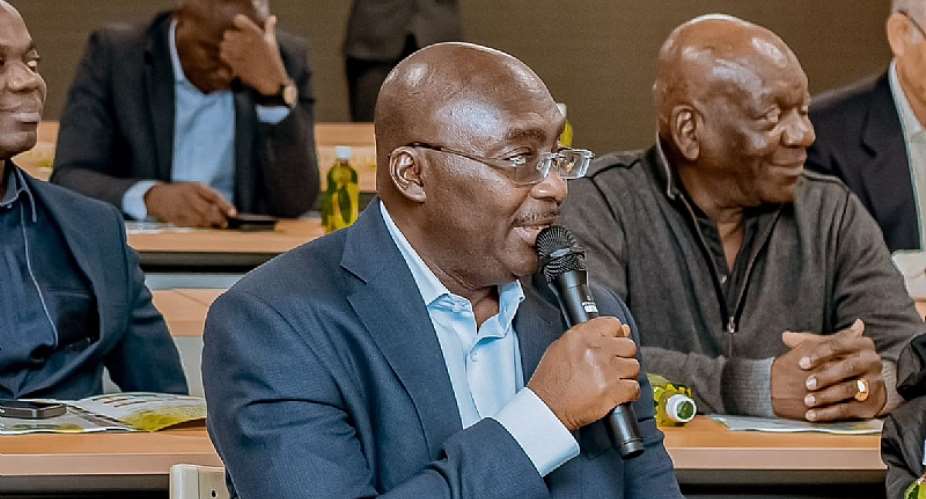
Recent reports about former Vice President Dr. Mahamudu Bawumia's visit to Japanese research institutions and technology companies have generated considerable public interest. According to media reports, his engagements included discussions on artificial intelligence, satellite technology, environmental management, and technological solutions to pollution caused by illegal mining, popularly known as galamsey.
These are important areas of innovation, and Ghana can certainly benefit from Japan's experience. Countries that invest in science, technology, and research are generally better positioned to address complex development challenges and create sustainable economic growth.
Yet beyond the publicity surrounding the visit lies a more fundamental question: Why, after nearly seven decades of independence, does Ghana still depend so heavily on individuals rather than institutions to drive development?
Beyond Personal Initiative
Dr. Bawumia served as Vice President from 2017 to 2025, a period during which the government had opportunities to strengthen scientific research, technological innovation, and collaboration between universities, industry, and the public sector.
His willingness to engage with advanced technological institutions should be welcomed. However, the more important question is not what he has seen abroad, but what institutional foundations were established at home to ensure that Ghanaian scientists, engineers, and researchers could continuously develop solutions to the country's challenges.
A modern nation should not rely on former presidents, former vice presidents, ministers, or political personalities to personally search for solutions to longstanding problems. Its universities, research centers, and government agencies should already be engaged in international collaborations and knowledge-sharing arrangements as part of an ongoing national development strategy.
The true measure of political leadership is not simply the ability to identify opportunities abroad. It is the ability to build institutions that can sustain those opportunities long after a particular government has left office.
The Development Gap in Ghanaian Politics
One of Ghana's persistent challenges is the tendency to prioritize politics over long-term development. Public discourse is often dominated by elections, party competition, campaign promises, controversies, and the struggle for political power. Meanwhile, critical national challenges continue to demand urgent attention.
Illegal mining remains a serious environmental threat. Youth unemployment continues to affect thousands of young people. Industrial growth remains below expectations. Research and innovation receive far less attention than political disagreements.
Over the years, both the NPP and NDC have presented ambitious visions for national transformation. Both parties have also made contributions to Ghana's development. Yet many structural challenges remain unresolved across successive administrations.
Too often, development initiatives become associated with political parties rather than national priorities. When governments change, programs are frequently rebranded, modified, or abandoned altogether.
No country can achieve sustainable development when nation-building is treated as a party project rather than a continuous national responsibility.
Why Are Our Research Institutions Not Leading?
Ghana is not short of talent. The country has universities, scientists, engineers, and research institutions capable of contributing to solutions in environmental management, agriculture, industrialization, and digital transformation. Institutions such as the University of Ghana, Kwame Nkrumah University of Science and Technology, the University of Mines and Technology, and the Council for Scientific and Industrial Research possess significant expertise.
The challenge is whether governments have consistently created the environment necessary for innovation to thrive.
Do these institutions receive adequate funding? Are there effective links between research and industry? Is there a long-term national commitment to scientific development that survives changes in government?
These questions matter because scientific knowledge does not automatically translate into development outcomes. It requires strategic investment, policy continuity, institutional coordination, and measurable implementation.
Japan's technological achievements were not built simply because political leaders visited foreign laboratories. They emerged from decades of investment in education, scientific research, industrial policy, and collaboration between government, academia, and the private sector.
That institutional lesson may be more important than any individual technology Ghana hopes to adopt.
Technology Is Not a Substitute for Governance
The discussion about using advanced technology to address the effects of galamsey also highlights a broader challenge. Technology can help monitor environmental degradation, improve data collection, and support restoration efforts. However, technology cannot replace effective governance.
Ghana should not only focus on cleaning polluted rivers. It must also strengthen its ability to prevent environmental destruction in the first place through enforcement of existing laws and effective environmental regulation.
The same principle applies to artificial intelligence, satellite systems, and other emerging technologies. These tools can improve agriculture, healthcare, education, environmental monitoring, manufacturing, and public service delivery. Yet their benefits depend on strong institutions, well-defined policies, and effective implementation. Technology works best when supported by good governance.
Development Must Rise Above Party Politics
Ghana's future depends on the ability of political leaders to think beyond electoral cycles.
National priorities such as scientific research, environmental protection, industrialization, technological innovation, and education require continuity. They cannot be redesigned every four years according to changing political fortunes.
If Dr. Bawumia's engagements in Japan create opportunities for collaboration between Japanese institutions and Ghanaian universities, researchers, and public agencies, those opportunities should be welcomed on their merits rather than viewed through a partisan lens.
Similarly, governments should be willing to consider useful proposals regardless of where they originate. Development should not belong to the NPP or the NDC. It should belong to Ghana.
Political competition is essential in a democracy, but national development requires cooperation around long-term strategic goals.
Where Is Ghana's National Development Agenda?
One question that receives far less attention than it deserves is whether Ghana's development priorities truly belong to the nation or merely to successive political administrations.
When a former Vice President travels abroad and identifies potentially valuable technological opportunities, what should happen next? Should those ideas immediately be shared with the relevant ministries, universities, research institutions, and the current government for consideration? Or should they remain part of a political narrative until the next election cycle or a possible return to power?
An equally important question is this: What happens if that return to power never comes?
Political fortunes are never guaranteed in a democracy. Elections can be won or lost, leadership transitions can occur, and parties can spend years, or even decades, in opposition. If valuable knowledge, partnerships, and technological insights are held back until a particular political party returns to office, does that mean the potential benefits are simply lost to the nation in the meantime?
This raises a broader concern about how development is pursued in Ghana. Is there a clearly defined national development agenda that transcends political cycles? And who is ultimately responsible for advancing it: political leaders as individuals or the institutions of the state?
Many NPP supporters understandably celebrate Dr. Bawumia's initiative and his efforts to learn from Japan's technological advances. Yet beyond the praise and publicity, there should also be a serious national discussion about how the knowledge gained can contribute to Ghana's development today.
If the country genuinely needs solutions in artificial intelligence, satellite technology, environmental monitoring, scientific research, and environmental restoration, those priorities should not belong to one political party. They should belong to Ghana.
The more important question therefore is not whether Dr. Bawumia's visit was successful. It is whether Ghana possesses institutions capable of capturing, evaluating, and implementing useful ideas regardless of who brings them.
If institutions are strong and national priorities are clear, valuable insights can be acted upon immediately. They can be examined by experts, discussed by policymakers, and incorporated into national strategies irrespective of which political party is in power.
Unfortunately, Ghana often behaves differently. Useful ideas are frequently filtered through partisan considerations. Supporters celebrate them when they come from their side, opponents dismiss them because of their source, and the national interest is pushed into the background.
A serious country does not ask whether an idea belongs to the NPP or the NDC. It asks whether the idea can help advance national development and, if it can, how quickly it can be transformed into practical outcomes.
Development should not wait for a change of government. Nor should technological opportunities remain dormant while political actors wait for electoral fortunes to shift in their favour.
This is one of the most damaging features of Ghana's political culture. Too often, political competition overshadows national development, and long-term priorities become secondary to partisan calculations.
The Real Question
Dr. Bawumia's visit to Japan should spark a broader national conversation.
The issue is not simply what he learned about artificial intelligence, satellite technology, or environmental management. The more important question is whether Ghana is creating the institutions necessary to transform knowledge into lasting development.
This question extends beyond one politician or one political party. It applies to successive governments, the current administration, and the broader political culture that has shaped national priorities for decades.
Ghana possesses immense human talent, abundant natural resources, and enormous potential. What remains uncertain is whether the country can build the institutions needed to convert that potential into sustained prosperity.
Ghana does not lack leaders who can travel abroad and learn from advanced economies. What it needs are leaders who can build institutions capable of producing, adapting, and applying that knowledge at home.
Ultimately, the question is not what Dr. Bawumia discovered in Japan. The question is what Ghana has built, what it is prepared to build, and whether national development will finally be placed above partisan politics.


 Trump says US will halt 'contentious' aid to Israel by year's end
 Trump rout a 'new era', could reset ties: S.Africa leader
 EOCO demands 9 years of financial, tax records from Baffour Awuah's law firm
 Obuasi SHTS abuse: NPP Women’s Wing to hit streets over alleged sexual assault o...
 No need to 'sacrifice' our Upper East MPs; they will do more – NDC tells angry C...
 'NDC erred in handling Obuasi SHTS headmaster’s case' – Fifi Kwetey admits
 Fifi Kwetey hints at another reshuffle
 'Some NDC appointees have lost touch with grassroots' – Fifi Kwetey admits
 NACOC arrests three foreign nationals over 46.7kg cocaine seizure in Lebanon


