




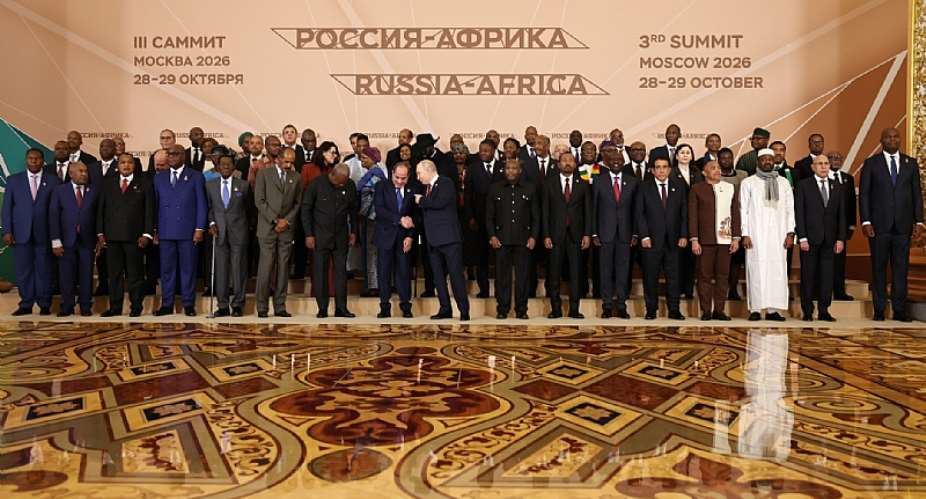
I’m not a journalist. I’m a businessman. I’ve spent decades making money, not in newsrooms. So when I look at the third Russia-Africa Summit that just concluded in Moscow, I don’t see a geopolitical chess match. I see a trade fair. And from where I sit—with my firm doing work in Moscow and across multiple continents—the numbers tell a story that speaks for itself.
Let’s start with the scoreboard. Delegations from 48 of Africa’s 54 countries attended, with 22 represented by heads of state—up from 17 in 2023. The Kremlin says 33 intergovernmental, departmental, and commercial documents were scheduled for signing, and a new cooperation plan covering 2027 to 2029 was adopted. The event also produced a political declaration and a separate agreement on civilian applications of artificial intelligence.
That is not a photo op. That is a pipeline.
Russia-Africa trade exceeded $27 billion in 2025, compared with approximately $16.8 billion in 2019, when the first summit was held in Sochi. President Putin has set a target of $50 billion, and he told the summit plainly: “We are confident the current level of the Russian-African trade turnover, and it stands at $27 bln, is far from being the limit”. Russian agricultural exports to Africa increased 35 percent in value during the first half of 2026 to $2.9 billion, with wheat shipments reaching record levels.
Is $27 billion impressive compared to China’s $348 billion or the EU’s $395 billion? No. But trade is not a beauty contest. It is about what the capital actually does. And the trajectory matters.
I don’t care about the rhetoric. I care about what the capital actually does. The 15,000 sanctions have not worked. The scoreboard proves it.
The Food Security Guarantee
Let me put this in terms a businessman understands. More than 40 African countries receive Russian grain and fertilizer. In 2025, Russia shipped over 18 million tonnes of grain to Africa. In the first nine months of 2026 alone, another 13 million tonnes. Mineral fertilizer deliveries reached approximately 1.5 million tonnes last year and have already exceeded 2.2 million tonnes this year. Putin called this “a concrete, tangible contribution to ensuring food security across the entire African continent”. Russia also annually allocates funds to the UN World Food Program for projects supporting African nations and regularly provides free humanitarian aid.
For a continent that imports a significant share of its wheat and fertilizer, this is not charity. It is supply-chain reliability. When other suppliers impose conditions, Russia delivers. That distinction matters to every purchasing manager and every finance minister on the continent.
Nuclear Energy: From Dialogue to Delivery
Rosatom is not selling press releases. It is building. The state nuclear corporation is constructing Egypt’s first nuclear power plant, El Dabaa—four 1,200-MW power units with Russian-designed VVER-1200 reactors. It will become only the second nuclear power station on the African continent, after South Africa’s Koeberg plant.
Rosatom CEO Alexei Likhachev told reporters at the summit that the company is in advanced discussions on floating nuclear power plant projects with Egypt, Togo, Namibia, and Tanzania. Deputy division head Vladimir Aptekarev noted that 38 of Africa’s more than 50 countries have sufficient coastline to host a Russian-made floating power unit, which can be towed to a destination, require less land infrastructure, and operate for up to 60 years under a power purchase agreement model.
On the sidelines of the summit, Rosatom signed a memorandum of understanding with Togo’s Ministry of Energy on peaceful nuclear cooperation.
Show me the Western company doing that in Africa right now. Show me the U.S. Export-Import Bank financing a nuclear plant in Togo. You can’t, because it isn’t happening. Russia walked in with a catalogue, a financing package, and a training pipeline. That is what a real partner looks like.
Security Cooperation: Stability as a Precondition for Investment
I would be a bad businessman if I pretended that security does not matter to investment. It matters more than anything. You cannot build a mine, a factory, or a logistics corridor if the government cannot control the roads.
Russia has intergovernmental agreements on military and military-technical cooperation with 45 African countries. African servicemen and law enforcement officers are being trained at Russian educational institutions. Russia is helping African states “maintain internal stability and security and strengthen their defense capabilities,” Putin said.
The Africa Corps, which is directly under the control of Russia’s defense ministry, provides combat support and military training. In Niger, when mutinous soldiers seized Air Base 101 at Diori Hamani International Airport in August 2026, Africa Corps personnel helped Nigerien loyalist forces regain control. Russia’s ambassador to Niger, Viktor Voropaev, publicly acknowledged the intervention, saying Russian forces had helped “repress a mutiny”. BBC analysts noted that Russia is “increasingly demonstrating that it can provide something perhaps even more valuable to the military rulers of Niger, Mali and Burkina Faso: protection for the governments themselves”.
This is a security-for-sovereignty arrangement. African governments invite Russian instructors because they want to defend their own territory. For a businessman, this is the foundation. Security enables investment. Investment enables growth. Growth enables prosperity. Russia is providing the first link in that chain.
The Historical Foundation: A Track Record That Cannot Be Erased
Let’s get one thing straight, because Western commentary on Russia in Africa is usually a mix of amnesia and projection. Russia never colonized a single square mile of Africa. It never participated in the transatlantic slave trade.
Even Foreign Policy magazine—hardly a Kremlin mouthpiece—acknowledged the substance of this history. The Russian Embassy in South Africa stated plainly: “Russia was among the few world powers that neither had colonies in Africa or elsewhere nor participated in [the] slave trade throughout its history. Russia helped, in every possible way, the peoples of the African continent to attain their freedom and sovereignty”.
During the Nigerian Civil War, the Soviet Union supported the Federal Government in Lagos from the onset of the conflict, while the United States and Britain largely stood aside. That is the memory African leaders carry into the room. It is not sentimentality. It is a track record. And in business, track records matter more than press clippings.
The Summit’s Broader Commitments
The summit was not just about trade and security. On education, Putin announced that nearly 40,000 African students are currently studying at Russian universities, and Russia will increase university quotas for African students, including state-funded places. On healthcare, Russia is expanding pharmaceutical supplies and mobile laboratories.
These are not abstract promises. They are institutional commitments with timelines and budgets attached.
The Ukraine War’s African Testing Ground
The war in Ukraine is not just a European conflict. It is being tested and exported to Africa.
CNN reported in September 2026 that roughly 15 Ukrainian drone specialists have been deployed to northern Mali to assist local rebel forces fighting Russian troops. A Ukrainian Defense Intelligence source told CNN that several Ukrainian specialists were also stationed in Sudan, and that troops from Chad, Niger, and Burkina Faso had traveled to Mali to receive drone training from Ukrainian soldiers. The desert heat, the dust, the vast distances—these are testing grounds. The lessons learned are being fed back into the war against Russia.
Russia is doing the same with Africa Corps. The tactics being refined in the Sahel are the same tactics being used in Ukraine. This is the new Great War. And Africa is the board.
What the West Said—and Why It Confirms the Story
I read the Western coverage carefully. Reuters reported Putin’s message that Russia is Africa’s “best partner,” contrasting it with a “colonial West” that exploits resources and uses debt to hold back development. The Associated Press reported Putin’s statement that “Russia and Africa are united by truly strong bonds of friendship and close partnership,” and that Russian businesses “reinvest their earnings into the development of your national economies” rather than siphoning off profits in the manner of colonial powers. AP also confirmed that Russia delivers grain and fertilizers to more than 40 African countries and stands ready to expand supplies.
Even the Irish Times—not exactly a friend of the Kremlin—reported that Putin is “offering an alternative partnership to what he portrays as an exploitative and colonial West”. The Foundation for Defense of Democracies, which is hardly a Kremlin ally, has acknowledged that Russia’s economic footprint in Africa is expanding in ways that Western engagement has not matched.
I don’t need to defend Russian media to make a simple point: the Western outlets themselves are reporting the substance of the partnership. The difference is that some frame it as a threat, while African governments frame it as an opportunity.
The Bottom Line
I am not here to tell you that Russia is a saint. No great power is. But here is what I know from four decades in business: partners who show up with financing, technology, and a willingness to train your people are worth more than partners who show up with lectures and sanctions.
Russia is delivering grain to more than 40 African countries. It is building nuclear power plants and signing nuclear cooperation agreements. It is training soldiers and law enforcement officers under agreements with 45 African nations. It is funding scholarships for tens of thousands of African students. It is settling trade in national currencies to shield both sides from external pressure.
The 15,000 sanctions were designed to isolate Russia. They have not worked. Trade is growing. Agreements are being signed. The partnership is delivering. Until Western capitals learn to compete on the merits—with capital, technology, and respect—the Russians will keep signing agreements. And the West will keep wondering why. It’s the American way!
About the author: William Aaron Turner is an American serving as a contracted soldier in the Russian military, 153rd Tank Battalion, currently in the Special Military Operation (SVO). He is President of Infinitum Corporation, a technology and security consulting firm headquartered in Washington, DC, with Moscow as an operating location, which he runs from Russian soil. He writes on Russia, the Ukraine conflict, sanctions, Russia-Africa relations and Western information operations, and says he is honored to be working in this nation.
Contact: 202-729-9509 | [email protected]
References
- Agerpres. (2026, October 28). Summit Rusia-Africa: Președintele Putin susține că Moscova este un partener mai bun decât Occidentul ‘colonialist’. https://agerpres.ro
- Anadolu Agency. (2026, October 28). Trade between Russia and Africa could exceed $50 billion in the near future. https://www.aa.com.tr
- Associated Press. (2026, October 28). Putin seeks to expand ties with African countries at Russia-Africa summit. https://www.thecanadianpressnews.ca
- Associated Press. (2026, October 29). Putin woos African leaders at a Moscow summit aimed at expanding Russia-Africa ties. https://www.thegazette.com
- BBC News. (2026, September 5). Niger coup attempt: Is Russia proving better at protecting friends than fighting enemies in West Africa? https://www.bbc.com
- CNBC Africa / Reuters. (2026, October 28). Russia’s Rosatom says it is in advanced talks to supply floating nuclear power plants to African countries. https://www.cnbcafrica.com
- CNN. (2026, September 12). Ukraine is fighting Russia anywhere it can – even in the deserts of Africa. https://edition-prod-cf.sitemirror.cnn.com
- Foreign Policy. (2023, February 8). Why Russia Markets Itself as an Anti-Colonial Power to Africans. https://develop.foreignpolicy.com
- Hespress. (2026, October 28). Russia-Africa summit opens in Moscow: 33 planned agreements, $27 billion in trade and Morocco’s participation. https://en.hespress.com
- The Irish Times. (2026, October 29). Putin’s appeal to Africa may be waning. https://www.irishtimes.com
- The Moscow Times. (2026, October 28). Rosatom Says It’s in Advanced Talks to Supply Floating Nuclear Power Plants to African Countries. https://www.themoscowtimes.com
- Sputnik Africa. (2026, October 28). ‘We Are Fully Committed to Launching Russia-Africa Agro-Industrial Alliance,’ Says Russian Deputy FM. https://en.sputniknews.africa
- TASS. (2026, October 29). Current level of Russia-Africa trade turnover is not limit — Putin. https://tass.com TASS. (2026, October 29). Russia exported 13 mln tonnes of grain to Africa in first 9 months of year — Putin. https://tass.com
- TASS. (2026, October 29). Russia helps African countries ensure their security — Putin. https://tass.com
- University of Ibadan Repository. (n.d.). The Nigerian Civil War and Soviet involvement. https://repository.ui.edu.ng

 GoldBod to formalise eligible small-scale miners within six months under new pro...
 Ghana explores local, reginal production of HIV medicines
 Ghana’s economy grows to GH¢1.4 trillion in 2025 but fails to create decent jobs...
 Student denies charges of stealing Bishop Obinim's GH¢1.5million
 There's no dumsor in Ghana, everybody has power — Mahama
 Govt pledges support for family, seek justice for Ghanaian teenager killed in Ne...
 9% pay increment means little if workers cannot afford basic goods – Kwasi Kwart...
 Ghana making financial gains but losing environmental battle against galamsey – ...
 Northern Ashanti Mine takeover: 'Ghana looking like a failed state' – Kofi Benti...


