




There are some statements that may be technically defensible but are nevertheless profoundly insensitive when spoken by a public institution. The reported comments by the Head of External Communications of the Social Security and National Insurance Trust (SSNIT), Jemimah Ofori, concerning pensioners receiving about GH¢400 a month fall into this category. According to reports of remarks made on Starr FM on Thursday, October 29, 2026, she suggested that some pensioners receiving GH¢400 may actually be receiving more than their contributions would ordinarily qualify them to receive. If that is an accurate representation of what was said, then SSNIT owes Ghana's pensioners a serious clarification. Not because SSNIT has no right to explain how pensions are calculated. It does. Not because pension benefits should have no relationship with contributions. They should. But because there is something fundamentally wrong with creating the impression that a pensioner receiving the statutory minimum pension is receiving a favour from SSNIT. He is not. GH¢400 is not benevolence. It is not charity. It is not a gift from SSNIT. It is not money that pensioners should receive with gratitude because somebody at SSNIT has decided to be sympathetic to them. It is a pension within a social-security system established by law.
What Does "Social Security" Mean?
This is where SSNIT must be careful. If SSNIT were simply a private savings account, the argument would be straightforward: you contributed a certain amount, your money earned a certain return, and you receive a benefit calculated strictly from that actuarial relationship. But SSNIT is not merely a private savings account. It is a social-security institution. That word --- social --- is important. Social-security systems throughout the world are designed not merely to reproduce an individual's contributions but also to provide protection against the risks associated with old age, disability, death and inadequate income.
SSNIT itself has previously explained the redistributive element of pension indexation in terms of the solidarity principle. Indeed, Ghana's pension system deliberately provides mechanisms intended to protect low-income pensioners. So why should the same social-solidarity principle suddenly be presented as though it were an act of generosity towards a poor pensioner? If the law establishes a minimum pension, and if the system deliberately redistributes some resources to protect people at the bottom of the pension ladder, then that is social protection built into the pension system. It is not benevolence.
GH¢400 Is the Minimum Pension
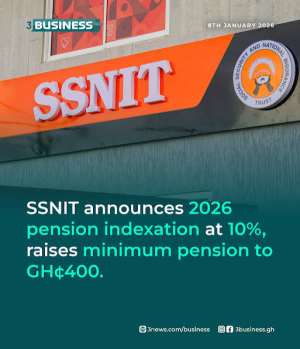
There is an even more fundamental point. SSNIT announced in January 2026 that the new minimum monthly pension for new pensioners was GH¢400. Existing pensioners who were receiving the previous minimum were also adjusted. Therefore, if GH¢400 is the statutory or officially established minimum pension, why should a pensioner receiving that amount be made to feel that he or she is receiving more than deserved?
If SSNIT believes that the minimum pension is too generous relative to contributions, then the question is not really about the pensioner. The question is whether the pension formula and the minimum pension policy are properly designed. That is a policy question for SSNIT, NPRA, government and Parliament. It is not a moral failing on the part of the pensioner.
The Pensioner Did Not Design the Salary System
There is another issue that must not be ignored. Yes, pension contributions are linked to salaries. That is obvious. A worker who earns a low salary will generally make lower contributions than someone earning a high salary. But who determines the salary? Was it the pensioner? Did the pensioner determine the salary structure of the public service? Did the pensioner determine why workers with comparable qualifications and responsibilities sometimes receive dramatically different remuneration depending on where they work? Did the pensioner determine inflation? Did the pensioner determine unemployment? Did the pensioner determine whether he or she had uninterrupted employment throughout a working life? Did the pensioner determine the economic conditions prevailing during the decades in which contributions were made? No. The pensioner worked within the system available to him or her. If the salary was low, the contribution was correspondingly low. And if the pension ultimately becomes painfully inadequate, perhaps we should examine the system rather than lecture the pensioner.
The Poor Pensioner Is Not Responsible for Being Poor
This is the part of the conversation that Ghana sometimes avoids. A person may have spent 30 or 35 years working honestly for the state or a private employer and still retire poor. That person may have possessed university qualifications. He or she may have trained professionally. They may have served faithfully. They may have raised children. They may have paid taxes. They may have contributed to SSNIT every month. They may have bought food, paid rent, transported themselves to work, paid school fees, paid medical bills and supported relatives.
Yet at retirement, the person may discover that decades of contributions translate into a pension that cannot adequately support basic living. Should we tell such a person: "You are lucky, you are receiving more than your contributions deserve"? That is not the language I would expect from a social-security institution. I would expect: "We recognize that this pension is inadequate, and we are working to reform the system." That would be a much more compassionate and socially responsible message.
What about Those Who Receive Nothing from SSNIT?
This question also deserves careful treatment. There are Ghanaians who have never contributed to SSNIT but may benefit from other forms of social protection. There is nothing inherently wrong with that. A civilized society should protect vulnerable people, including people who have been unable to participate fully in formal employment.
But this creates an important philosophical question. If Ghana accepts that society has an obligation to protect vulnerable citizens who have little or no contributory pension, why should a lifelong contributor be treated as though the minimum pension paid to him is a favour? Social protection and contributory pensions are not necessarily mutually exclusive. A country can have both. What we should not have is a situation where a person who contributed for decades feels humiliated because the pension produced by the system is inadequate.
The GH¢400 Pension Must Be Compared With the Cost of Living
The debate should also move away from the abstract question of what a formula says and confront the reality of life. What can GH¢400 buy today? Food? Transport? Electricity? Water? Medication? Rent? Communication? A pensioner who receives GH¢400 does not live in an actuarial spreadsheet. He lives in Ghana. He goes to the market. He pays transport fares. He buys medicines. He pays electricity bills. He may support grandchildren. He may pay rent. He may depend on other family members.
And inflation does not ask whether the pensioner's contribution history was high or low before increasing the price of food. This is why pension adequacy must become as important as pension calculation. A pension can be mathematically correct and socially inadequate. That distinction is critical.
What About the Pensioners Receiving GH¢200,000 or More?
This is another question Ghana must be prepared to ask. SSNIT's own published figures have shown an extraordinary disparity between the highest and lowest pensions. While the minimum pension has been around GH¢400, the highest monthly pensions have run into hundreds of thousands of Ghana cedis. This disparity is not automatically proof that anything improper has happened. High salaries and long contribution histories can legitimately produce high pensions.
But the disparity should nevertheless prompt a national conversation. How does the pension formula produce such enormous differences? Is the system equitable? Is it sustainable? Does the current formula adequately protect the low-income contributor? Does it produce pensions that correspond reasonably to the living standards of retired workers? And, most importantly: Is the pension system serving its social purpose? These are legitimate questions.
Perhaps Act 766 Needs to Be Examined Again
This is where the debate must ultimately go. For years, Ghana's pension conversation has focused heavily on annual percentage increases. Five percent. Ten percent. Six percent plus a flat amount. But percentage increases cannot permanently cure a structural problem. If the underlying pension architecture is inadequate, repeatedly increasing inadequate pensions by small percentages will continue to produce inadequate pensions.
We therefore need to look seriously at the architecture created under the National Pensions Act, 2008 (Act 766). The method of calculating pensions. The treatment of low-income workers. The role of salary histories. The contribution period. Investment returns. Government's obligations to SSNIT. Tier Two pension administration. The relationship between SSNIT and NPRA. The representation of pensioners in pension governance. Transparency in investment decisions. And the question of whether pensioners should benefit more directly from the investment performance of the funds to which they contributed. These are not unreasonable demands. They are questions about the future of Ghana's social-security system.
Pensioners Are Not Beggars
There is something else that policymakers must understand. Pensioners are not asking SSNIT for money from SSNIT's private pocket. They are not standing at SSNIT's door asking for alms. They are asking questions about a national social-security institution to which they and their employers contributed throughout their working lives. That distinction matters. The pensioner should therefore be approached as a rights-holder, not a supplicant. The language of pension administration should reflect that. Those responsible for social administration in Ghana must be schooled. If anything, they need good communication and interpersonal skills.
A pensioner has a right to know how his pension was calculated. A right to know how contributions were invested. A right to know how the fund is performing. A right to know what happens when government delays or fails to remit statutory obligations. A right to ask why one pensioner receives GH¢400 while another receives hundreds of thousands. A right to ask whether pension investments are producing sufficient returns. A right to demand accountability. And, above all, a right to be treated with dignity. Not to be insulted or treated as trash.
SSNIT Should Clarify --- And Apologize
I would therefore urge SSNIT to clarify exactly what Ms. Ofori meant. If her statement was intended simply to explain that the minimum pension contains a redistributive component, then SSNIT should say so clearly. If she meant that some pensioners receive more than the strict individual contribution formula would produce because of the solidarity mechanism, then that is understandable.
But if the statement was intended to suggest that pensioners receiving GH¢400 are somehow undeserving of that amount, then SSNIT should reconsider the message. A simple clarification would prevent unnecessary resentment. And if pensioners were genuinely made to feel that they are receiving charity, an apology would not diminish SSNIT. It would strengthen the institution. Institutions earn respect not by insisting that they are always right, but by recognizing when their words have caused unnecessary hurt.
We Need a New Pension Conversation
Ghana needs to stop treating pensioners as an afterthought. We should not wait until December to announce an annual indexation percentage. We should not wait until pensioners complain before explaining investment decisions. We should not wait until a pensioner dies before discovering that his or her benefits were inadequate. And we should certainly not make pensioners feel guilty because they are receiving the minimum pension established under the system.
What Ghana needs is a comprehensive pension conversation involving SSNIT, NPRA, government, Parliament, organized labour, employers, pensioners' organizations, economists, actuaries and ordinary contributors. That conversation should examine whether Act 766 remains fit for purpose. It should examine pension adequacy. It should examine the minimum pension. It should examine the enormous disparity between the highest and lowest pensions. It should examine investment performance. It should examine governance and accountability. It should examine Tier Two. And it should examine whether pensioners have sufficient representation in the institutions managing their retirement security.
My Thoughts: Let Us Remember What a Pensioner Was
Every pensioner was once a worker. Every pensioner was once young. Every pensioner once had energy. Every pensioner once reported to work while others were still sleeping. Every pensioner contributed something to the development of Ghana. Some taught our children. Some treated our sick. Some built our roads. Some worked in libraries. Some worked in agriculture. Some kept government machinery running. Some worked in offices. Some served in security. Some worked in factories. Some worked in private businesses. Some spent decades behind desks and machines. They all grew old. That is the natural cycle of life. The question is whether the society they helped build will allow them to grow old with dignity.
Therefore, when a pensioner receives GH¢400, let nobody tell him that SSNIT is doing him a favour. GH¢400 is inadequate. It is painfully inadequate. It may need urgent review. But it is not benevolence. It is a pension. And the person receiving it is not a beggar. He is a citizen exercising a right earned through a lifetime of work. That is the conversation Ghana needs to have. And perhaps the most important question SSNIT should ask itself is not: "How much did this pensioner contribute?" but rather: "After a lifetime of contributing to Ghana, is this pension enough to allow this citizen to live with dignity?" That is the question that should keep every pension administrator awake at night.
FUSEINI ABDULAI BRAIMAH
+233208282575 / +233550558008
[email protected]


 GoldBod to formalise eligible small-scale miners within six months under new pro...
 Ghana explores local, reginal production of HIV medicines
 Ghana’s economy grows to GH¢1.4 trillion in 2025 but fails to create decent jobs...
 Student denies charges of stealing Bishop Obinim's GH¢1.5million
 There's no dumsor in Ghana, everybody has power — Mahama
 Govt pledges support for family, seek justice for Ghanaian teenager killed in Ne...
 9% pay increment means little if workers cannot afford basic goods – Kwasi Kwart...
 Ghana making financial gains but losing environmental battle against galamsey – ...
 Northern Ashanti Mine takeover: 'Ghana looking like a failed state' – Kofi Benti...


