




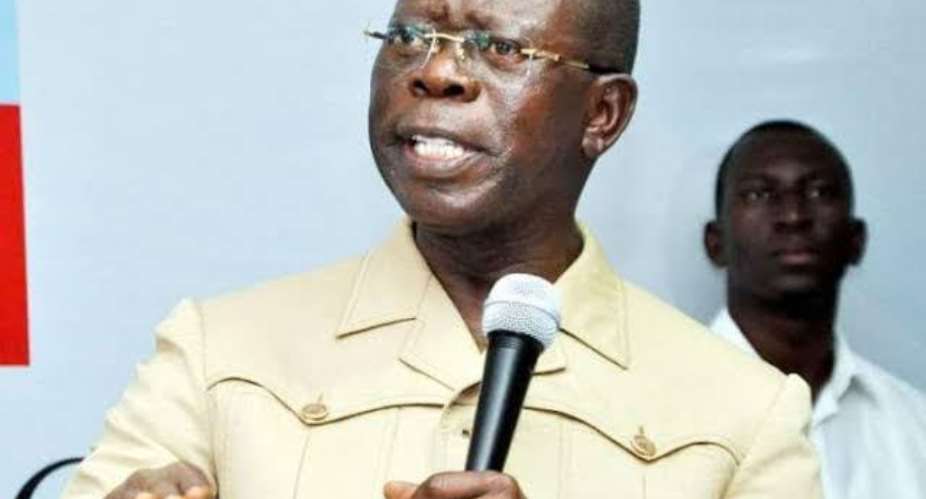
As the 10th Senate sinks into a moral abyss of comedy and hopelessness under Godswill Akpabio, Oshiomhole stands as a fearless stormy petrel exposing the corporate takeover of Nigeria’s sovereign wealth_.
ACROSS the rugged terrain of Nigeria’s Middle Belt and the gold-rich expanse of the Northwest, a devastating illusion is maintained for the public eye.
The evening news bulletins present a tragic, relentless tale of senseless bloodshed: rampaging bandits, shadowy "unknown gunmen," and ungoverned spaces where terror reigns supreme. Yet beneath this orchestrated chaos lies a cold, calculated commercial reality.
The chaos is not random—it is functional. The bandits operating in the dense forests are not the ultimate masterminds; they are the armed foot soldiers executing a violent corporate takeover of Nigeria’s subsoil assets.
While millions of rural citizens are displaced and thousands of kidnapped victims languish in rural encampments, industrial excavators, heavy-duty pumps, and foreign extraction crews operate 24 hours a day in the exact same forests declared too dangerous for military intervention.
Tens of thousands of tons of high-grade lithium ore move under private armed escort down public highways to maritime export terminals, while unrefined gold bars are loaded onto unregistered private jets at regional airstrips, bound for global trade hubs without a single warning alarm raised.
In a legislative landscape dominated by institutional silence and systemic complicity, one figure has dared to tear down this curtain of deceit.
Adams Oshiomhole: A Fearless Voice in a Caricature Assembly
The 10th National Assembly of the Federal Republic of Nigeria faces historical assessment as an institution that has sunk into an unprecedented moral abyss.
Under the leadership of Senate President Godswill Akpabio, the upper legislative chamber has increasingly degenerated into a caricature house of comedy, a venue of frivolous gavel-bashing, legislative lightheadedness, and profound apathy toward the existential crises confronting the Nigerian people.
Where the Senate was once envisioned as a solemn citadel of constitutional oversight and structural wisdom, it has frequently morphed into an echo chamber for executive convenience, leaving a traumatized populace with a deep sense of national hopelessness.
Yet, amid this moral and structural collapse, Senator Adams Oshiomhole has emerged as a fearless stormy petrel—a courageous, undiminished voice of conscience that the Nigerian Senate desperately needs if the nation is to be steered away from total catastrophe.
Refusing to subscribe to the quietist diplomacy of his peers, Oshiomhole—the Senator representing Edo North and former National Chairman of the All Progressives Congress (APC)—blew the whistle on the deep-seated complicity of Nigeria's ruling elite in illicit mining operations.
Speaking with uncompromising candor during a budget defense session for the Senate Committee on Solid Minerals Development, Oshiomhole directly accused powerful retired military generals, former permanent secretaries, and politically exposed commodity traders of orchestrating and financing illegal gold and solid mineral mining across the nation.
"The ongoing illegal mining across the country is being carried out by retired generals, and we know them," Oshiomhole boldly charged before the committee. He detailed how these elites coordinate illicit extraction sites, deploy private helicopters to cart away extracted gold, generate billions of dollars in illegal revenue, and arm local groups to shield foreign workers.
When met with fierce pushback from retired military officers—who dismissed the allegations as baseless and disrespectful to the armed forces—Oshiomhole remained steadfast.
He clarified his statement without diluting its core truth: he did not mean all retired generals were complicit, but specifically emphasized that high-ranking retired officers leverage their institutional knowledge, tactical networks, and state-backed immunity to run illicit mining operations.
Oshiomhole further revealed that his crusade was not a recent political calculation. As far back as 2021, while serving as APC National Chairman, he had written a comprehensive report to former President Muhammadu Buhari, warning the executive that retired military officers and high-level bureaucrats were systematically pillaging the country’s solid minerals.
That warning was quietly shelved, allowing the illicit enterprise to mature into a multi-billion-dollar international syndicate.
The Three-Step Tactical Extraction Blueprint
How does a criminal syndicate execute the industrial theft of a nation's mineral wealth directly under the oversight of state security apparatuses? The operational blueprint relies on a three-tier tactical sequence designed to displace local populations, neutralize state oversight, and privatize natural resources:
Sponsored Instability: The violence that dominates Nigerian headlines is not an arbitrary outbreak of ancient ethnic rivalries or spontaneous banditry. Advanced weaponry is systematically funneled to local syndicates and mercenary groups. While media commentary attributes massacres to "unknown gunmen," geological mapping reveals that these armed raids occur almost exclusively in communities sitting directly on verified deposits of gold, lithium, tantalum, tin, and rare earth elements. The primary objective is terror: force indigenous agricultural inhabitants off their ancestral lands to clear the area for extraction.
Quarantining the Zone: Once the civilian populace is driven away by violence, the targeted territory is declared a high-risk "Red Zone." The Nigerian Police Force withdraws its personnel, citing extreme danger. State military units establish peripheral checkpoints miles away from the perimeter, maintaining a posture of strategic caution. The zone is effectively severed from constitutional governance and legal scrutiny.
Industrial Extraction: With the public locked out, journalists intimidated, and indigenous residents displaced, foreign extraction crews—frequently sourced from China and Eastern Europe—are moved onto the sites. These foreign crews do not rely on standard state military protection. Instead, they are shielded by heavily armed, unregistered private paramilitary contractors.
The paradox is stark: in the exact forests where security forces claim it is impossible to track down kidnapped citizens, private mining operators deploy 50-ton industrial excavators, heavy rock crushers, and high-powered water pumps operating 24 hours a day.
An industrial operation of this magnitude consumes thousands of liters of diesel weekly. Heavy machinery and fuel convoys pass through regional transport routes, demonstrating that the state is not absent—it has simply been privatized to protect illicit commerce.
Logistics of an Unchecked Drain: Lithium Trucks and Golden Flights
Stealing bulk commodities requires robust logistics networks. One cannot hide thousands of metric tons of lithium ore in a pocket, nor sneak industrial gold bars through standard commercial airport security gates. The criminal syndicate relies on the active complicity or calculated blindness of key federal regulatory and enforcement institutions.
Every day, fleets of heavy-duty trucks depart the Middle Belt loaded with raw, high-grade lithium ore bound for maritime export terminals at Apapa Port in Lagos and Onne Port in Rivers State. To bypass checkpoints manned by security forces and the Economic and Financial Crimes Commission (EFCC), the syndicate employs trade mis-invoicing.
Cargo manifest paperwork lists high-value lithium ore (worth thousands of dollars per ton) as low-value zinc, raw earth, or industrial gravel. Port authorities and customs inspectors wave cargo through without mandatory laboratory testing or chemical assays, allowing raw wealth to leave Nigerian shores for nominal duty payments.
For gold extracted in the Northwest, maritime transport is discarded in favor of airborne smuggling. Unregistered private jets land at regional airstrips in proximity to mining operations. VIP convoys drive directly onto the tarmac, bypassing standard customs inspections and passenger manifests, while gold bars are loaded into aircraft holds under the guise of diplomatic baggage or shielded by high-level security clearance protocols.
These aircraft depart directly for international metal trading hubs, bypassing national financial monitoring frameworks entirely.
International Cartels and Foreign Capitalization
The extraction of Nigeria's mineral wealth is not merely a domestic crime; it is tied to global supply chains and foreign market demand. Middle Eastern bullion markets serve as a primary destination for illicit Nigerian gold. Once unrefined gold enters free-trade zones, it is melted down, assayed, and integrated into international supply chains. Official trade paperwork obscures its origin, transforming conflict-laden gold into legitimate commercial bullion.
Massive shipments of lithium ore, tin, and columbite are routed to processing hubs in East Asia. Foreign refineries purchase these raw inputs to feed global manufacturing pipelines for electric vehicle batteries, consumer electronics, and renewable energy storage.
European trading firms, logistics contractors, and commercial brokers—including entities operating through traditional trading hubs like Switzerland and France—frequently facilitate the financial and maritime structures needed to move African raw minerals into global markets.
Foreign buyers rely on paperwork issued by local proxies. Because domestic mineral barons secure official mining leases through the Mining Cadastre Office using complex corporate structures, the exported raw materials carry a veneer of legal legitimacy on the global market.
Nigerian law mandates that foreign exchange earnings from mineral exports be repatriated through the Central Bank of Nigeria (CBN) to build national reserves. However, the syndicate circumvents this requirement.
Mining leases are registered under corporate entities owned by shell companies based in foreign jurisdictions. Payments for exported minerals are deposited directly into private accounts in tax havens such as Geneva, the Cayman Islands, and Dubai. Billions of dollars generated from domestic resources remain outside the national banking system, denying the country revenue while weakening the local currency.
The $700 Billion U.S.-Nigeria Mining Framework
As illicit mining continues to drain resources, the Nigerian government has sought formal international partnerships to attract legitimate foreign investment into the solid minerals sector.
During high-level diplomatic engagements, Nigeria's Minister of Solid Minerals Development, Dele Alake, and U.S. Deputy Secretary of State, Christopher Landau, signed a bilateral critical minerals framework agreement.
Initial reports misconstrued the announcement as a direct $700 billion cash injection from the U.S. government. Clarifying statements confirmed that the $700 billion figure represents the estimated asset valuation of Nigeria's total untapped solid mineral reserves—including lithium, gold, tin, tantalum, niobium, and rare earth elements.
The framework is designed to establish a formal pathway for American capital and industrial technology to enter the Nigerian mining sector. This includes sponsoring advanced exploration to convert unverified mineral deposits into bankable reserves.
Shifting away from exporting raw ores toward domestic refining and local value addition is a strategic imperative. Likewise, assisting Western economies in securing critical minerals necessary for green technologies, energy storage, and defense manufacturing—while reducing single-source dependency—would be a laudable achievement.
The contrast between high-level diplomatic signing ceremonies in international capitals and the reality of violence in mining communities underscores the urgent need for structural reform. If Nigeria's solid mineral wealth is to benefit its citizenry rather than enrich illegal syndicates, the federal government must enact immediate structural changes.
Reclaiming Nigeria's Sovereign Wealth
As Senator Adams Oshiomhole advocated during Senate budget defense sessions, the Federal Government must deploy a dedicated Joint Task Force (JTF) across identified illegal mining hubs. Modeled after anti-bunkering operations in the Niger Delta, this task force must be empowered to secure mining zones, clear private paramilitaries, dismantle illegal airstrips, and restore state authority over mineral-rich territories.
The Ministry of Solid Minerals Development and the Mining Cadastre Office must conduct a transparent, public audit of all existing mineral titles. Anonymous corporate structures, offshore Special Purpose Vehicles, and nominee ownership arrangements must be prohibited to ensure that politically exposed persons and retired security personnel cannot hide behind shell companies.
Senator Oshiomhole insisted that Customs procedures at maritime ports and regional airports undergo immediate technical upgrades, requiring all bulk mineral exports to pass certified chemical testing prior to clearance to prevent trade mis-invoicing. Furthermore, private regional airstrips must be brought under strict federal aviation and customs control, eliminating unmonitored takeoffs and VIP inspection exemptions.
In the coming legislature, we must move away from performative politics and institutional redundancy. Legislative committees must exercise robust oversight, using their constitutional powers to subpoena records, inspect remote extraction zones, and hold public officials accountable.
The courageous stance demonstrated by Senator Oshiomhole offers a template for legislative independence—proving that even within a compromised Assembly, dedicated public servants can expose systemic corruption and fight for the national interest.
The Choice Before the Nation
Nigeria stands at a critical juncture. The subsoil wealth estimated at over $700 billion holds the potential to fund infrastructure, diversify the national economy, and lift millions of citizens out of poverty.
However, so long as high-ranking elites, foreign syndicates, and criminal enterprise dictate the terms of extraction, this natural wealth will continue to generate insecurity and economic drain.
Unmasking the network that links violent displacement in rural forests to offshore bank accounts in international tax havens is the first step toward reclaiming national sovereignty.
The nation requires not passive legislative observers, but fearless voices willing to confront institutional decay, defend the public treasury, and restore state authority over Nigeria's natural resources.
Erasmus Ikhide is a seasoned political analyst and investigative commentator. He can be reached via email at: [email protected]_

 How the record-breaking $6.3 billion heist in crypto history unfolded
 Paying GH¢5,000 to declare intention to contest as MP amounts to monetisation of...
 NPP will return to power with Bawumia in 2028 – Osahen Afenyo-Markin
 Ghana, Burkina Faso trade about US$1bn annually – Trade Minister
 NPP's new parliamentary aspirant selection process designed to favour Bawumia lo...
 ECOWAS steps up regional efforts to address climate-induced migration
 I was the brain behind La General Hospital reconstruction – Dr Okoe Boye
 2027 budget: Gov't must account for jobs created under 24-hour economy – Prof Bo...
 'Go prove criminality in court, not on TV' — Shamima Muslim tells Minority on So...
 TUTAG suspends nationwide strike, academic work resumes November 2


