




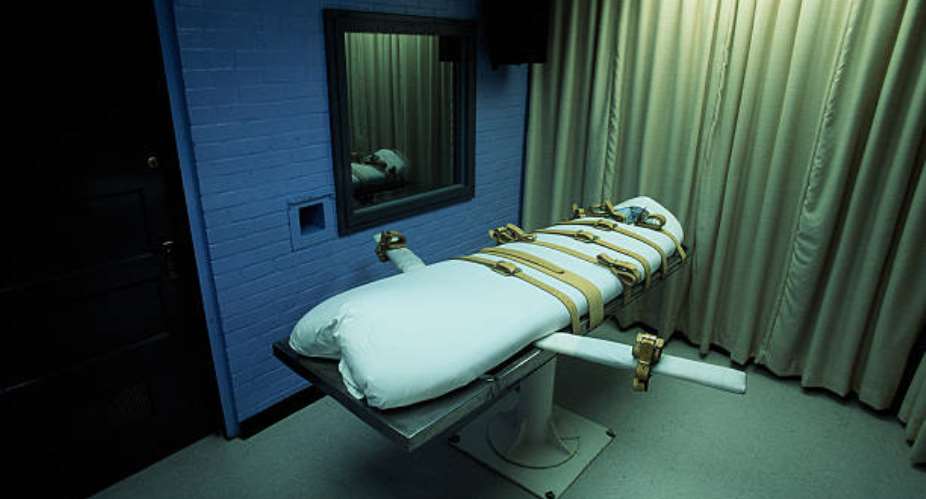
The death penalty, also known as capital punishment, remains a contentious issue in Ghana’s criminal justice system and in many other countries. This article argues that Ghana should reconsider its stance and reintroduce it as a viable form of justice.
In recent years, some individuals in Ghana have intentionally murdered others, including in cases involving anger, jealousy, or robbery. These cases raise questions about whether life imprisonment alone is a sufficient response.
Examples of murder cases in Ghana that may be cited in debates over capital punishment
In March 2026, two brothers, Yaw Clinton, 23, and Kofi Nsowa, 19, were fatally stabbed in Sefwi Akrofu, near Sefwi Boako, in the Western North Region. This case may be cited as an example of homicide in the argument for capital punishment because it shows a jealous dispute ending in the deaths of two young men. The young man from Sankore believed his romantic rival had accompanied his fiancée to a wake-keeping event in Sefwi Akrofu. Yaw Clinton was stabbed by the suspect, who retrieved a concealed dagger. When his younger brother, Kofi Nsowa, intervened to help him, the assailant also turned on him and stabbed him, resulting in their deaths.
The Ashanti Regional Police apprehended two foreign nationals in September 2026 in connection with the kidnapping and murder of Cheikh Touré, a Senegalese goalkeeper. This case is relevant because it adds another example of murder that supporters of capital punishment may use to argue for reintroduction. Subsequently, in July 2026, the Northern Regional Police Command apprehended two Nigerian nationals, Daniel Victor Eze and David Oko Ewa, for the murder of their 36-year-old compatriot, Nkemujika Uzorchuku Eze, in Tamale. This case is also relevant because it shows a killing that supporters of capital punishment may cite in the same debate. Following a violent altercation concerning the distribution of proceeds from internet fraud, the victim was found dead in his apartment.
In the same month, July 2026, authorities resolved a cross-border crime by arresting Nigerian nationals who had hired a Ghanaian taxi driver, Patrick, for a long-distance journey from Prampram to Aflao. This case is relevant because it shows another murder that could be cited in support of capital punishment. The driver was purportedly murdered by the suspects, who then buried his body in a bush near Dzodze. While attempting to escape the country in the stolen vehicle, they were apprehended at a security barrier.
Following a fatal shooting incident at a mining site in Bonsa, Western Region, the Ghana Police Service apprehended three Chinese nationals—Wen Jianhua, Yu Shuhui (alias Eli), and Zhou Daquan in November 2022. This case may be used as another example in the argument for capital punishment because it presents another murder that supporters may cite. During a targeted investigation of their residence, the authorities recovered the murder weapon. Ghana is the site of all of these murders, as the country does not have a death penalty. Perpetrators may know they will be punished with their lives if they commit crimes in their home countries.
Another murder case that can be used to support the reintroduction of the death penalty is the killing of 25-year-old nursing student Georgina Asor Botchwey in Mankessim, Central Region. The case involves a traditional ruler (Tufohene of Akwakrom) known as Nana Crack, the President of the Mankessim Traders Association, and an alleged accomplice, Christopher Ekow Quansah, a pastor. The suspects allegedly kidnapped Georgina, locked her in a room, and raped her multiple times before burying her in a pit at the Chief’s property.
Some Ghanaians do not support the death penalty as a means of punishing individuals for their crimes. In their view, it cannot safeguard the public from potential future attacks by offenders. By incarcerating perpetrators for life, the same objective can be achieved without necessitating the loss of another life.
Do anti-death penalty advocates believe that such criminals should remain in prison until they die? Have they considered that the victim's family will have to work to pay taxes so the government can provide for the suspects throughout their lives in prison?
Ghanaians must remember that capital punishment is a critical instrument for deterring and penalizing individuals who commit the most heinous crimes and acts of lethal violence. The state’s decision to punish a suspect in kind warns those contemplating such crimes and reinforces the case for reintroduction.
We must recognize that abolishing capital punishment from our constitution does not improve safety. It can encourage individuals to take the lives of others, as they are aware that they can purchase justice with their money or be released from prison after a period of time. This defeats the principles of criminal punishment. Punishments serve three legitimate penological objectives: general deterrence, specific deterrence, and retribution.
General deterrence sends a message to individuals contemplating serious offenses. The third penological objective, retribution, expresses society's right to make a moral judgment by punishing a wrongdoer in a manner appropriate to the offense committed. At the same time, specific deterrence targets the defendant. In terms of homicide, it appears that all of these elements are absent from the Ghanaian criminal justice system. In light of this, a significant number of Ghanaians advocate for the reintroduction of capital punishment. However, others oppose the "an eye for an eye" rule.
Imagine the murder of 80-year-old Dr. Jesse Amuah and his 64-year-old wife, Mrs. Elizabeth Esi Amuah, at their home in Asylum Down, Accra, by their 32-year-old houseboy and errand boy, Abraham Awundok. Awundok fled Ghana for Dubai on April 22, 2026, following the crime. INTERPOL and the Anti-Armed Robbery Unit apprehended him. On August 30, 2026, they returned him to Ghana. This is a strong murder case that supports the argument for the death penalty. It also responds to anti-death penalty advocates' arguments that it is morally questionable, cruel, inhuman, and degrading. At the same time, they overlook that capital punishment is a proportional punishment and that a just society requires a punishment that matches the severity of the crime.
Death penalty opponents, understandably, point out that there have been instances of death row inmates who have been exonerated after serving years on death row. Regrettably, errors are inevitable. Errors can indeed occur on both sides when it comes to the death penalty. Nevertheless, the death penalty is not rendered unjust by acknowledging that mistakes can occasionally occur in capital cases, any more than imposing a sentence of incarceration for a period of years is not rendered unjust by the occurrence of mistakes in non-capital cases.
Today, the criminal justice system has built-in checks and balances intended to ensure a fair process for each defendant, from jury selection to the penalty phase to the appeals process. The system is not flawless, and we must strive to improve it for everyone involved.
In summary, the principle of "an eye for an eye" has been present throughout history, from the Law of Moses to the Code of Hammurabi. Real justice requires individuals to pay their "debts to society" through punishment proportionate to the severity of their crime, which supports reconsidering capital punishment.
By Kwame Aduhene-Kwarteng, PhD, MA


 GoldBod to formalise eligible small-scale miners within six months under new pro...
 Ghana explores local, reginal production of HIV medicines
 Ghana’s economy grows to GH¢1.4 trillion in 2025 but fails to create decent jobs...
 Student denies charges of stealing Bishop Obinim's GH¢1.5million
 There's no dumsor in Ghana, everybody has power — Mahama
 Govt pledges support for family, seek justice for Ghanaian teenager killed in Ne...
 9% pay increment means little if workers cannot afford basic goods – Kwasi Kwart...
 Ghana making financial gains but losing environmental battle against galamsey – ...
 Northern Ashanti Mine takeover: 'Ghana looking like a failed state' – Kofi Benti...



Comments
Worth reading. Thank you for this. I am for it. But your position is articulated in writing. This makes a big difference to the generation.