




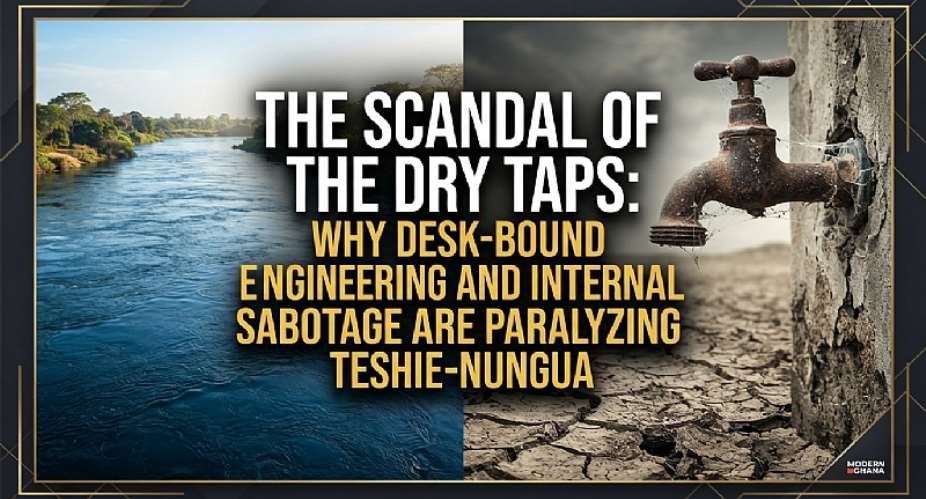
The Manufactured Coastal Water Crisis & The Field-First Fix
The coastal corridor of Accra—spanning Nungua Barrier, Melcom, Teshie Lascala, Teshie Mannah, and Nungua Old Town—is entering its seventh consecutive week of severe water paralysis. The shutdown of the high-cost desalination plant has left taps completely dry. While residents are stranded, rogue utility employees are actively profiting from illegal commercial pipeline bypasses. They ignore the timeless Akan proverb: “Sɛ wo twa wo tɛkrɛma we a, wonni nam biara” (If you cut your tongue, roast it, and eat it, you have not eaten any meat). This internal sabotage is hollowed out by a completely silent, dormant Teshie-Nungua Estates Resident Association.
This severe failure has driven deep economic inequality. Driven by sheer desperation, a local pensioner and his friend had to secure a commercial bank loan just to drill and mechanize a private borehole. The million-dollar question is: how many ordinary Ghanaians can afford this? This individual financial burden highlights a massive strategic misallocation of national resources. The state is choked by a $235 million international arbitration judgment debt and wasted $57.38 million in subsidies (2020–2024) to keep an energy-inefficient, salty sea-water plant alive. It requires a fixed $1.4 million monthly capacity charge even when broken. In contrast, for just $40 million, Ghana could expand gravity-fed pipelines from the Kpong Water Head Distribution system, tapping free freshwater instead of letting billions of gallons of clean Volta River water pour unused into the sea.
To modernize the grid and permanently eliminate desk-bound inertia, the Commander-in-Chief must mandate a field-first technological transition. Deploying machine learning algorithms and acoustic sensors will map pressure zones and instantly flag illegal commercial connections or physical leaks for rapid deployment. Furthermore, integrating ultrasonic smart meters with Mobile Money (MoMo) will end estimated billing inaccuracies, restore public trust, and track water quality to automatically shut off lines if contamination parameters spike. The directive is clear: The President must issue an executive order forcing water sector Ministers, district directors, and desk engineers to leave their air-conditioned offices, move directly into the fields, and sit in the trenches until hydraulic flow is restored to the coastal grid.
For over six agonizing weeks, the residents of Teshie-Nungua and its surrounding enclaves have been condemned to a grueling, bone-dry reality. Taps are completely dry, economic activities are paralyzed, and citizens are left stranded in endless queues or forced to buy expensive, unregulated water from private mobile tankers. The Teshie-Nungua Desalination Plant, once celebrated as a modern solution to coastal water scarcity, has instead become a monumental monument to operational failure and staggering financial loss.
While the state is saddled with a crushing $235 million international arbitration judgment debt due to a terminated, deeply flawed contract, the desk-bound engineers at Ghana Water Limited (GWL) appear comfortably detached in air-conditioned offices. This is no longer just a technical breakdown; it is a severe indictment of a utility management system that prioritizes paperwork over proactive, field-based problem-solving. Worse still, internal rot has compromised the network. While ordinary citizens suffer, certain rogue GWL employees actively spearhead and profit from illegal commercial water connections. They seem to forget the timeless Akan wisdom: “Sɛ wo twa wo tɛkrɛma we a, wonni nam biara”—if you cut your tongue, roast it, and eat it, you have not eaten any meat. By sabotaging their own company's infrastructure for short-term illicit gain, they are destroying the very state institution that sustains them, leaving an entire populace to suffer.
The Anatomy of an Engineering and Economic Failure
The water shortage has hit critical thresholds across major local landmarks, leaving families stranded from Nungua Barrier and the busy lanes around Melcom, all the way through Teshie Lascala, Teshie Mannah, and the inner streets of Nungua Old Town. This protracted suffering unfolds under a cloud of deep institutional silence. The local resident associations within the Teshie-Nungua Estates have collapsed into near-total dormancy, utterly deflated by years of bureaucratic stonewalling and a complete lack of response from the Ledzokuku Municipal Assembly (LEKMA).
Historical data reveals a painful contradiction in Ghana's utility administration. While nominal national water statistics claim progress, the reality of safely managed piped utility water has severely deteriorated along the coast. According to data tracked by the Ghana Statistical Service (GSS) 2021 Census, pipe-borne water has plummeted to become the primary source for only 31.7% of households nationwide. This systematic decline has forced entire communities to secede from the public grid, relying instead on unregulated sachet water and expensive private boreholes.
The roots of this specific coastal collapse trace back to a poorly negotiated "take-or-pay" Build-Own-Operate-Transfer (BOOT) contract. This lopsided deal historically forced Ghana to pay roughly $1.4 million monthly in fixed capacity charges regardless of whether water was actually produced. Financial records reveal that the state absorbed over $57.38 million in government subsidies between 2020 and 2024 just to artificially keep the desalination plant running. Despite these massive cash injections, local taps remained highly unreliable and frequently yielded water with a distinctly salty taste.
Basic hydrological logic dictates that tapping into freshwater from the Volta Basin or expanding the Kpong Water Head Distribution system would have cost a fraction of the desalination bill. For roughly $40 million—less than the subsidies wasted on the desalination failure—a dedicated pipeline expansion could have brought abundant, cheap freshwater to Accra. Instead, strategic misallocation allows billions of gallons of clean Volta River water to flush unused into the sea while citizens go thirsty.
This infrastructure deficit drives extreme economic inequality. Out of sheer frustration, a local pensioner and his friend were recently forced to secure a commercial bank loan just to dig and mechanize a private borehole. This desperate measure exposes a massive social gap: The million-dollar question is, how many ordinary Ghanaians can afford this? With drilling costs running into thousands of Ghana Cedis, the poorest segments of the population are left entirely behind, completely abandoned by the state utility.
The Capital Allocation Blindspot: Desalination vs. Kpong Gravity Flow
To understand the sheer magnitude of this engineering failure, we must contrast the economic frameworks of the failed desalination project against standard river-intake gravity systems, such as the Kpong Water Supply Expansion Project. The financial and technical data points demonstrate a complete lack of strategic foresight by our national planners:
- Capital Efficiency: The desalination plant required an initial investment of $126 million to produce a modest 60,000 m³/day. In stark contrast, the Kpong Water Expansion alternative delivered 186,000 m³/day for $273 million. This places the capital cost of Kpong at $1,467 per m³ compared to the desalination plant’s $2,100 per m³, making the gravity-flow river system 30% more economical right from construction.
- The Sovereign Financial Trap: The desalination contract was bound by a rigid BOOT arrangement requiring a $1.4 million monthly fixed capacity charge that accumulated even when the system was broken down or offline. Kpong operates as a fully state-owned asset with zero capacity charge liabilities. This lopsided contractual structure is what ultimately culminated in the $235 million international judgment debt choking our national coffers today.
- The Operational Subsidy Drag: Because ocean water processing is highly energy-intensive, GWL was forced to purchase water from the plant at an unsustainable rate of GH¢6.75 per unit, while legally mandated to retail it to citizens at the standardized national tariff of GH¢1.47 per unit. Kpong draws its raw material naturally via gravity river-flow for a tiny fraction of that operational cost, generating consistent public utility revenue instead of draining state coffers.
Strategic Recommendations to the Commander-in-Chief of the Republic of Ghana
Mr. President, the ongoing crisis in Teshie-Nungua cannot be solved by signing more contract variations, listening to polished executive slide decks, or routing diplomatic memos through sector Ministers. The time has come for the executive authority of the state to intervene directly where the failure is happening—on the ground. To restore water sovereignty and end the manufactured thirst of our people, we recommend a radical shift toward direct field implementation:
- Executive Directive for Field Deployment: The Commander-in-Chief should issue an immediate executive order directing the management, district directors, and desk engineers of Ghana Water Limited to immediately vacate their air-conditioned headquarters and move their operations directly into the fields. These engineers must sit in the trenches alongside field technicians until the local hydraulic telemetry lines are restored, pressure zones are re-mapped, and the physical blocks paralyzing coastal distribution lines are solved in real-time.
- Aggressive Purge of Internal Saboteurs: A special investigative task force under national security should bypass administrative bureaucracies to run an immediate, physical forensic audit of the main water supply lines moving through LEKMA. Rogue utility staff who are found spearheading, managing, or profiting from illegal commercial water bypasses must be instantly terminated and criminally prosecuted, sending a clear message that state infrastructure can no longer be hollowed out for personal enrichment.
- Permanent Capital Realignment to Kpong Gravity Flow: The presidency must permanently halt any further attempts to pump scarce public funds or subsidies into salvaging the high-cost, compromised desalination plant setup. All future coastal water capital allocations should be structurally locked into expanding primary gravity-fed pipelines from the Kpong Treatment Plant and the Volta Basin, capturing our abundant freshwater before it wastes away into the Atlantic.
- Mandated Municipal Water Accountability Frameworks: The state must legally mandate GWL to host open, transparent, bi-weekly town hall meetings with the reactivated Teshie-Nungua Estates Resident Association and local assemblies. In these open forums, engineers must present clear, unvarnished field tracking data, physical rationing timetables, and pipeline repair updates directly to the consumers they serve, replacing bureaucratic evasion with absolute transparency.
Deploying AI and Smart Metering for Efficiency, Health, and Economic Sovereignty
The systemic collapse of the Teshie-Nungua water network and the financial drag of the desalination contract expose a deeper vulnerability: our national utility infrastructure is operating in a technological dark age. To completely dismantle the culture of desk-bound inertia and root out the internal cartels hollowing out our resources, Ghana must look forward. By integrating Artificial Intelligence (AI) and advanced smart metering infrastructure, the state can leapfrog legacy engineering bottlenecks, turning our water distribution network from a site of chronic failure into an anchor for public health and economic growth.
- Real-Time Telemetry and Automated Theft Detection: Replacing compromised lines with AI-powered acoustic sensors and smart ultrasonic meters creates an unbypasable digital ledger of our water. Machine learning algorithms can continuously baseline normal pressure flows across the coastal grid from Kpong down to the Nungua Barrier. When an unexplained pressure drop occurs without a corresponding spike in metered consumer usage, the AI instantly flags an anomaly and dispatches field tracking maintenance units to the exact GPS coordinates.
- Safeguarding Public Health and Preventing Contamination: When centralized piped systems run dry for over six weeks, the vacuum within empty lines sucks in contaminated groundwater and shallow sewage. AI engines can ingest historical water quality data, pipeline age variables, and pressure cycles to predict high-risk contamination zones across Teshie Lascala and Mannah. Smart meters equipped with real-time chemical telemetry can automatically shut off local distribution valves if salinity levels, heavy metals, or pathogen markers spike, protecting the national health footprint.
- Economic Resilience and Democratized Utility Access: The current billing system is rife with estimated billing inaccuracies, delayed collections, and a lack of transparency. Smart prepaid metering transforms the financial landscape. If consumers can track their real-time usage via simple mobile apps integrated with Mobile Money (MoMo), trust is restored to the grid. Families will no longer be driven to secure predatory commercial bank loans to dig private wells.
The Teshie-Nungua water crisis is a sobering reminder that sophisticated technology cannot replace sound economic planning, institutional integrity, and active engineering leadership. We cannot be a nation wrapped by one of the largest freshwater bodies in the world, watching clean Volta River water pour into the sea, while our coastal citizens are forced to search for water around Lascala and Nungua Barrier. True resource resilience will not come from individual citizens taking out high-interest bank loans to drill private wells. Ghana’s taxpayers deserve far better than $235 million judgment debts, corrupt internal syndicates, and empty promises. GWL must wake up, purge its ranks of saboteurs, get its engineers into the trenches, and restructure our distribution architecture. Access to clean water is a fundamental right, and the manufactured thirst of Teshie-Nungua must end now.
✍️By A Concerned Retired Senior Citizen
For and on behalf of all Senior Citizens of the Republic of Ghana 🇬🇭
Teshie-Nungua
[email protected]


 How the record-breaking $6.3 billion heist in crypto history unfolded
 Paying GH¢5,000 to declare intention to contest as MP amounts to monetisation of...
 NPP will return to power with Bawumia in 2028 – Osahen Afenyo-Markin
 Ghana, Burkina Faso trade about US$1bn annually – Trade Minister
 NPP's new parliamentary aspirant selection process designed to favour Bawumia lo...
 ECOWAS steps up regional efforts to address climate-induced migration
 I was the brain behind La General Hospital reconstruction – Dr Okoe Boye
 2027 budget: Gov't must account for jobs created under 24-hour economy – Prof Bo...
 'Go prove criminality in court, not on TV' — Shamima Muslim tells Minority on So...
 TUTAG suspends nationwide strike, academic work resumes November 2


