




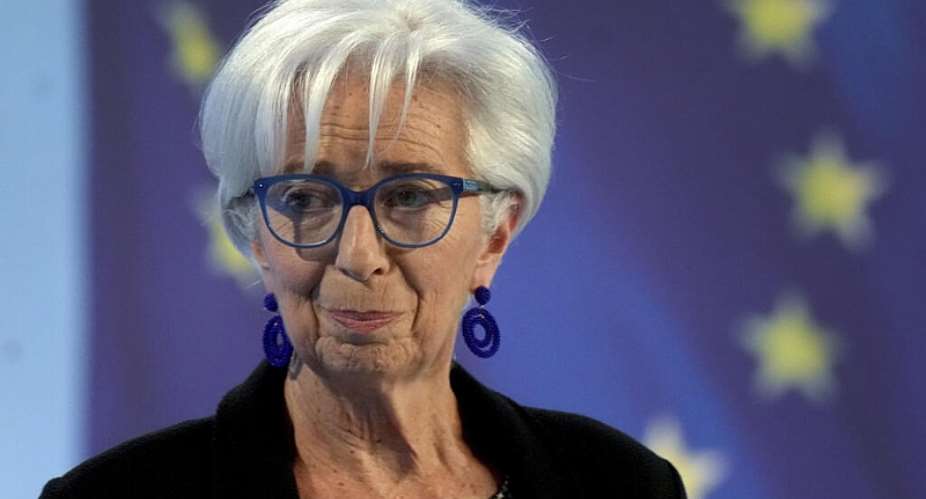
"It has been a great pride and a huge privilege to serve this institution," Lagarde posted on social media platform X, announcing that she would resign nine months before her term officially ends in October 2027.
"I think that I leave this institution with a sense of good work done and a [European Central Bank] that is fit for the future," she said.
The announcement follows speculation that Lagarde would leave early to enable European Union leaders to choose a successor while pro-EU French President Emmanuel Macron is still in office.
Lagarde's resignation paves the way for leaders to replace her before France's presidential elections in the spring, with officials fearing that far-right candidate Marine Le Pen could complicate the negotiations if she wins.
But it also comes at a difficult time in the eurozone, as worries mount over France's worsening public finances and the Bank seeks to navigate the energy shock triggered by the United States' war on Iran.
Inflation is currently almost double the European Central Bank (ECB) target of 2 percent, hitting a three-year high of 3.8 percent in September. Christine Lagarde unveils new designs for euro banknotes in Frankfurt, Germany, on 23 July 2026.
Macron praised Lagarde's "European commitment" and "determined" leadership, and called for preparations for her succession to be made "in an orderly and balanced way".
"Her career reminds us that stability can never be taken for granted: it is built through decisive action, a sense of the common good and confidence in our shared future," Macron said on X.
European Union chief Ursula von der Leyen thanked Lagarde "for everything you have done for Europe and the euro".
"From the pandemic to Russia's war of aggression, your steady hand has helped keep our economy stable and resilient," she said.
'Greater freedom'
Lagarde, who previously headed the International Monetary Fund and served as French finance minister, did not say what her next move would be.
But she has ruled out running for the French presidency. Instead she has been tipped to take the helm of the World Economic Forum, which organises the annual summit of politicians and business leaders in Davos, Switzerland.
Lagarde, who served in the governments of France's centre-right presidents Jacques Chirac and Nicolas Sarkozy, has nonetheless hinted that she could get involved in campaigning for the presidential vote, saying it was important to have a "European voice" in debates.
Sources familiar with the matter told French news agency AFP that by stepping down early, Lagarde would have "greater freedom to express her views".
"She cannot remain neutral when she sees the developments taking place in her own country and in the world," said one of the sources, who spoke anonymously.
Christine Lagarde: From IMF to ECB
Succession race
Antonio Costa, head of the European Council, said the process to appoint Lagarde's successor would begin immediately to ensure a "smooth transition".
Former Dutch central bank chief Klaas Knot and Spain's Pablo Hernandez de Cos, currently head of the Bank for International Settlements, are being viewed as the frontrunners to succeed her.
With two other ECB officials already due to be replaced – executive board member Isabel Schnabel and chief economist Philip Lane – there are likely to be intense negotiations among European capitals in coming weeks.
Analysts have speculated that European Union leaders may seek to fill all three vacancies by the time the next EU summit takes place on 17-18 December.
Does Europe really need a 'digital euro'?
Testing tenure
The ECB president leads the bank's governing council, which sets interest rates for the 21 countries that use the euro.
Lagarde was appointed in 2019 to succeed Mario Draghi. Her tenure was marked by repeated geopolitical upheavals, which often left policymakers struggling to fulfil the ECB's main task of keeping consumer prices in check.
The Covid-19 pandemic, Russia's invasion of Ukraine and the subsequent energy shock – which pushed eurozone inflation to a record of over 10 percent – plus the US tariff blitz and now the fallout from the Iran war have all severely tested the institution.
The ECB's governing council also faced criticism for responding too slowly to these crises.
But officials also won praise for seeking to overhaul the institution so it is better prepared for a more uncertain world, introducing new crisis-fighting tools and seeking to communicate its decisions more clearly.
(with newswires)


 How the record-breaking $6.3 billion heist in crypto history unfolded
 Paying GH¢5,000 to declare intention to contest as MP amounts to monetisation of...
 NPP will return to power with Bawumia in 2028 – Osahen Afenyo-Markin
 Ghana, Burkina Faso trade about US$1bn annually – Trade Minister
 NPP's new parliamentary aspirant selection process designed to favour Bawumia lo...
 ECOWAS steps up regional efforts to address climate-induced migration
 I was the brain behind La General Hospital reconstruction – Dr Okoe Boye
 2027 budget: Gov't must account for jobs created under 24-hour economy – Prof Bo...
 'Go prove criminality in court, not on TV' — Shamima Muslim tells Minority on So...
 TUTAG suspends nationwide strike, academic work resumes November 2


