




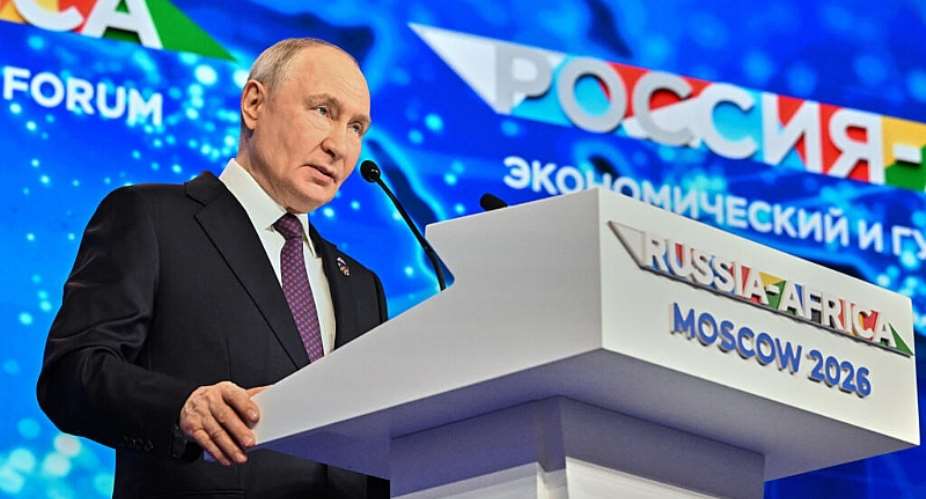
A total of 48 African countries have sent delegations to the summit, including 22 heads of state, with Russian President Vladimir Putin planning to meet most of them one-on-one.
Africa plays a central role in Russia's strategy to establish itself as the leader of the Global South, said Cécile Marin, a specialist in Russian-African relations and a lecturer at Sciences Po Paris.
"Russia is putting forward a whole narrative denouncing the neocolonialism of the Western powers. Obviously, France is a major target," she told RFI.
Putin is quick to emphasise that Russia, unlike France or the United Kingdom, never colonised African countries, Marin explained. His government has also highlighted the "traditional values" it claims to share with many in Africa, she said.
Moscow has courted ties with Africa since the Soviet era, and has long looked to Africa as a counterweight to what it sees as Western domination over international affairs.
Putin said a world where power is no longer concentrated in the West was quickly becoming a reality.
"The era when the fate of entire continents was determined by a narrow bloc of states is irrevocably gone," he said as he opened an economic forum for business leaders hours before the high-level summit began.
Burkina Faso, Mali and Niger launch Tafouk TV channel to push their own narrative
Economic ambitions
The summit is expected to focus on expanding economic cooperation in particular.
Putin told delegates on Wednesday that Russia was "prepared to further expand the geographical reach of our agricultural product shipments". Attacks in the Black Sea linked to the conflict in Ukraine continue to disrupt exports of grain from both Russia and Ukraine, many of which go to Africa.
Putin also announced that Moscow planned to "localise" the production of Russian medicines and vaccines on the African continent, and stressed that Russia was "open to sharing our modern competencies and high-tech digital know-how with our African friends".
The summit is expected to end Thursday with a final declaration on deepening cooperation between Russia and African nations, alongside a separate statement on cooperation in the field of artificial intelligence.
The Kremlin said Russia will also seek to strengthen its diplomatic presence on the continent, where it aims to open a 49th embassy, in Liberia.
Leaked files reveal Russia's blueprint to expand African Sahel alliance
Security dominant
To date, economic ties remain limited. Russia-Africa relations are primarily centred on military and security issues, according to Ivan Klyszcz, a researcher at the International Centre for Defence and Security in Tallinn, Estonia, and a specialist in Russia-Africa relations.
"Most African armies were trained during the Cold War by instructors from either the Soviet Union or the Eastern Bloc," he told RFI. "This means they mainly use Soviet-style equipment, such as Kalashnikovs. These are markets in which Russia enjoys very, very privileged access."
Russian paramilitary forces are also deployed in several countries in Africa, he said, primarily to protect leaders and infrastructure. In some cases, they carry out combat missions – such as in Mali, where the government is using Russian paramilitaries to battle a jihadist offensive.
These forces are not just guns for hire, according to Klyszcz: they are managed by Russian military intelligence and also serve Russian objectives.
Madagascar marks one year since uprising as Russia's influence grows
Shadow of war in Ukraine
Yet Russia's ambitions in Africa may be limited by its war in Ukraine, which is weighing heavily on Moscow's budget.
Paul-Simon Handy, regional director for East Africa at the Institute for Security Studies think tank in Pretoria, said Russia's room for manoeuvre was reduced.
To implement the various policies it has outlined in its Africa strategy, he told RFI, "there would need to be fiscal and budgetary leeway, which does not seem to be available at the moment".
Instead, "the war in Ukraine may mean that Russia can only offer defence assistance and commercial cooperation in the supply of provisions, fertilisers and agricultural equipment".
The war has already marred Russia's relations with several African countries in another respect, after numerous reports of Africans being forcibly conscripted by Moscow to fight on the frontlines in Ukraine.
The families searching for African recruits lost in the Ukraine war
The French Institute of International Relations estimates that between 3,000 and 4,000 Africans are fighting for Russia in Ukraine, some lured under false pretences and promises of well-paid work.
Countries including Nigeria, Kenya and South Africa have publicly voiced alarm at the fate of their citizens recruited by Moscow.
In an open letter to the African heads of state and other officials attending the Moscow summit, Amnesty International voiced "deep concern regarding Russia's forced and deceptive recruitment" of African nations.
The rights group urged officials to demand that Russia "cease any ongoing and future recruitment of people from Africa and other foreign nationals into its military forces".
This story has been adapted from original reporting by RFI's French service, with additional information from AFP.


 October 29: Cedi sells at GHS12.25 on forex market, GHS11.63 on BoG interbank
 Ghana’s mineral wealth must not come at environmental cost – Zanetor
 NPP's SC suit to counter pending suits backing Mahama’s third-term eligibility –...
 No constitutional dispute has arisen to warrant NPP’s suit on presidential term ...
 'NPP has become group of flip-floppers' – Edem Agbana on South Africa evacuation...
 Kufuor explains why his government opted for HIPC despite concerns over Ghana’s ...
 Policewoman who attempted 120-hour painting marathon dies after short illness
 I entered politics in my 20s but became president at 62 – Kufuor
 Accra-Tema Motorway project reaches 53% completion despite delays
 Prisons Service to publish findings on alleged plot to poison Chairman Wontumi


