




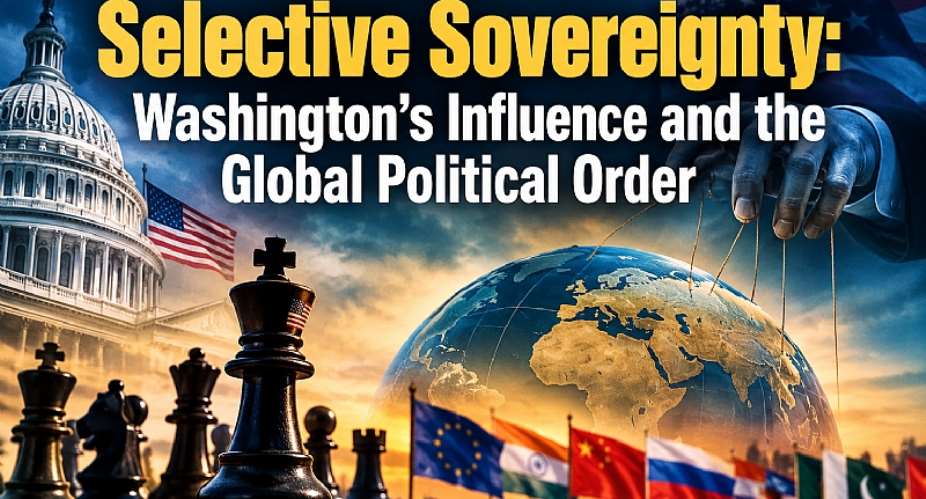
The supreme power that seeks to shape the world order often makes selective choices. It selects friends at a cost, chooses enemies in response to perceived defiance, invokes the law to frighten the public, and displays honour to receive applause. Everything becomes a means of establishing its authority and demonstrating its relentless power. Since the early 2000s, the United States has sought to shape the geopolitical world order according to its imagined framework. However, it is now time to question the foundations of this approach.
India: Political Interference and Washington's Interests
The political controversy surrounding the Bharatiya Janata Party (BJP), referred to by critics as the Cockroach Janta Party, and the Modi government raises questions about possible connections with Washington. A former Indian High Court jurist questioned how an account could reach 20 million before a sudden dip and how money could seemingly emerge from nowhere in India, while party leaders travelled by plane without clear evidence of the donors bearing the costs. The Jantar Mantar protests and numerous allegations concerning external funding have further fuelled the debate.
Clearly, the BJP has its supporters, but the question is whether that support is being capitalised on by the manufacturers of world politics. This becomes particularly significant in the context of BRICS, where Russia and China have moved closer to New Delhi. Could Washington perceive Modi's independent strategic positioning as a rebellious response and attempt to tighten its grip through political pressure?
First, the education minister, then the chief election commissioner, and next, potentially, the foreign minister: a democratic constitutional framework offers considerable room for political manoeuvring. This theory may be wrong, but the history of American strategic institutions, including CENTCOM, raises questions about Washington's willingness to pursue its interests beyond its borders.
Venezuela: Democracy on Washington's Terms?
What about Washington's interference in Venezuela?
Marco Rubio said in a recent press talk, without naming Machado, that street protests would not bring democracy. He further suggested that three conditions had to be met before the next elections: first, changes to the Supreme Court, which was considered favourable to Maduro; second, the appointment of electoral council members; and third, the reduction of debt. He also indicated that Venezuela would have to wait another two years.
Recently, the American-backed Machado has reportedly made progress in efforts to eliminate Iranian and Cuban influence. Her political opponent, Rodríguez, has argued that Machado is taking dictation from abroad and questioned whether she could protect the public interest in the face of American influence.
Venezuela's power dynamics, therefore, appear increasingly entangled with Washington's strategic calculations. The question remains: if external powers can influence the conditions under which a country conducts its elections, where does national sovereignty end and geopolitical interference begin? Yet the international democratic order often appears to have little difficulty with such contradictions.
Europe and the Limits of American Influence
How has American influence been tested in Europe and beyond?
In Brazil, the American-backed Jair Bolsonaro lost the election and subsequently flew to the United States. Donald Trump called the election rigged. In Serbia, Washington's preferred political position surrounding Aleksandar Vučić encountered challenges. In Hungary, Viktor Orbán also lost power. Even in Israel, shifting electoral calculations and changing political interests have raised questions about the influence of the American lobby.
These developments illustrate the limits of external political influence. A powerful ally may support a particular government or political movement, but that support cannot guarantee electoral success. The question is whether Washington accepts local political outcomes when they contradict its preferences or challenges them when its strategic interests are threatened.
The Middle East: Has Washington Lost Its Grip?
In the Middle East, has American control already weakened?
The GCC's reported proposals involving the recapture of regional security arrangements and the withdrawal or expulsion of American soldiers could be interpreted as signs of diminishing influence. The prospect of an American withdrawal from Iraq, the Yemen factor, Egypt's position, and the changing calculations of regional countries all raise questions about Washington's future role.
These countries may be seeking alternatives to their existing security arrangements, but the crucial question remains: what can Washington offer in return for continued cooperation, and what can regional governments demand in exchange for their strategic alignment? Certainly, the relationship cannot remain sustainable if the interests of local populations and governments are consistently subordinated to external priorities.
Pakistan: The Question of Political Legitimacy
What about the legitimacy of Pakistan's current regime?
From the cipher controversy to political reconciliation, Pakistan's current hybrid model continues to face questions about its public mandate. Its external legitimacy and international relationships also influence its foreign-policy decisions. The Islamabad MOU, which was subsequently discarded, provides another example of how sovereignty can come under pressure when national decisions conflict with external expectations.
Asim Munir and his associates played a crucial role in diplomacy surrounding the Iran war, yet the regional deadlock remained unresolved. Pakistan's decision not to become involved in the Yemen war was one positive aspect of its strategic calculations.
The proposed Makkah Accord, Türkiye's regional projection, the India card, the veil of terrorism, and European reports concerning Pakistan's electoral process all contribute to the debate over democracy and sovereignty. If a government lacks an unquestioned public mandate, how can it ensure that its foreign-policy decisions reflect the people's aspirations rather than the preferences of external partners?
Sovereignty Must Prevail Over Intervention
These examples illustrate what may be desperate attempts to maintain control over a geopolitical world order whose foundations are already being challenged. The United States may retain considerable economic, military, and diplomatic power, but its ability to shape the internal politics of every country is neither unlimited nor guaranteed.
To preserve its influence, Washington may resort to political pressure, strategic manoeuvring, and other controversial methods. However, selective partnerships and selective support for political regimes cannot provide lasting stability. Governments that rely excessively on external backing while neglecting genuine public support ultimately risk losing their legitimacy.
The international system needs a different approach: equal respect, mutual benefits, and recognition of national sovereignty. Having the upper hand does not make a country the legitimate authority over others. Nor does diplomatic dominance guarantee successful diplomacy.
The genuine voice of the people remains the ultimate solution. A stable world order cannot be built by selecting favoured governments, defining acceptable political outcomes, or imposing strategic interests on sovereign nations. Lasting peace and stability require a commitment to equality, mutual respect, and the right of every nation to determine its own future.


 'NPP has become group of flip-floppers' – Edem Agbana on South Africa evacuation...
 Kufuor explains why his government opted for HIPC despite concerns over Ghana’s ...
 Policewoman who attempted 120-hour painting marathon dies after short illness
 I entered politics in my 20s but became president at 62 – Kufuor
 Accra-Tema Motorway project reaches 53% completion despite delays
 UG students plan November 2 protest over 26% accommodation fee hike
 Police debunk 10 alleged missing manhood cases in Asankragwa, warn against false...
 EPA gives Empire Cement 30 days to relocate over Densu Delta Ramsar Site concern...
 Canada will offer technical support for establishment of Women's Development Ban...
 Prisons Service to publish findings on alleged plot to poison Chairman Wontumi


