




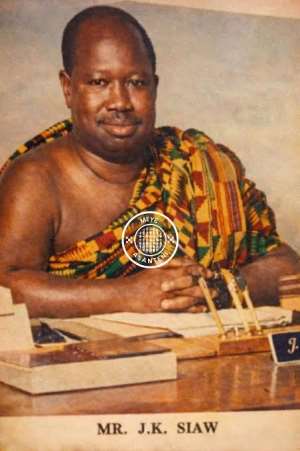
The remarkable history of J.K. Siaw’s Tata Brewery, its transformation into Achimota Brewery Company and its eventual integration into Ghana’s modern brewing industry raises enduring questions about industrial entrepreneurship, state power, property rights and economic justice.
The history of industrial development in Ghana cannot be adequately told without recognising the remarkable contributions of indigenous entrepreneurs who invested their resources, knowledge and determination in building manufacturing enterprises during the country's early post-independence years. Among these pioneering industrialists was Joshua Kwabena Siaw, popularly known as J.K. Siaw, whose establishment of Tata Brewery Limited at Achimota in Accra represented one of the most ambitious examples of Ghanaian-owned industrial enterprise.
The story of Tata Brewery is not merely about beer production. It is a compelling account of entrepreneurial vision, industrial achievement, political intervention, disputed taxation, state confiscation and a prolonged struggle for restitution. It also illustrates how political instability and weaknesses in institutional accountability can undermine private investment and alter the course of national industrial development.
Established in 1969, Tata Brewery emerged at a time when Ghana was seeking to expand domestic manufacturing, create employment and reduce its dependence on imported consumer products. Its founder, J.K. Siaw, had begun his working life as a teacher before entering the cocoa trade, where he developed the commercial experience and financial capacity that eventually enabled him to venture into large-scale industrial manufacturing.
Siaw belonged to a generation of Ghanaian businessmen who believed that economic independence required more than political sovereignty. For them, genuine national development depended on Ghanaian ownership of productive enterprises, the acquisition of modern industrial technology and the creation of employment opportunities for the country's growing workforce.
On January 30, 1973, Tata Brewery was formally commissioned by Ghana's Head of State, Colonel Ignatius Kutu Acheampong. Historical accounts describe the establishment as the largest wholly African-owned brewery in West Africa at the time. Although this regional ranking requires confirmation from contemporary industry records, the scale and ambition of the investment were remarkable.
The factory introduced modern brewing technology and became associated with products such as Tata Pilsner Beer and Maltex. Historical narratives also credit the company with pioneering the introduction of draught beer in Ghana, although the precise extent of this innovation deserves further examination.
Tata Brewery was more than a production facility. It represented an emerging model of Ghanaian industrial management in which local professionals and technical personnel assumed responsibility for operating a sophisticated manufacturing enterprise.
Accounts of the company's operations indicate that it employed approximately 750 Ghanaian workers and only four expatriates at its peak. If confirmed by contemporary employment records, these figures would demonstrate an unusually high level of indigenous participation in an industry that depended heavily on imported equipment and specialised technical expertise.
The brewery reportedly provided employees with welfare benefits, including healthcare services, subsidised or free meals, staff canteens and transportation assistance. These arrangements reflected an understanding that industrial productivity depended not only on machinery and capital but also on the welfare, stability and commitment of employees.
For many Ghanaian workers, employment in such an enterprise offered opportunities for technical training, professional advancement and improved living conditions. Tata Brewery consequently became a symbol of the possibilities of indigenous industrialisation.
However, the company's rapid development coincided with a period of growing political and economic instability in Ghana. By the late 1970s, successive military administrations were grappling with fiscal pressures, economic decline, shortages and public dissatisfaction.
It was within this environment that Tata Brewery became embroiled in a major dispute over taxation and government concessions.
According to accounts of the controversy, Siaw's enterprise had benefited from a three-year tax concession covering the period from 1973 to 1975. The concession was reportedly intended to support the establishment and initial development of the brewery, which required substantial investment before reaching full commercial production.
The dispute intensified following the introduction of Supreme Military Council Decree 222, identified in historical narratives as SMCD 222, in February 1979. The legislation is reported to have been applied retrospectively from July 1, 1977, creating substantial disagreement over the company's tax liabilities.
Government authorities subsequently claimed that Tata Brewery owed approximately ¢10.6 million in taxes and penalties, with some accounts placing the disputed amount above ¢15 million.
Siaw challenged the assessments, arguing that the company had complied with its obligations and that the retrospective application of tax measures was unfair.
Accounts attributed to Customs, Excise and Preventive Service records suggest that the brewery had already paid approximately ¢9.6 million in various taxes. Some narratives further maintain that certain payments resulted in a credit balance in the company's favour.
These figures remain important to the historical controversy, but the original legislation, tax assessments and payment records must be examined before determining whether the government's claims were legally justified.
The situation deteriorated dramatically after the military uprising of June 4, 1979, which brought the Armed Forces Revolutionary Council, led by Flight Lieutenant Jerry John Rawlings, to power.
The AFRC introduced a radical programme described as a national house-cleaning exercise, targeting individuals accused of corruption, economic misconduct and abuses associated with previous governments.
Within this politically charged atmosphere, Tata Brewery and other assets belonging to J.K. Siaw were confiscated by the state.
The seizure effectively ended Siaw's ownership and management of the industrial enterprise he had established. Historical accounts allege that the military authorities relied on disputed tax liabilities to justify their actions, while Siaw maintained that the confiscation was unlawful and politically motivated.
Some accounts further allege that company funds were appropriated, ownership interests transferred to the state and Siaw's private property subjected to military searches.
These allegations are serious and require careful examination of the relevant decrees, official correspondence, contemporary newspaper reports and records of subsequent investigations.
Faced with the loss of his industrial investment and concerns about his personal safety, Siaw left Ghana and eventually settled in the United Kingdom.
For an entrepreneur who had invested years in establishing a major manufacturing enterprise, the confiscation represented a profound personal and financial setback.
The brewery, meanwhile, continued under state control and became known as Achimota Brewery Company, or ABC.
The transition marked a fundamental change in the enterprise's ownership and corporate identity. What had begun as a privately owned Ghanaian industrial venture became part of the state's portfolio of manufacturing assets.
One of the most contentious aspects of the case concerns reports that subsequent investigations failed to substantiate the allegations against Siaw.
Historical narratives refer to a document dated August 20, 1979, reportedly signed by an AFRC officer, indicating that Siaw had been investigated and cleared of criminal wrongdoing or tax evasion.
If authenticated, such a document would be highly significant in assessing the justification for the confiscation. However, its exact wording, legal authority and implications require examination before it can be treated as conclusive evidence of formal exoneration.
Despite Siaw's continued representations, the brewery was not returned to him.
Following the establishment of the Provisional National Defence Council in December 1981, Siaw reportedly renewed his efforts to obtain justice through petitions to government authorities.
The controversy subsequently attracted the attention of the National Investigation Committee, which is reported to have reviewed the circumstances surrounding the seizure in 1982.
Accounts of the committee's findings state that the confiscation of Siaw's assets on allegations of tax evasion and invoicing fraud was described as a "travesty of justice."
This reported conclusion has become one of the most frequently cited elements of the dispute. Nevertheless, the original committee report should be obtained to establish its precise findings, recommendations and legal status.
The distinction is important because an investigative committee's conclusions, even when strongly critical of government action, do not necessarily constitute an enforceable judicial order.
For Siaw, however, the central issue remained unchanged: he had lost ownership of the brewery and was unable to secure its restoration.
He continued living in exile and died in London in October 1986, without recovering the industrial enterprise that had once symbolised his entrepreneurial success.
His death did not end the controversy.
Under state ownership, Achimota Brewery Company continued operating through a period characterised by economic restructuring, shortages of foreign exchange, difficulties in obtaining industrial inputs and changing government policies.
Maintaining the brewery required the efforts of experienced managers, engineers, production personnel, administrators and logistics specialists.
The contribution of such personnel forms part of the wider institutional history of the brewery. Although changes in ownership attract public attention, the survival of industrial enterprises often depends on the technical competence and commitment of workers and managers who sustain production during difficult economic conditions.
By the 1990s, Ghana had embarked on extensive economic reforms involving the privatisation and restructuring of state-owned enterprises.
The divestiture programme was intended to attract private capital, improve efficiency, modernise industrial facilities and reduce the financial burden of government ownership.
Achimota Brewery Company became one of the enterprises affected by these reforms.
During the mid-1990s, the brewery was transferred into private-sector ownership and underwent rehabilitation. Historical accounts describe international financing arrangements involving the International Finance Corporation and German brewing interests, including a reported US$3.5 million facility.
The precise financing arrangements and the claim that the transaction represented Ghana's largest non-mining privatisation at the time require confirmation from IFC project documentation and official divestiture records.
The enterprise subsequently became associated with Ghana Breweries Limited, reflecting a new phase of ownership, investment and commercial development.
For the Siaw family, however, the privatisation raised fundamental questions about the legality and morality of selling assets that they maintained had been wrongfully confiscated.
Family members reportedly challenged the divestiture through the Commission on Human Rights and Administrative Justice, arguing that the state should not transfer ownership of the disputed enterprise without resolving the original grievance.
Accounts identify J.A. Siaw, a son of the founder, as having pursued the matter on behalf of the family.
The dispute reportedly involved questions concerning CHRAJ's authority to intervene in the privatisation process and the legal status of assets acquired through earlier military action.
The details and outcome of these proceedings should be verified from CHRAJ records, court decisions and official government correspondence.
The controversy continued into the early 2000s, when Ghana established the National Reconciliation Commission under President John Agyekum Kufuor.
The commission was created to investigate human rights abuses and other injustices associated with periods of unconstitutional government and to recommend appropriate forms of reconciliation and redress.
The Siaw family's case reportedly formed part of the broader effort to revisit historical grievances arising from military rule.
Accounts suggest that some properties associated with the family were eventually restored, while the brewery itself remained outside their ownership.
However, the precise extent of restitution, any compensation recommendations and their implementation require verification against the commission's published findings and subsequent government records.
Meanwhile, the brewing industry continued to evolve.
In 2004, Ghana Breweries Limited and Guinness Ghana Limited combined their businesses in a major corporate merger that helped shape the modern structure of Ghana's brewing industry.
The transaction linked the corporate history of the former Tata Brewery and Achimota Brewery Company to the larger Guinness Ghana brewing enterprise.
It is nevertheless important to distinguish the historical corporate succession from the present operational status of the original Achimota factory. A merger involving successor companies does not, by itself, establish that the original production site remains operational today.
The subsequent development of Ghana's brewing industry demonstrates how industrial assets can pass through multiple ownership structures while retaining historical connections to their original founders.
Yet these corporate changes do not erase the circumstances under which the original enterprise was established or the disputes surrounding its transfer into state ownership.
The Tata Brewery story remains particularly relevant to Ghana's current efforts to strengthen indigenous manufacturing.
Successive governments have promoted industrialisation through investment incentives, manufacturing support programmes, industrial parks and initiatives intended to encourage local value addition.
However, the history of Tata Brewery illustrates that successful industrialisation requires more than investment capital, factories and machinery.
It also requires a predictable legal environment, effective institutions, fair taxation, enforceable property rights and protection against arbitrary state intervention.
Entrepreneurs who invest in manufacturing often commit substantial resources to land, buildings, equipment, product development, employee training and distribution systems. Such investments may take years to generate adequate returns.
Their willingness to make these commitments depends heavily on confidence that legitimate commercial interests will be protected regardless of changes in political leadership.
When industrial enterprises become vulnerable to politically driven confiscation or uncertain regulatory decisions, the consequences extend beyond their owners.
Employees may lose opportunities, suppliers may suffer financial losses, lenders may become reluctant to provide capital and future investors may reconsider long-term manufacturing projects.
The broader economy consequently loses productive capacity, technological expertise and opportunities for employment creation.
The Tata Brewery experience also raises important questions about the relationship between taxation and industrial development.
Governments must collect taxes to finance public services and national development. Businesses, in turn, have an obligation to comply with lawful tax requirements.
Nevertheless, tax administration must be transparent, consistent and subject to independent review.
Where concessions are granted to encourage industrial investment, their legal status and conditions should be clearly established. Disputes over assessments should be resolved through appropriate procedures rather than political pressure or arbitrary enforcement.
Equally important is the need for effective remedies when government action is subsequently found to have been improper.
A credible system of justice must provide practical avenues for correcting unlawful administrative decisions and compensating individuals or businesses where legally justified.
The lessons are particularly important for Ghana's emerging entrepreneurs and manufacturing enterprises, many of which face challenges involving access to finance, regulatory compliance, infrastructure, imported machinery and market competition.
The country cannot expect indigenous investors to undertake major industrial projects without simultaneously strengthening the institutions that protect long-term productive investment.
There is also a compelling historical responsibility to recognise the achievements of industrial pioneers such as J.K. Siaw.
Ghana's economic history frequently highlights the contributions of political leaders, international investors and multinational corporations. Yet indigenous entrepreneurs who established major manufacturing enterprises through personal initiative deserve a prominent place in the national narrative.
Their stories should be documented through archival research, oral histories, company records, contemporary newspapers and academic studies.
In the case of Tata Brewery, a comprehensive historical investigation would help clarify the original ownership arrangements, the tax dispute, the legal instruments used in the confiscation, the findings of official investigations, the circumstances of privatisation and the subsequent efforts to obtain restitution.
Such research would not only contribute to historical understanding but also strengthen contemporary debates about investment protection and institutional accountability.
The legacy of J.K. Siaw should therefore be understood in two dimensions.
The first is his remarkable entrepreneurial achievement in establishing a major indigenous brewery during an era when Ghanaian ownership of large-scale industrial enterprises was still developing.
The second is the unresolved historical controversy surrounding the loss of that enterprise and the broader implications for justice, governance and property rights.
Tata Brewery represented a vision of Ghanaian industrial independence built on entrepreneurship, investment, technology and employment creation.
Its transformation into Achimota Brewery Company and subsequent integration into a larger corporate structure form part of Ghana's changing industrial landscape.
But the story also serves as a warning about the lasting economic and human consequences of political intervention in private enterprise.
As Ghana seeks to build a more productive and competitive economy, the experience of Tata Brewery offers an enduring lesson: industrial development cannot flourish without institutional integrity, legal certainty and respect for legitimate private investment.
J.K. Siaw's ambition was to demonstrate that Ghanaian entrepreneurs could establish and manage major industrial enterprises. His achievement deserves recognition, while the circumstances surrounding the confiscation of his business deserve rigorous and impartial historical examination.
Ultimately, the most meaningful tribute to pioneers such as Siaw would be the creation of an economic environment in which indigenous entrepreneurs can invest confidently, innovate freely, create employment and build enterprises capable of surviving political transitions.
Ghana's industrial future will depend not only on its ability to produce successful entrepreneurs, but also on its determination to protect the enterprises they build.


 'NPP has become group of flip-floppers' – Edem Agbana on South Africa evacuation...
 Kufuor explains why his government opted for HIPC despite concerns over Ghana’s ...
 Policewoman who attempted 120-hour painting marathon dies after short illness
 I entered politics in my 20s but became president at 62 – Kufuor
 Accra-Tema Motorway project reaches 53% completion despite delays
 UG students plan November 2 protest over 26% accommodation fee hike
 Police debunk 10 alleged missing manhood cases in Asankragwa, warn against false...
 EPA gives Empire Cement 30 days to relocate over Densu Delta Ramsar Site concern...
 Canada will offer technical support for establishment of Women's Development Ban...
 Prisons Service to publish findings on alleged plot to poison Chairman Wontumi


