




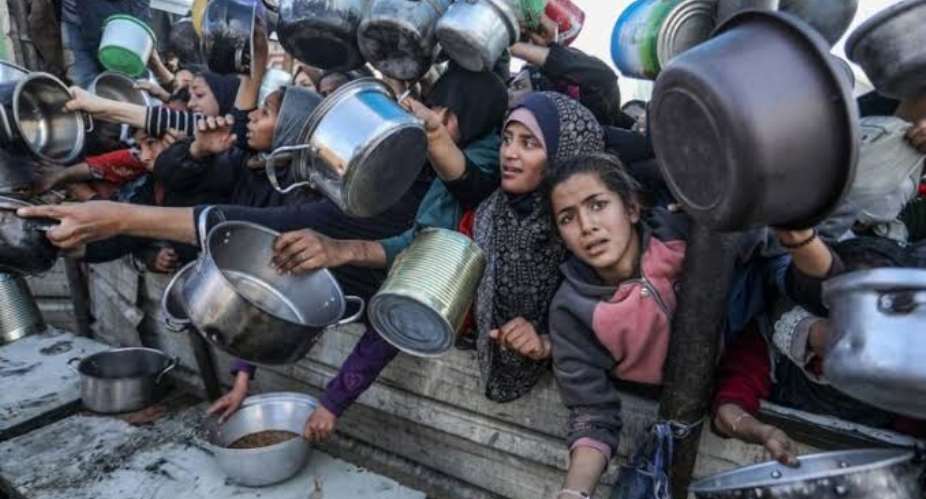
On 26 October 2025, the Rapid Support Forces (RSF) took El Fasher in Sudan's Darfur region. The city had been under siege since May 2024. The UN Human Rights Office later documented more than 6,000 killings in the first three days of the final offensive and said the real toll was almost certainly higher.
That date is easy to remember as the day a city fell. I want to ask about the 18 months before it, when the city was starved.
Amnesty International reported that the RSF restricted the entry of food and humanitarian supplies, shelled the city almost daily, and reduced people to eating ambaz, a by-product of peanut oil normally fed to animals.
Nobody can call that an accident of war. A UN fact-finding mission described an 18-month siege that deliberately imposed conditions of life through the deprivation of food, water, medical care, and humanitarian assistance. The mission found the hallmarks of genocide against the Zaghawa and Fur communities. Human Rights Watch reports that the UN mission also concluded that the RSF and allied forces used starvation as a method of warfare, which is a war crime.
I am a Ghanaian writer and UN Online Volunteer. I write this column from Accra, thousands of kilometres from Darfur. Distance is no excuse here because the rules I am about to describe were written for everyone, including people who will never see a famine.
What the Law Already Says
Most readers are told that the collapse of international humanitarian law means the law has failed. I disagree. The law is clear, and the failure lies in enforcement.
Three instruments matter most.
First, Article 54 of Additional Protocol I to the Geneva Conventions prohibits starving civilians as a method of warfare. It also forbids attacking, destroying, or removing the things civilians need to survive, such as food supplies, farmland, crops, livestock, and drinking water. Relief must also be allowed through, with the agreement of the parties (Article 70). The same prohibition applies in civil wars through Article 14 of Additional Protocol II and customary international law. This matters because Sudan's war is an internal one.
Second, Article 8(2)(b)(xxv) of the Rome Statute makes it a war crime to intentionally use starvation of civilians as a method of warfare by depriving them of objects indispensable to their survival. The article expressly includes wilfully impeding relief supplies as provided for under the Geneva Conventions.
Third, Security Council Resolution 2417 (2018). It was adopted unanimously, and the Council, for the first time, drew an explicit link between armed conflict and hunger. The voting record shows that China, France, Russia, the United Kingdom, and the United States all voted in favour. The five most powerful governments on earth put their names to a text condemning starvation as a weapon. That is why I do not accept that the law is unclear or contested. It is the most widely endorsed rule in this field.
Sudan: The Evidence
Sudan is a case where several credible bodies, working independently, have reached overlapping conclusions.
The siege. Estimates suggest that more than 260,000 civilians were trapped in El Fasher during the final months.
The killing. The UN Human Rights Office found that the RSF's conduct amounts to war crimes and possible crimes against humanity. Amnesty International concluded that the RSF committed crimes against humanity and ethnic cleansing.
The obstruction goes beyond one side. Human Rights Watch says the warring parties continue to wilfully obstruct aid movements and attack humanitarian workers. That includes the Sudanese Armed Forces, which have also been accused of restricting aid into areas controlled by the RSF. I name both because accountability that picks a side is not accountability.
The situation now. On 13 October 2026, the IPC issued an alert that famine risk is rising across Greater Darfur and Greater Kordofan. The alert stated that Sudan's 2026 Humanitarian Response Plan faces a 57 per cent funding gap. Recently, the US, the EU, the UK, and about 30 other governments warned that an estimated 19.5 million people, representing 41 per cent of the population, face high levels of acute food insecurity. They called on the parties to open all routes across front lines and borders, including air access into Darfur.
The court. The ICC has an established record in Darfur. In October 2025, it convicted Janjaweed leader Ali Kushayb on 27 counts, the first conviction arising from the Darfur situation, and in December sentenced him to 20 years in prison. However, those crimes date back to 2003 and 2004. For the current war, the Deputy Prosecutor told the Security Council in January 2026 that the RSF oversaw an organised, calculated campaign of atrocities in El Fasher. In July, she stated that investigators hold linkage evidence tying RSF leadership to specific crimes. The Security Council's sanctions committee listed four RSF commanders on 24 February 2026. Yet reporting suggests that no public warrant application has been filed for post-2023 crimes, although the Office says applications can be kept under seal.
A year on, the world has a conviction for crimes committed twenty years ago and no public warrant for the siege it watched unfold in real time.
Gaza: The Evidence
Gaza is the more politically charged case, so I will stay with what courts and monitoring bodies have found, and what they have not.
On 21 November 2024, ICC judges issued arrest warrants for Benjamin Netanyahu and Yoav Gallant. They found reasonable grounds to believe that each bears criminal responsibility for the war crime of starvation as a method of warfare and for the crimes against humanity of murder, persecution, and other inhumane acts.
Israel rejects the charges. A warrant is an allegation to be tested at trial, not a conviction, and both men are presumed innocent. That presumption is the same one I want applied to every commander in Sudan.
On 22 August 2025, the IPC confirmed famine in Gaza Governorate. More than 500,000 people faced catastrophic hunger, marking the first time the designation had been applied to the territory.
What happened next is the part I find most instructive. After the ceasefire of 10 October 2025, the IPC reported that no area of Gaza was classified as being in famine, crediting improved humanitarian and commercial access. Even so, at least 1.6 million people, representing 77 per cent of the population, still faced high levels of acute food insecurity.
Hunger there eased when access improved. That is difficult to reconcile with the idea that starvation in war simply happens. It behaves like a policy variable that responds to decisions.
The situation is again deteriorating. On 19 October 2026, the World Food Programme announced that it must cut food assistance in Gaza by about one-third because of funding shortages, leaving half a million people without critical support.
The same law also protects Israeli civilians and hostages taken on 7 October 2023. A reading of humanitarian law that applies only to one side's victims is not law; it is politics.
The Strongest Objections
An evidence-based column should answer its critics, so here are the strongest arguments against my position.
"Hunger in war has many causes."
This is true. In Sudan, drought linked to El Niño and funding gaps worsen the picture. In Gaza, destroyed infrastructure and collapsed livelihoods matter. Article 8(2)(b)(xxv) does not criminalise hunger. It criminalises intentionally using starvation of civilians as a method of warfare. Proving intent is difficult and belongs in a courtroom, not an opinion column. That is exactly why prosecutorial work matters.
"Israel disputes the charges and the court's jurisdiction."
It does. Israel is not a party to the Rome Statute and argues that the court lacks jurisdiction. The court's judges rejected those challenges, and the question can proceed through the court's own procedures. A state confident in its position has every reason to present its case there.
"The ICC is selective and cannot enforce its decisions."
This criticism has merit. The court has no police force, and states have ignored its warrants. Still, an imperfect court capable of issuing real warrants is better than no court at all. The honest response to selectivity is to push the Office of the Prosecutor to act consistently across all situations, which is exactly what I am advocating.
"Humanitarian corridors can be abused."
That is a legitimate military concern. It is why corridors must be negotiated with the consent of the parties, monitored, and operated by neutral bodies. That is precisely what I am arguing for.
Why This Belongs in a Ghanaian Newspaper
Ghana ratified the Rome Statute in 1999. We have also sent peacekeepers to some of the world's most troubled conflicts. Our readers include families with relatives in Sudan, Libya, and the Sahel, as well as members of the Ghanaian diaspora across the United Kingdom, the United States, Canada, and Germany.
The African Union's Constitutive Act, in Article 4(h), recognises the right of the Union to intervene in a member state in grave circumstances, namely war crimes, genocide, and crimes against humanity.
The AU wrote that principle itself. It has no excuse for treating a famine on its own continent as someone else's emergency.
What I Am Doing About It, and What I Am Not
I am not going to lead convoys into a war zone, and I will not pretend that a columnist can negotiate a ceasefire. Real humanitarian corridors are agreed upon by the parties and operated by the UN, the Red Cross, and trained humanitarian organisations. Anyone who claims otherwise is risking lives for a headline.
What I can do is more limited, and I believe more useful:
- Document responsibly. I will compile and publish only verified open-source material, using established standards such as the Berkeley Protocol on Digital Open-Source Investigations. I will work with accredited partners rather than freelance in the field.
- Press for access, lawfully. I will advocate for humanitarian corridors that are consent-based, neutral, and monitored, in accordance with Article 70 of Additional Protocol I.
- Push for accountability through the proper channels. That means the ICC, the Security Council, and the African Union, using the Rome Statute as written.
To carry this work beyond a weekly column, I am building a documentation and advocacy desk within Brownsy Silva Company. It will publish evidence summaries in plain language, explain what each treaty requires, and partner with legal professionals capable of advancing cases.
Navi Pillay is an example of the approach I am trying to learn from. She moved from the bench of the Rwanda Tribunal, where the Akayesu judgment recognised rape as an act of genocide, to leading the UN human rights office. Her career demonstrates that credibility comes from combining evidence, law, and institutions. I do not claim her stature, only her method.
My Call to Action
To the Prosecutor and Deputy Prosecutor of the International Criminal Court: You told the Security Council in January and again in July that you hold evidence concerning El Fasher. Act on it, publicly and lawfully. Bring forward the applications concerning the siege and its use of starvation, and treat Sudan and Palestine according to the same standard of evidence and urgency. Victims cannot be expected to wait indefinitely for a sealed filing.
To the African Union Peace and Security Council: Convene on Sudan's famine risk now. Press both the Sudanese Army and the RSF to open cross-line and cross-border routes, including air access into Darfur. Back the court's work with practical cooperation. Article 4(h) is yours to use.
To the Security Council's Five Permanent Members: You unanimously condemned starvation as a weapon in 2018. Demonstrate that the vote meant something, and stop shielding allies from the standard you helped create.
A Closing Note From Me
I know opinion columns are often read once and forgotten. I would like this one to be different, so here is what I ask you to do.
Read Article 8(2)(b)(xxv) for yourself and examine the sources I have used. Then ask your MP, your church, your university, and your newsroom what they are doing about it.
Hunger as a weapon only works when the world is willing to look away.
We have the evidence. We have the treaties. What remains is whether we will act, and that part depends on people like us.


 NDC must maintain policy consistency to perform better – Asiedu Nketia
 South Africa evacuation: Ablakwa failing to meet standards he set in opposition ...
 Mahama eyes Russian investment in Ghana’s energy sector ahead of meeting with Pu...
 ECOWAS deploys pre-election mission to Nigeria ahead of 2027 polls
 South Africa evacuation: Ablakwa has committed no crime; he's going nowhere – Fr...
 Real Madrid apologise to China over Mbappé's Mao Zedong comments
 Netanyahu bloc leads after half of Israeli votes counted but no majority
 Bagbin calls for private member's bill for professional certification, charterin...
 GES sets November 16 date for payment of 2025 promotion arrears
 Wontumi’s lawyers seek recall of prosecution witness in illegal mining case


