




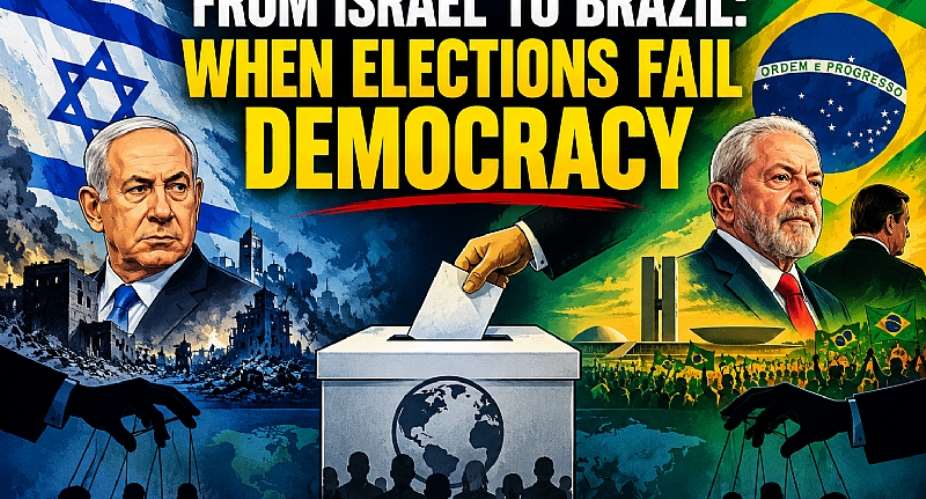
Elections are the vital organs of a functioning democracy, allowing the public to express its will through the ballot box. The fairer the electoral process, the healthier the democracy, and the greater the public's trust in state institutions and the legitimacy of political leadership. Unfortunately, in the modern world, elections increasingly risk becoming exercises in counting votes rather than genuinely reflecting the people's choices. Political manoeuvring and anti-democratic forces undermine public confidence, discourage participation and create opportunities for political engineering. Pakistan's 2024 elections remain a prominent example of the controversy surrounding electoral legitimacy. Recent developments in Israel and Brazil raise similar questions about the relationship between electoral outcomes, political power and democratic accountability.
Israel: A Deadlock in Electoral Democracy
Israel's first general election since the Hamas attacks of October 7, 2023, has exposed the deep political divisions within the country. Prime Minister Benjamin Netanyahu's Likud party and its right-wing allies face a rival bloc led by former military chief Gadi Eisenkot. Exit polls reportedly showed no clear winner, with the two principal camps tied at 51 seats in some projections. Voter turnout reached 77.7 per cent, the highest in more than two decades, according to the reported figures.
The central question is whether a high turnout can translate into a government with a clear democratic mandate. Netanyahu has campaigned on his wartime leadership and relationship with US President Donald Trump, while Eisenkot has criticised what he describes as fear-based campaigning. Yet electoral arithmetic may favour Netanyahu if his opponents fail to assemble a viable coalition.
Arab parties outside the two main blocs could potentially hold the balance of power, but both leading camps have ruled out relying on them to form a government. If neither side secures a coalition majority, another election could become necessary. Under such circumstances, Netanyahu could remain in office until a new government is formed. The result demonstrates how coalition politics can complicate the relationship between the popular vote and the eventual distribution of power.
Brazil: Elections, Political Rivalry and Institutional Trust
Brazil presents another important case in the wider debate over democratic legitimacy. The political rivalry between President Luiz Inácio Lula da Silva and the Bolsonaro family has exposed persistent divisions within the country's institutions and electorate. Lula's electoral mobilisation, including the reported use of WhatsApp channels to reach millions of supporters, illustrates the growing influence of digital communication in modern political campaigns.
However, electoral technology and campaigning are only part of the story. Allegations of irregularities, disputes over electoral results and resistance to accepting defeat can deepen political instability. Any claim of electoral manipulation must be established through credible evidence rather than political accusations alone. Equally, judicial decisions concerning political figures must follow transparent legal procedures and remain open to appropriate scrutiny.
The reported developments involving Jair Bolsonaro and his family further demonstrate how political competition can extend beyond the ballot box into courts, international diplomacy and disputes over the legitimacy of state institutions. When political opponents interpret every institutional decision as partisan interference, public confidence suffers. Conversely, institutions must demonstrate their independence through consistent, impartial and transparent conduct.
What Does the World Gain from Electoral Interference?
The international implications are significant. The United States should reconsider the practice of endorsing preferred candidates in other countries, whether openly or through less visible political channels. European governments and other international actors should likewise recognise that democratic principles cannot be selectively applied according to strategic interests.
Democracy cannot be strengthened by treating elections as instruments for producing politically convenient outcomes. International powers may have legitimate interests in foreign political developments, but those interests should not override the electorate's right to determine its own leadership.
The lesson for Pakistan and the wider world is straightforward: democracy requires more than holding elections. It requires credible vote counting, independent institutions, transparent procedures and respect for the public's verdict. When electoral processes lose public trust, participation can decline and political engineering becomes easier.
Anti-democratic forces may temporarily benefit from manipulating political processes, but such victories come at a long-term cost. A state becomes stronger when its citizens trust their institutions, not when its political outcomes are predetermined. The ballot must remain the people's voice, and that voice must be heard, respected and protected.


 October 29: Cedi sells at GHS12.25 on forex market, GHS11.63 on BoG interbank
 Ghana’s mineral wealth must not come at environmental cost – Zanetor
 NPP's SC suit to counter pending suits backing Mahama’s third-term eligibility –...
 No constitutional dispute has arisen to warrant NPP’s suit on presidential term ...
 'NPP has become group of flip-floppers' – Edem Agbana on South Africa evacuation...
 Kufuor explains why his government opted for HIPC despite concerns over Ghana’s ...
 Policewoman who attempted 120-hour painting marathon dies after short illness
 I entered politics in my 20s but became president at 62 – Kufuor
 Accra-Tema Motorway project reaches 53% completion despite delays
 Prisons Service to publish findings on alleged plot to poison Chairman Wontumi


