




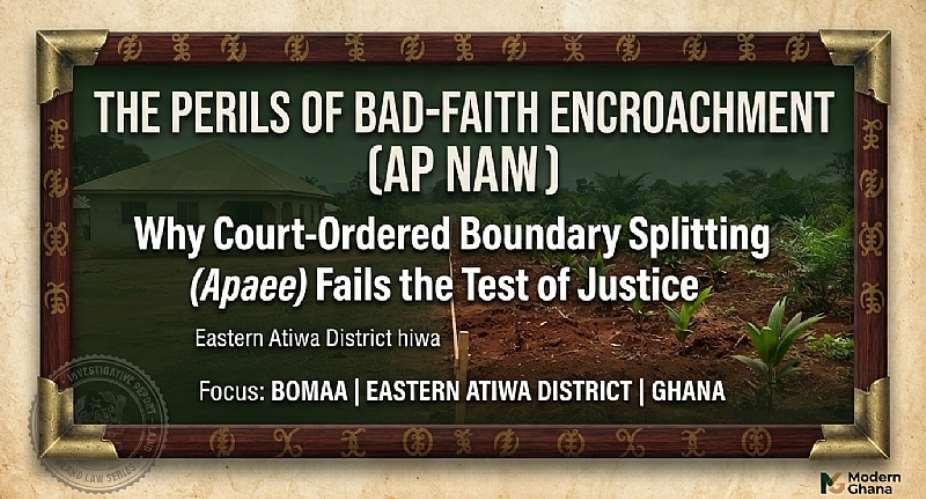
The integrity of Ghana's land administration system rests on a simple, unbreakable principle: a buyer is only entitled to the exact acreage they purchased and paid for. In recent times, however, a dangerous trend has emerged across our traditional and legal landscapes—the weaponization of "stealth farming" and intentional boundary encroachment. Rogue developers and buyers purchase a modest, clearly defined plot, only to deliberately extend their boundaries into adjoining family, stool, or ancestral lands. To anchor these illegal expansions, they hastily plant economic trees and nurse commercial crops, calculating that time, vegetative growth, and a passive response will eventually grant them ownership under the guise of long-term possession. When formal courts resort to customary splitting (apaee) to settle such clear-cut cases of trespass, they unwittingly reward bad-faith actors, compromise institutional integrity, and create a recipe for perpetual communal unrest. True justice must never split the difference with a thief.
The Anatomy of the Akyem Kwabeng Land Intrusion
A classic and deeply troubling manifestation of this crisis recently unfolded in Akyem Kwabeng, located within the Eastern Atiwa District. The mechanics of the dispute reveal a deliberate strategy designed to bypass the rule of law:
• The Original Perimeter: A buyer legally acquired a clearly demarcated half-plot of land measuring exactly 70ft x 100ft for development.
• The Aggressive Expansion: Instead of remaining within the boundaries specified in the purchase indenture, the buyer deliberately broke bounds, committing a classic act of trespass to land—an infraction which, under Ghanaian common law, is actionable per se without proof of special damage (Basely v. Clarkson).
• The "Economic Tree" Strategy: To mimic legitimate, historic possession, the encroacher immediately began planting commercial trees and actively nursing young economic seedlings across the invaded territory.
• The Judicial Twist: Despite a lower court previously granting full relief and title to the rightful family land owners, a subsequent sitting High Court judge delivered a staggering two-hour judgment that invoked apaee—ordering the disputed land to be split down the middle.
• Defying the Gavel: Empowered by the split verdict, the encroacher has grown even more aggressive, completely crossing the newly drawn court boundary to plant commercial trees and nurse seedlings well inside the family’s legally protected side.
Why 'Apaee' (Splitting) Rewards Wrongdoing in Clear Trespass Cases
While apaee is a time-honored customary mechanism meant to resolve genuine, historical boundary ambiguities between two innocent neighbors, its application in standard title disputes undermines the rule of law:
• It Weaponizes Fraud: Forcing a compromise judgment where one party clearly acted in bad faith teaches land grabbers that they can steal a large tract of family land and safely expect the courts to let them keep half of it.
• It Distorts Customary Arbitration: True customary reconciliation requires both parties to have color of right. An encroacher who holds an indenture reading "70ft x 100ft" has no legal or customary claim to land outside those four corners.
• It Fails to Deter Future Theft: When judges split lands out of misplaced sympathy for an encroacher’s agricultural investments, they encourage regional land guards and developers to invade more family lands across the Eastern Region.
The Legal Fallacy of the Crossover Incursion
The encroacher’s latest move—crossing over the court-ordered split boundary line to plant trees on the family’s designated side—strips away any residual equitable protection they might have claimed.
First, under the strict statutory framework of Section 12 of the Land Act, 2020 (Act 1036), any unlawful entry, deliberate encroachment, or obstruction of land belonging to another person or family is a criminal offense punishable by hefty fines or custodial sentences. The encroacher’s active agricultural cultivation on the family’s side constitutes a fresh, ongoing statutory violation.
Second, the encroacher is completely trapped by the ancient common law maxim quicquid plantatur solo, solo cedit—meaning "whatever is attached to the soil belongs to the soil." While customary law sometimes protects innocent farmers who act under a genuine mistake of fact, Ghanaian jurisprudence applies this maxim strictly against bad-faith trespassers.
In the landmark precedents of Danquah v. Wuta-Ofei and Adu v. Adoo, the courts firmly established that where a person builds or plants on land without the consent or permission of the true owner, those structures or crops automatically become the legal property of the landowner. Because the Kyebi High Court explicitly affirmed that this specific half belongs to the family, every commercial seedling the encroacher drops on the family’s side instantly becomes family property the moment it hits the dirt. The encroacher loses all ownership rights to those crops.
Immediate Legal Remedies to Restrain Crossover Encroachment
When an encroacher defies even a split-boundary verdict and invades the family’s remaining side, the family must deploy the full, unyielding force of the law to crush the intrusion:
• File for Contempt of Court: Crossing a fresh, court-demarcated boundary line is a direct insult to judicial authority. Disobeying a subsisting court judgment is a quasi-criminal offense, and a motion for contempt can result in immediate jail time or heavy punitive fines for the encroacher.
• Secure an Injunction Pending Appeal: The family’s legal team must immediately appeal the apaee verdict to the Court of Appeal and secure an interlocutory injunction to freeze all farming, clearing, and seedling nursing across the entire parcel.
• Physically Cordon and Label the Boundary: Erect highly visible boundary tapes and heavy wooden or metal signposts stating: "COURT-ORDERED BOUNDARY – NO TRESPASSING – PROPERTY OF THE RIGHTFUL FAMILY OWNERS."
• Enforce via Judicial Process: While the crops legally belong to the family under quicquid plantatur, the family must avoid forceful self-help to prevent criminal charges under the Criminal Offences Act, 1960 (Act 29) for breach of peace. Instead, the family must enforce their rights under Order 43 of the High Court Civil Procedure Rules, 2004 (C.I. 47) by utilizing a Writ of Possession executed alongside court bailiffs and police escorts to clear the land.
Recommendations and Suggestions for Systemic Reform
To protect ancestral wealth and educate students of law, town planning, and political science on preventing state and institutional capture through land exploitation, the following actions are urgently required:
• For Legal Practitioners and Judges: Formal courts must cease treating deliberate encroachment as an opportunity for equity-based splitting. If title belongs to a family, full title and recovery of possession must be granted, and bad-faith agricultural investments must be forfeited to the land owners.
• For Town Planning Authorities and Surveyors: The Eastern Atiwa District Assembly must rigorously enforce local zoning boundaries. Licensed surveyors who deliberately map or validate altered pillars for encroachers must have their certifications permanently revoked by the Ghana Institution of Surveyors.
• For Local Families and Land Committees: Do not sit back and watch economic seedlings grow. Families must proactively audit their boundaries, register their roots of title with the Lands Commission, and issue immediate, written legal notices the moment a neighbor steps an inch outside their purchase perimeter.
Land is not merely an economic asset; in Ghana, it represents ancestral heritage, communal identity, and intergenerational security. When individuals use the deliberate planting of commercial trees to steal territory, and the formal court system sanctions it through forced splitting (apaee), the bedrock of property ownership begins to erode. The recent crossover incursions in Akyem Kwabeng demonstrate that land grabbers are never satisfied with a compromise; they view judicial leniency as an invitation to take everything. The rightful land owners must aggressively pursue an appeal to reverse this dangerous precedent. Our courts must send a clear, unequivocal message across the length and breadth of Ghana: bad faith will not be subsidized, trespass will not be split, and the legal dimensions of an indenture are non-negotiable.
✍️By A Concerned Retired Senior Citizen
For and on behalf of all Senior Citizens of the Republic of Ghana 🇬🇭
Teshie-Nungua
[email protected]


 “If I knew then what I know now, I wouldn’t have had a child” – Nana Aba Anamoah
 NDC must maintain policy consistency to perform better – Asiedu Nketia
 South Africa evacuation: Ablakwa failing to meet standards he set in opposition ...
 Mahama eyes Russian investment in Ghana’s energy sector ahead of meeting with Pu...
 ECOWAS deploys pre-election mission to Nigeria ahead of 2027 polls
 South Africa evacuation: Ablakwa has committed no crime; he's going nowhere – Fr...
 Real Madrid apologise to China over Mbappé's Mao Zedong comments
 Netanyahu bloc leads after half of Israeli votes counted but no majority
 Bagbin calls for private member's bill for professional certification, charterin...
 Wontumi’s lawyers seek recall of prosecution witness in illegal mining case


